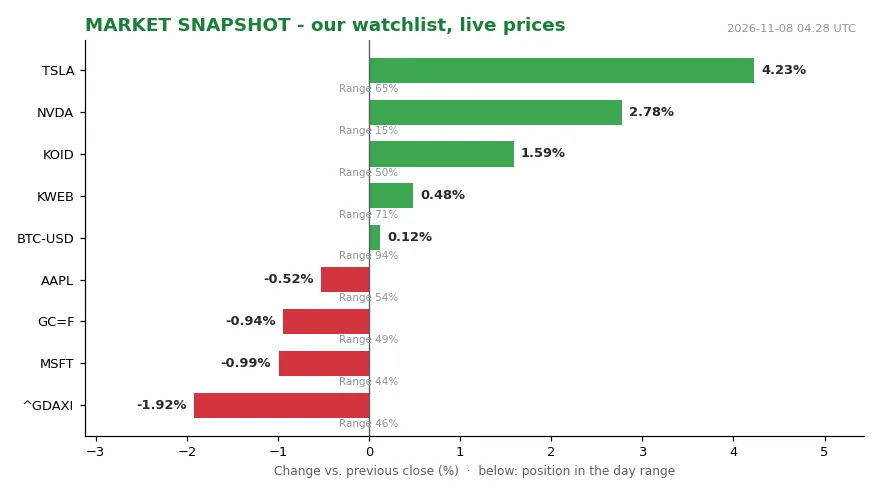
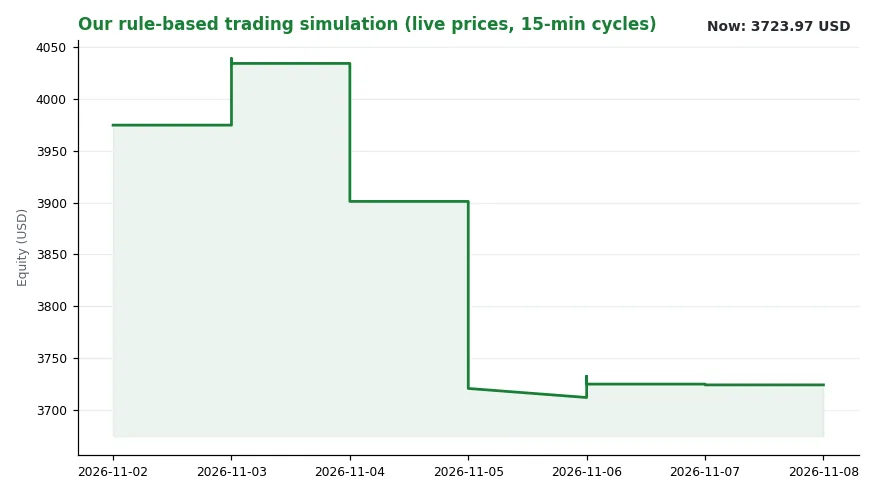
At 04:25 UTC our watchlist was not telling a story about fear. It was telling a story about dispersion. NVDA printed 186.64, up 2.78% on the previous close, yet sat near the day’s low — just 15% of its range. TSLA traded 358.22, up 4.23%, mid-range at 65%. Our China-exposure proxy KWEB stood at 24.88, up 0.48%, holding 71% of its range. KOID was 31.97, up 1.59%, exactly mid-range at 50%. Gold slipped 0.94%. The DAX dropped 1.92%. BTC-USD sat at 75861.80, up 0.14%, near the day’s high at 119% of range. Sim equity: 3723.97 USD, flat against the same time yesterday, with 1863.17 in cash. The latest rule-based decision on the book: WATCH KWEB. The busiest signal channel on 7 November: central banks. Regime reading: trend falling, level 3.63.
The pattern reads as rotation, not retreat. Money is not leaving risk. It is moving between pockets of it, and it keeps paying up for scarcity where it finds it. That is the lens we bring to the blind-box trade.
The root
The verb “to collect” descends from the Latin colligere — to gather together. A collection is a gathering that someone chose. The blind box industrialised that choice by removing it: the buyer picks a series, never a figure. What arrives is decided after payment.
Pop Mart did not invent the blind box, but its dolls helped popularise the format around the world. Labubu launched in 2019 and became the company’s most successful toy line. Fans bought boxes repeatedly to get the version they wanted, says Samer El Hajjar, a marketing lecturer at the National University of Singapore. [1] Scarcity did the rest.
That is the first rung: a mechanic that turns a purchase into a lottery ticket, and a lottery ticket into a repeat purchase.
What the ladder built
The second rung is the demand it produced. The monsters became fashion statements, carried by celebrities including Kim Kardashian and Blackpink’s Lisa. Queues formed. Pop Mart temporarily pulled the toys from its UK shops after reports of customers fighting over them. One fan paid more than $150,000 for a human-sized Labubu. Collectors paid $15 or more for a sealed box and considerably more on the resale market for the character they actually wanted.
The parent company became worth more than Hasbro and Mattel put together. It listed in Hong Kong in 2020 and still carries a valuation of nearly $24bn.
The third rung is the correction. Pop Mart recently reported that global sales in the three months to the end of September fell by as much as 50% on the previous year. Outside mainland China the drop was steeper still: US revenue down by at least 70%. The shares have fallen by more than 50% from last year’s peak. The company still runs 500 shops in more than 30 countries and 2,000 vending machines worldwide.
So the mechanism is not collapse. It is the unwinding of a scarcity premium.
The mechanism
The channel runs through supply, not sentiment.
Pop Mart ramped up production to meet demand. Ashley Dudarenok of the China research firm ChoZan links the fading sense of exclusivity to that production ramp. Ensito, the North Carolina collector who left his tech job in 2024 to produce Labubu content full-time, describes the shelf he now sees: “Now it doesn’t feel that way. I walk into a Pop Mart and there’s a whole series of Labubus sitting there,”
He has spent more than $50,000 building a collection of more than 400 Labubus, a figure he told the BBC he is “embarrassed to say”. [1] He commissioned a row of custom Labubu-like jagged teeth from a dentist to wear at events. He travelled as far as Italy and Spain for new releases. “Those videos used to be able to hit 10,000 really quickly but I’m struggling to do that now.” That is what a scarcity trade looks like once the scarcity is engineered away. The buyer was paying for the hunt as much as for the object. Remove the hunt, and the premium goes with it — and so does the resale market that fed the premium.
The actors
Pop Mart loses pricing power at the margin and gains volume. Whether that is a good trade depends on whether the brand can hold a character in memory once the queue is gone. El Hajjar says investors worry that the global success was a viral moment rather than sustainable growth built on long-term customer loyalty.
Katelynn Carlson owns 36 Labubus and describes the blind-box ritual as “nostalgic”, evoking the feeling of opening gifts as a child. Hedy Khaled, who keeps 70 Pop Mart figurines in Liverpool, draws a line between trend-chasers and “real fans”. Clara Barbero from Canada calls Labubus a “dead trend” while still tracking releases, and says she is “curating” rather than hoarding. Lawrence Yu in Melbourne spent about $1,400, once drew up to a million views per unboxing clip, and now plans to be “more selective”. His read: “I definitely think the trend has slowed down… People go crazy and then it fizzles.” The competitors take the shelf. Sonny Angels and glow-in-the-dark Smiski figurines are moving fast. Miniso sells blind-boxed Disney and Marvel characters across more than 8,000 shops globally. Vincent Huang of Miniso frames the shift: “Consumers aren’t particularly concerned about where the brand comes from,” adding that buyers are “more focused on the shopping experience - the designs, value for money, and enjoyment.” And Sanrio, owner of Hello Kitty, posted record earnings in the year to March — which analyst Boustani suggests is the advantage of a character library built over decades rather than a single season.
The outlook
Pop Mart is buying time and story. It built a theme park in Beijing. It announced a Labubu film. Dudarenok states the test plainly: “The real test for next year is whether Pop Mart can make people love a character without a celebrity holding it.” [1] That is the honest shape of the uncertainty. Nobody knows whether the park, the film or the next series re-ignites demand. What is known is the sequence: a company that sells a story after the toy, rather than before it — the reverse of how Disney works.
The same caution belongs on the tape. Our regime reading says trend falling, level 3.63 — a cautious label, not a verdict. KWEB at 24.88 with 71% of range intact is not a market pricing a Chinese consumer collapse. The DAX at -1.92% is a European story more than an Asian one. The busiest signal channel is central banks, not collectibles. Pop Mart is one name inside a far larger consumer and China allocation, and a 50% quarterly sales decline at one company is evidence about a fad, not a forecast for an asset class. Which is why the book sits at WATCH.
Ensito’s own summary is the least sentimental line in the whole story: “There’s always going to be a trend every year. There’s always gonna be something that’s gonna be really popular.” Carlson supplies the counterweight. The dolls keep her collecting because of how they make her feel, not because of the feed: “I think there’s something special about embracing our inner child and enjoying things simply because they make us happy.” Both statements can hold at once. The trend fizzles. The gathering continues. The only open question is the price of the gathering.
And that price has already been set once: more than $150,000 for a single human-sized Labubu. By plain arithmetic, that is ten thousand sealed boxes at $15 each — ten thousand small, unopened unknowns traded for one object that a queue once made priceless.
Sources
Mentioned organisations (context, not sources)
- National University of Singapore — Organisation (homepage)
- Hasbro — Organisation (homepage)
- Mattel — Organisation (homepage)
- ChoZan — Organisation (homepage)
- BBC — Organisation (homepage)
- Miniso — Organisation (homepage)
- Disney — Organisation (homepage)
- Marvel — Organisation (homepage)
- Sanrio — Organisation (homepage)