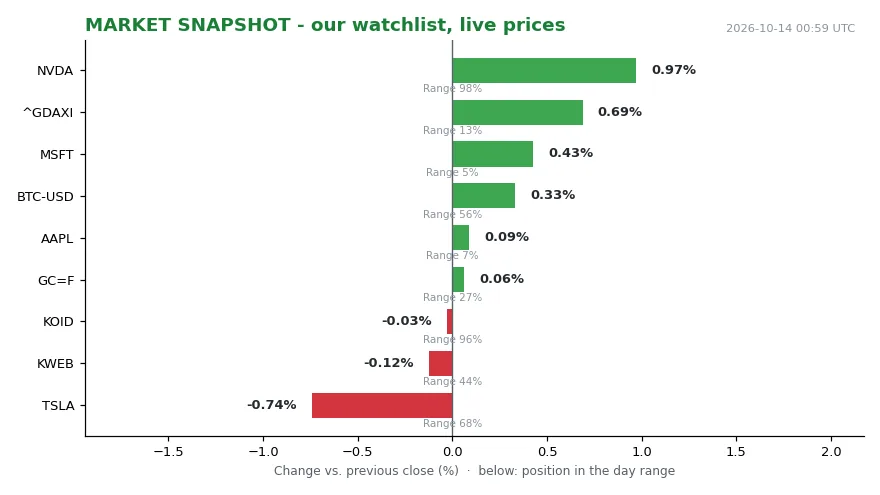
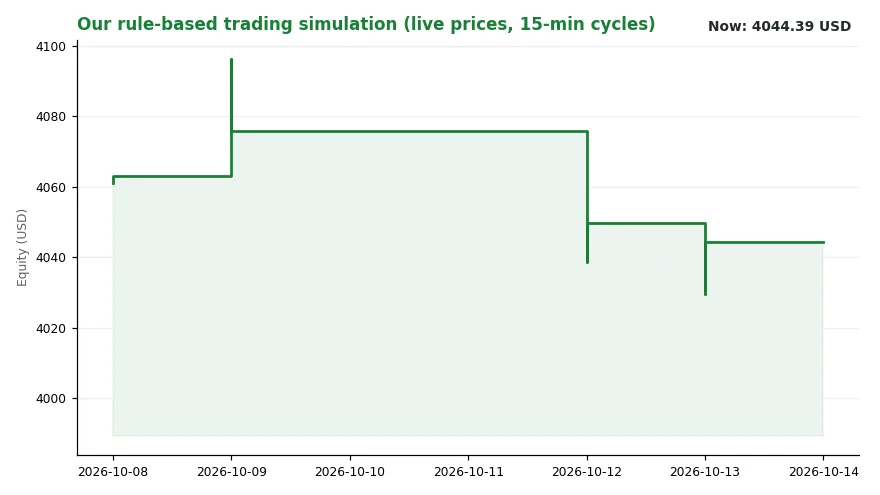
Our measurement first. On our watchlist NVDA sits at 228.52, up 0.97% and near the top of its daily range; AAPL at 341.27, up 0.09% but pinned near the day’s low; MSFT at 543.45, up 0.43%, also near the low; TSLA at 375.23, down 0.74%, mid-range; BTC-USD at 83,389.32, up 0.36%, mid-range; gold at 4,177.70, flat and near the low; the DAX at 25,259.90, up 0.69% but near the low; KOID at 34.67, flat and near the high; KWEB at 24.72, down 0.12%, mid-range. Our simulated book stands at 4,044.39 USD, unchanged from the same time yesterday, with 2,023.60 in cash. The busiest signal channel on 13 October was central banks, two events, and our regime reading is trend falling, level 3.63. Against that tape, the energy complex tells its own two-speed story: Brent for December delivery fell 2.0% to $104.60 a barrel, and WTI for November slipped a similar margin to $91.89. Those two readings pull in different directions, and that is the story: crude is easing at the front of the curve while the barrel that moves trucks and freight refuses to follow.
Read those numbers together and a pattern shows up. Gasoline is correcting — the U.S. average was $4.3413 a gallon on Tuesday, down from $4.8133 a month ago. Diesel is not: it averaged $6.2787 a gallon, barely changed from $6.3151 a week earlier. Our reading is that this is not a market pricing an energy shock that has ended. It is a market pricing an energy shock that has changed shape — a lighter headline number sitting on top of a still-squeezed middle distillate complex.
The number everyone is waiting for
Against that backdrop, the U.S. Consumer Price Index report lands on Wednesday. Economists expect headline inflation of 0.5% month-over-month and 3.6% to 3.7% year-over-year, up from 0.4% and 3.4% in August. The core reading, which strips out volatile energy and food, is seen at 0.2% for September, down from 0.3% the month before, with the annual core rate holding steady at 2.4%.
The market has already repriced the policy path. The probability of a Federal Reserve rate hike at the October 27-28 meeting has fallen to roughly 19% to 20%, down from over 70% in late September. That is a large move in a matter of weeks, and it rests on a simple reading: if core inflation is cooling while energy does the noisy work, the Fed has room to slow down. “You’ve seen supply shocks create a sticky situation,” Jeffrey Schulze, head investment strategist at the Franklin Templeton Institute, said, pointing to oil supply disruptions, tariff shocks and AI-related consumer goods price spikes. [1] His forward view is cautiously constructive: “But as we move toward 2027, some of these risks are going to start to moderate. That moderation may already be underway. I think you see softening across the board [in September].” [1]
The channel: why airfares move first
The channel matters more than the headline. Energy shocks reach consumer prices through different doors at different speeds.
Air travel is the fastest door. Airfares rose more than 2% month-over-month in both July and August, and 25% year-over-year, tracking elevated jet fuel costs. Fuel accounts for roughly 17% to 21% of an airline’s total operating expenses, which makes ticket pricing unusually sensitive to a spike in crude. When the barrel moves, the seat price moves with it, often within the same quarter.
Retail and manufacturing are the slow doors. Pass-through effects in those categories can take several months — or several quarters — to appear. That lag is the reason the September print may look calm even while the underlying pressure has not disappeared. Schulze’s expectation is that the delayed effects surface later: “I think that’s going to be something that potentially shows up closer toward the end of the year, rather than in the September release.” [1] This is the honest uncertainty in the whole debate. A soft core reading for September is evidence about September. It is not evidence about November. The lag structure means the same data can support both a dovish and a hawkish interpretation depending on what an analyst assumes about how quickly costs migrate from fuel tanks to shelf prices.
The actors: a diesel deal that may not move diesel
Into that gap stepped a political intervention. Last week, U.S. President Donald Trump struck a deal with Russian President Vladimir Putin to supply Russian diesel to U.S. and global markets, with the U.S. Treasury issuing a general license that suspends sanctions on Russian diesel exports until April 7, 2027.
The political reception was hostile on both sides of the Atlantic. European leaders criticized the temporary exemption, contending that pressure on Moscow should be increased rather than eased.
The initial tranche of about 2.25 million barrels does not cover a single day of U.S. consumption, estimated at roughly 4.1 million barrels a day. In a global middle distillates market that remains badly squeezed, that volume is marginal. Before those attacks, Russian diesel exports averaged more than 3 million metric tons a month, roughly 1,000,000 barrels per day.
The deal’s structure also carries a timing risk that the headline numbers obscure. Russia has pledged more than 300,000 metric tons immediately, an additional 500,000 metric tons in November 2026, then 1 million metric tons, with a potential 3 million metric tons in the cards — all of it contingent on the condition of Russian oil refineries, the same capacity under attack.
What to watch, and what stays open
Four checkpoints matter from here. The September CPI print itself, and specifically whether core comes in at the 0.2% consensus or surprises in either direction. Whether the delayed pass-through into retail and manufacturing goods appears in the final months of the year, as Schulze anticipates. The diesel spread: as long as the middle distillate market stays tight, the freight and logistics cost base stays elevated regardless of what gasoline does. And the October 27-28 Fed meeting, where current pricing assigns only a one-in-five chance of a hike.
None of this is settled. The supply shocks Schulze describes — oil disruptions, tariffs, AI-driven goods prices — are described by their own analyst as moderating, not resolved. The diesel deal’s back half depends on infrastructure that is actively being targeted. And the lag between an energy shock and its appearance in core inflation is a range, not a date.
This is educational analysis, not investment advice.