
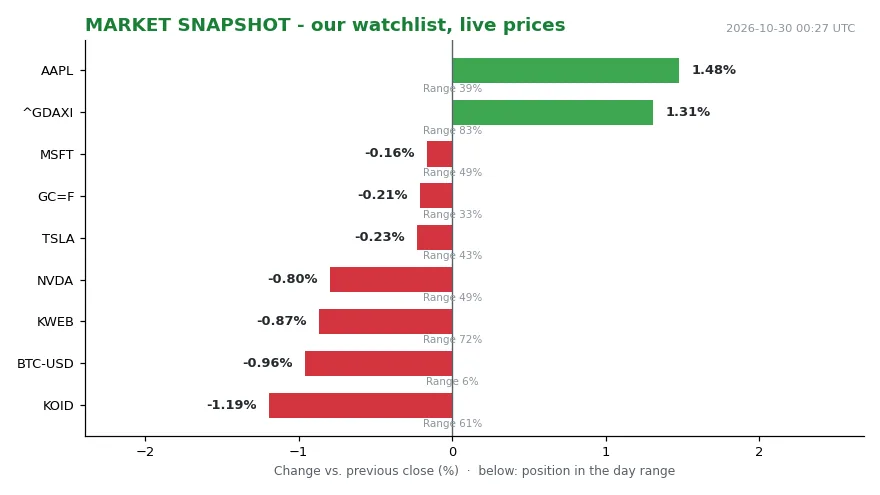
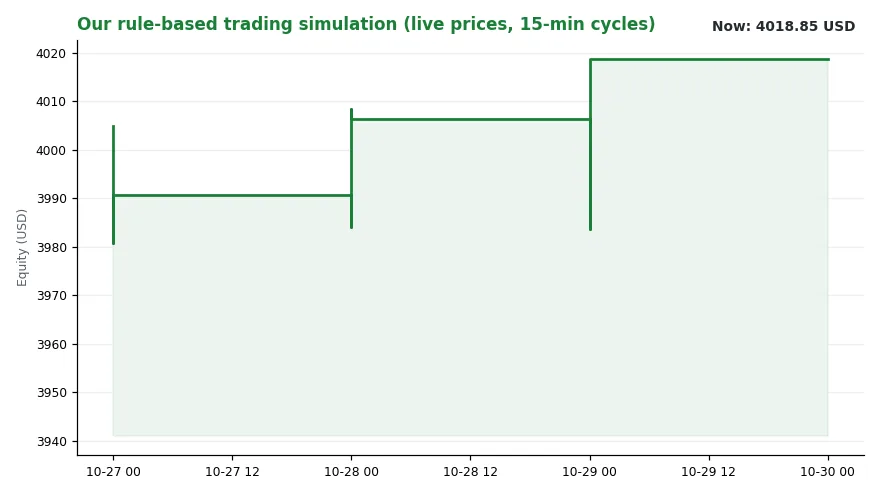
At 00:23 UTC on 30 October 2026, our watchlist squeezed a full session into a single frame. NVDA stood at 213.66, down 0.80% against the previous close and mid-range at 49%. AAPL printed 348.91, up 1.48%, and also sat mid-range at 39%. The DAX read 26,039.68, up 1.31%, close to its day high at 83% of range. BTC-USD traded at 76,752.25, down 1.34% and near the day low at -77% of range. Gold futures were 4,019.00, down 0.31%, near the bottom of its range at 16%. Our simulated equity book held 4,018.85 USD, flat versus the same time yesterday, with 1,999.02 USD in cash. The most recent rule-based decision was WATCH KWEB at 0.00. The regime reading was trend=falling, level 3.63, and the busiest signal channel on 29 October was “central banks”, with one event.
Read together, the frame shows European equity bid into the close, US mega caps mixed, and the classic hedges offered near their lows. That is a rotation signature, not a conviction signature. Money leaned toward European equity beta and away from instruments usually bought for protection. Three caveats belong on the same line: this is one snapshot, one session, and our own watchlist only. Nothing in it forecasts tomorrow.
What the frame does not contain matters just as much. There is no UK energy supplier on that list. There is no household bill, no tariff schedule, no eligibility test. Our measurement can record what screens did while an old argument about who pays for warmth ran through a newspaper letters page. It cannot price the design of that argument. That gap is the honest starting point for this piece.
What was actually published
On 21 October 2026, the Guardian’s money letters section carried a letter from Dr Alex Chapman, head of economic and environmental policy at the New Economics Foundation. [1] The letter answers a 14 October column by Nils Pratley. Pratley’s argument, as Chapman restates it, was that the secretary of state, Miatta Fahnbulleh, should “keep things simple” and develop a targeted social tariff to protect vulnerable households from surging energy bills. The headline over that column described the “rising block tariff” as “a bad idea for bills. Chapman’s reply does not spend its words defending the rising block. It attacks the simplicity claim itself: “Unfortunately, there is nothing simple about such a scheme.” [1] That single sentence is the hinge of the whole letter, and it is worth unpacking slowly.
A benefits system inside the meter
Chapman’s first objection is institutional rather than moral. A targeted social tariff, in his description, means “creating a new benefits system inside our privatised energy industry”. Eligibility must be defined, verified, updated and defended. Disputes must be adjudicated. That machinery is the part that does not appear in a headline about protecting the vulnerable. He reaches for two comparisons to show where it leads. The first is the “interminable debates” around the existing benefits system. The second is social care, which he calls a failing system and a lottery that can strip pensioners of savings and the family home. Andy Burnham appears in the letter as the political counter-example, on a mission to dismantle that lottery and now planning universal public provision of adult social care. The analogy is Chapman’s, and it is doing specific work: it argues that universality can be administratively cheaper than selectivity.
Where the sorting rule bites
The letter then cites a concrete proposal as a case in point. The Resolution Foundation’s scheme, Chapman writes, delivers “rough justice”, because it “penalises households based on the income of the highest earner”. That is a mechanical point, not a rhetorical one: the scheme sorts households by the income of the highest earner, so the sorting rule, not the need, determines the outcome. Chapman puts “worthy” and “unworthy” in quotation marks to describe what any targeting system produces by construction. The criticism is precise: the sorting rule, not the need, determines the outcome.
Warmth as a universal right
Chapman’s own design is stated plainly. Energy essentials should be a universal right, not a means-tested benefit. He defines the essentials with unusual concreteness for a policy letter: “Every household should be able to afford the energy essentials: enough warmth to survive a winter; enough electricity to switch on the lights and run a fridge.” [1] The delivery mechanism is equally direct — “have the Treasury fund a true price cap on an essential block of electricity and gas”. One design detail carries real weight: electrically heated homes should be allowed to transfer across their gas allowance. He describes the result as a policy from which everyone wins, especially if electrically heated homes are allowed to transfer across their gas allowance.
Heavy users in winter, free sun at noon
The letter separates the emergency design from the long-run funding question and offers more than one route for paying for it. The first is to charge households with very high energy consumption more. The second is the Australian “solar sharer” scheme, which gives every household three hours of free electricity in the middle of the day. Chapman presents that scheme as grounds for hope that renewables could soon deliver true energy security. He does not claim either route is settled. He explicitly says the long-term design of a universal offer “can be debated”.
The mechanism, stated without decoration
The channel here is not a share price. It is the price of a defined block of energy and the balance sheet that stands behind it. Three levers are visible in the letter. One is eligibility: under targeting, an administrative filter sits between a household and a lower bill. A second is price-setting: under the universal variant, a capped tranche of units carries a protected price. A third is fiscal: the Treasury, not the levy payer, funds the difference.
There is also a distributional mechanism, and it runs in two directions. Universal provision spreads the benefit and the cost widely. High-consumption charging concentrates the cost at the top of the usage curve. Those two moves pull against each other, and the letter does not pretend otherwise.
Who gains, who pays, who decides
Under the universal variant, every household gains a protected block, and electrically heated homes gain more if the transfer across the gas allowance survives. The Treasury carries the funding burden. In the long-run variant, very high-consumption households carry more of it.
The decision sits with the secretary of state, Miatta Fahnbulleh, whose department would design any scheme, and with the Treasury, which Chapman wants to fund the capped block. The menu itself is being written by think tanks in public: the New Economics Foundation on the universal side, the Resolution Foundation on the targeted side. On Chapman’s account, suppliers occupy an uncomfortable middle. Under targeting they become administrators of a benefit. Under a capped block, the eligibility apparatus disappears and the cost lands on public funding instead.
What to watch next
Two observable items follow from the text. First, whether a consultation on tariff design appears, and with what options. Second, whether transferability for electrically heated homes survives contact with a real design, because that detail is where a universal scheme becomes complicated again.
The disagreement between the two think tanks is technical before it is political: it turns on the sorting rule, not on whether vulnerable households deserve support.
Back to the frame
At 00:23 UTC our screens showed a rotation: European equity up near its high, crypto and gold soft near their lows. That frame will be replaced by another one tomorrow, and the replacement will carry no more information about a household’s winter bill than today’s did. The number that would actually decide a January in a cold flat is not on our list at all. It sits in whatever rule eventually separates an essential block of units from the rest. Universal or targeted is the variable worth watching, and it will not announce itself in a percentage move.