Kilauea inflation reveals limits of eruption forecasting
The Limit of What Sensors Can See
Before any fountain of molten rock tore into the sky over Kilauea, the ground itself was already telling a story. The summit was inflating by half a meter per day. [1] That is not a subtle signal, and it is the kind of measurement that can be read in real time. Yet the instruments that scientists had planted across the volcano — seismic, infrasound, geodetic, gas, and both visual and thermal cameras, thirty-five stations in all — could not answer the one question that mattered most: when, exactly, would the fountains begin? [1] A volcano can be wired like a patient in intensive care, and still the moment of eruption arrives without a clear seismic warning immediately beforehand. The ground swells. The magma reservoir refills. [1].
What changed the picture was not a new sensor. It was pattern recognition across eruptions. The USGS recognized that consecutive eruptions occurred when the summit tilt reached similar levels. [1] While the precise tilt associated with eruptions tended downward over time, the difference between consecutive eruptions stayed relatively small. That consistency turned a chaotic-looking sequence into something forecastable.
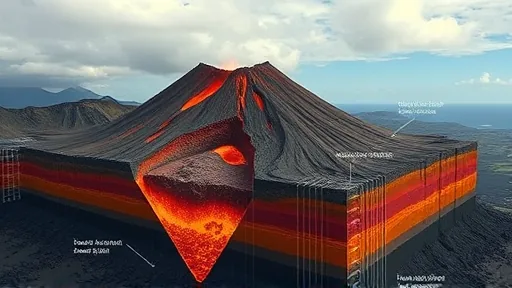
The 2018 eruption had partly drained one of the underground lava reservoirs beneath Kilauea. After that, the refilling began. From 2019 onward, the refill accelerated. The local peak inflated at more than 22 centimeters per year. By 2023, that rate had more than doubled to 57 centimeters per year, and the swelling spread to a nearby caldera. [1] In 2024, a large series of earthquakes accompanied the opening of a vent, and a 900-meter-long fissure opened, sending fountains as high as 160 meters into the sky over the course of 13 hours. Less than a day after that subsided, a second eruption followed.
Here is the uncomfortable truth this record exposes. The instruments were there. The stations were there. Years of inflation data were there. But the immediate trigger — the thing that tips a swelling reservoir into a fountain — still hides in the infrared chaos of the eruption itself. [1].
Two Signals, One Story
The forecasting success at Kilauea is not a volcanology trick. The summit tilt worked not because it was precise in absolute terms, but because the difference between consecutive eruptions stayed small. [1].
Consider the chemistry. Magnesium oxide, which provides an indication of the temperature of the magma, fluctuated throughout the eruption cycle, consistent with a cycle in which eruptions deplete a reservoir that is then refilled with hot material. In contrast, other oxides rose over time, suggesting that the newly arriving material has a distinct chemical composition. That is a layered signal: temperature says “refilling,” composition says “from somewhere else.” Two independent measurements, one story. [1].
The gas data add a third layer, and here the lesson is about what not to conclude. Sulfur dioxide levels rose during eruptions and dropped afterward, but remained high throughout the entire period. Levels of this chemical are associated with gases escaping from magma, so this implies that more of it goes on during eruptions, but it also occurs continuously between them. [1] The new data clearly does not favor the formation of a carbon dioxide foam, because the levels of that gas remained low throughout the eruption cycle.
But a puzzle remains, and it is the kind of puzzle that should interest anyone modeling threshold behavior. The evidence leans toward the steam-driven eruption model, but it is unclear why a process that is occurring throughout the cycle suddenly triggers fountains when it rises a bit. [1] The answer is not in the data yet.
A Repeating Experiment
That rarity is what makes the current sequence so valuable. An eruption within the summit crater, Halema’uma’u, has produced 52 additional fountain eruptions as of last month, the most violent of which spewed lava over 400 meters into the air. [1] That is not a single event to be studied after the fact. It is a repeating experiment, run over and over, with the same instruments watching each time. The volcano is keeping score.
It does not mean the eruptions are now predictable in a deterministic sense. It means the probability of an eruption can be estimated from a measurable quantity, and alerts can be issued when that quantity crosses a threshold. For a hazard that arrives without clear seismic precursors, that is a meaningful advance. It is also a modest one. The forecasts are statistical, not mechanistic. They tell when, not why.
What the record ultimately provides is a constraint on timing, evolution, and the processes driving episodic fountaining globally. Kilauea has had only three fountaining episodes since 1823, even though it is the youngest and most active volcano in Hawaii, so every well-documented sequence matters beyond the island. [1] Mount Etna and Iceland produce similar fountains, and the mechanisms proposed for Kilauea are proposed for them too. The multiparameter record from this eruption gives those other systems something to be compared against: a baseline of inflation rates, gas levels, oxide fluctuations, and tilt thresholds, all measured simultaneously.
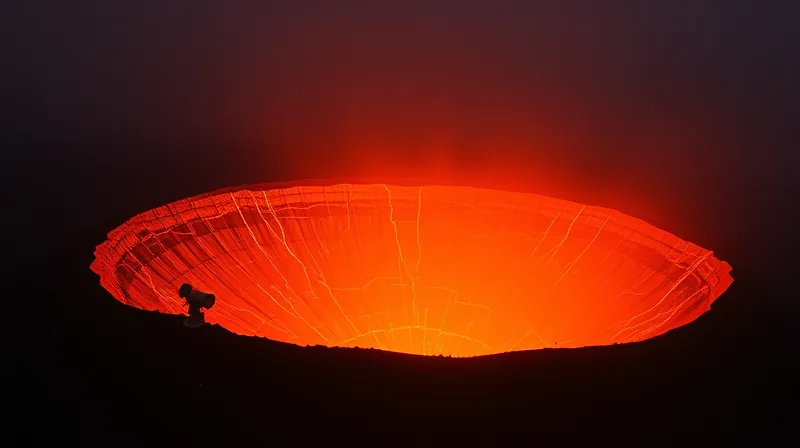
The contribution here is not a solution to a practical problem. It is a sharper picture of a fundamental process. How does a magma reservoir recharge? How does the material that refills it differ from what was there before? What role does water play in turning a slow swell into a 400-meter fountain? These are questions about how the Earth moves material from depth to surface, and they are being answered with a completeness that rare, well-instrumented eruptions allow. Despite the wealth of nearby sensors, the researchers acknowledged it would be nice to have more data. Sampling of gas levels is typically done at infrared wavelengths, and there was a lot going on in the infrared during a fountaining eruption. Because of the height of some of the fountaining, it was not necessarily safe to install more monitoring hardware. One camera notably sacrificed itself to bring back images of red-hot, semi-molten rock falling from the sky. Kilauea has proven itself a spectacular laboratory for studying volcanic activity. It has not yet proven ready to give up all its secrets. [1].