
London trophy flats repriced by slow negotiated price cuts
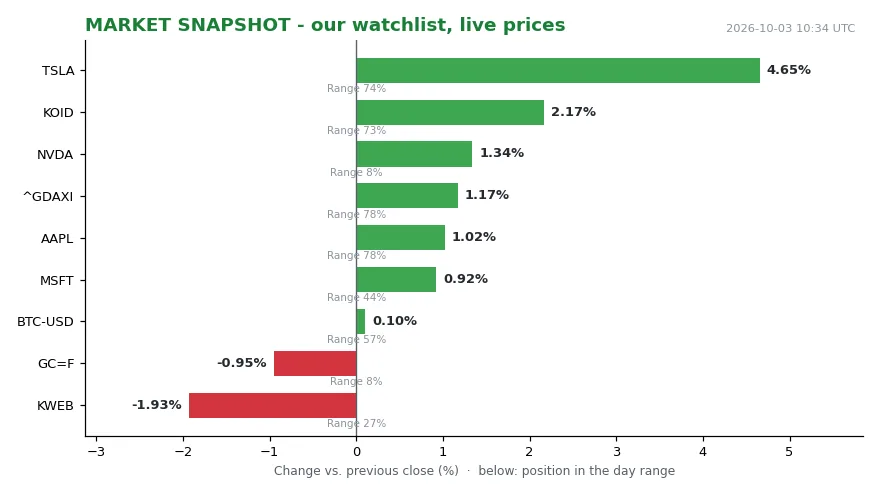
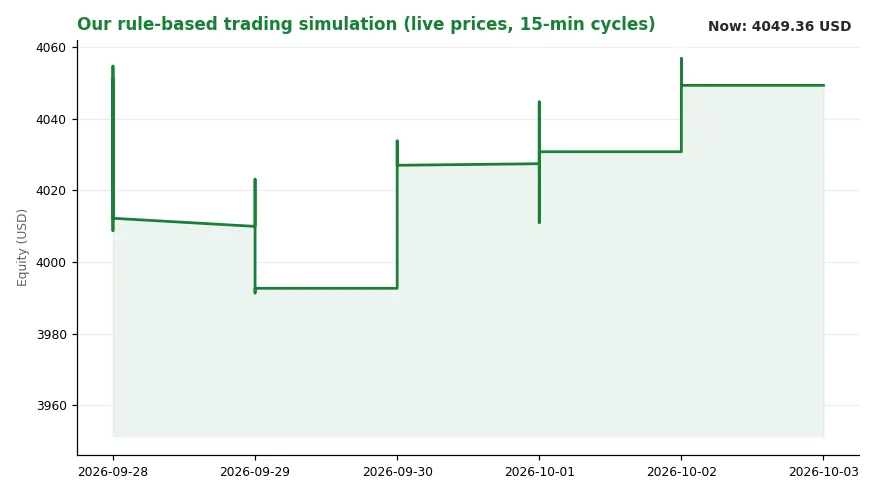
Our own measurement first, because it frames everything below. As of 2026-10-03 10:30 UTC our watchlist shows NVDA at 233.95 (1.34% versus previous close, near day lows at 8% of range), AAPL at 333.69 (1.02%, near day highs at 78% of range), MSFT at 517.53 (0.92%, mid-range), TSLA at 370.59 (4.65%, mid-range), BTC-USD at 84,576.31 (0.08%, mid-range), gold at 4,162.30 (-0.95%, near day lows), the DAX at 25,231.20 (1.17%, near day highs), KOID at 36.74 (2.17%, mid-range) and KWEB at 23.86 (-1.93%, mid-range). Our simulated book stands at 4,049.36 USD, flat versus the same time yesterday, with 2,020.64 USD in cash; the latest sim decision was WATCH KWEB. The busiest signal channel on 2026-10-02 was central banks, and our regime reading is trend=falling, level=3.63. Against that backdrop, the UK housing data reads as a slow repricing, not a crash: inner London borough prices fell 8.3% in the year to June while the UK average rose about 2%, and inside that inner-London figure Westminster printed minus 25.4% year on year, the City minus 20.4%, Kensington and Chelsea minus 14.7%.
One shape runs through those readings: the discount is doing the work, not the headline price. Sellers are not being wiped out by a wave of forced sales. They are being negotiated down and they are signing anyway. That is a different animal from a crash, and it is the animal worth watching.
What actually happened
The trigger story is a single flat. An elegant Georgian facade, a full-width balcony, an address in South Kensington that puts the Natural History Museum and the V&A within a short walk. The listing at Queen’s Gate Gardens has come down by nearly £1m since last year, to £4.4m.
It is not a one-off, and that is the point. A nearby house originally listed at £20m was slashed to £14m this year. In Notting Hill, a stucco-fronted (a facade finished in stucco, a smooth plaster coating typical of Notting Hill) property that came to market two years ago at £16m is now offered below £14m. In Knightsbridge, bordering Hyde Park and home to Harrods, the arithmetic indicates a steeper discount: > [1] Harry Dawes, buying agent (a broker who searches for and negotiates property purchases on a buyer’s behalf) based in Belgravia: “There is a flat on Pont Street, a five-minute walk from Harrods, which sold at £4.4m in 2014, then sold at £3.5m. It can now be bought at £2.5m.” [1] The average UK house price was just under £275,000 in September, according to Nationwide. [1]
The mechanism
Properties in the capital became overvalued in the mid-2010s after a period of rapid price growth. London was then hit by Brexit, the Covid pandemic, higher property taxes and a surge in borrowing costs.
The valuation overshoot is the important part of that chain, because it explains who is now selling. The buyers who drove the mid-2010s run were not owner-occupiers chasing a school catchment. They were capital looking for a store of val> [2] Anthony Payne, chief executive of the data analyst LonRes: \"London benefited dramatically from international investment and buyers wanting property here as a store of wealth and a way of making money. These are the people that inflated the market, but now more and more of them are deserting it.\” [1]…
The tax regime is the second channel. The abolition of the non-dom regime (the set of UK tax rules that applied to residents whose permanent home is outside the UK) removed a specific reason for a specific group of people to hold UK assets. Jeremy Gee, managing director at the super-prime agency Beauchamp Estates (the very top slice of the market, typically £10m and above), points at the exit rather than the entry: > [3] Jeremy Gee, Beauchamp Estates:… “When there are not that many buyers and lots of properties, the prices are going to be softer. Many of our sellers have decided that enough is enough — let’s just sell the property and move on.”
Then came the announcement.
That estimate is doing real work on the sell side, because most of these owners have held for at least a decade, though some sellers are now selling at a loss. The loss is relative to a peak they never actually re> [4] Harry Dawes, buying agent (a broker who searches for and negotiates property purchases on a buyer’s behalf): \"If they are older, they have to take a lifetime view on their property and accept that from a profit and loss perspective, this last trade might not look good. We bought three flats for a client’s kids last year - two in Chelsea and one in Notting Hill - and every seller was selling at a loss.\” [1]…
Who wins, who loses, who decides
It is at least two, and they are moving in opposite directions.
At the top, business is brisk. Stuart Bailey, head of super-prime London sales (the very top slice of the market, typically £10m and above) at Knight Frank, draws the line: > [5] Stuart Bailey, Knight Frank: “It is a matter of premium or discount, retail or trade, brand new or not, and there is nowhere in between. It’s the discounted properties dragging the market down."……
The transaction data backs the split: the sale of homes priced at £10m or more climbed 50% in the three months ended in June compared with the same quarter in 2025, according to the property developer JLL, while Savills found that transactions in the £15m to £20m bracket rose by almost 40% in the second quarter of this year compared with last. [1].
Below that line, it is a buyer’s market and the buyer knows it. Gee describes the fault line precisely: > [6] Jeremy Gee, Beauchamp Estates: “There’s still demand from overseas buyers who want to buy best-in-class trophy assets."… “American and Middle Eastern buyers are underpinning that market."… “But then there is everything beneath that. Anything secondhand, needing a bit of work, where you might normally find a domestic buyer, that is where it is a bit stickier.” The losers are concentrated: sellers who bought between roughly 2014 and 2017, owners of unrefurbished secondhand stock, and anyone who needs liquidity on a schedule. The winners are cash buyers and tenants with deep pockets., to avoid maintenance, stamp duty, service charges and property tax exposure. That preference has tightened prime rental supply: The demand base itself has not vanished. Camilla Dell, a buying agent, points to Americans, Singaporeans and Nigerians, and notes that politics rarely enters the conversation: > [7] Camilla Dell, buying agent: “Most people accept that the UK does not have the best political stability but they want to live here."… “And actually, it helped that Andy Burnham ruled out an overhaul of property taxes in the next budget.” And London is not losing a global race so much as sitting one out. San Francisco rose 4.8% and Lisbon 3.3% in the first half of this year, both lifted by tech wealth. Tokyo was the standout at 7%, as international buyers took advantage of a weak yen and thin luxury supply. Berlin’s prime market was the worst performer in Europe, squeezed by borrowing costs and weak growth. London’s problem is not unique; its tax and ownership structure is.
What to watch
The forecasters have already moved: the estate agent Strutt & Parker has downgraded its forecast for prime central London price growth to 4.4% by 2030, against an estimate of 9% to 12% at the start of the year. That is not a prediction of decline. It is a prediction that the recovery, when it comes, will be slow enough to notice. [1].
Anthony Payne is less diplomatic about where we are in the cycle: > [8] Anthony Payne, LonRes: “I look at some of the stuff that’s coming on the market and you just think to yourself, ‘My God, this is such unbelievably good value’."… “Hand on my heart, I do not think we are at the bottom of the market yet.” [1] So watch four things: the discount to asking price, which widened from 8.3% to 10.4% between the first half of 2025 and the first half of 2026 and is the cleanest sentiment gauge here; days on market, at 186 in the first half of 2026 against 178 a year earlier; the flow of departing non-doms, which no index captures directly; and whether anything priced above £2m gets materially easier to sell. [1].
The calendar item that binds all of it is the next Budget. Andy Burnham has ruled out an overhaul of property taxes in it, and by Dell’s account that reassurance has already helped at the margin. Until that Budget lands, the tax overhang stays live, and the sellers who have already decided that enough is enough will keep setting the price.