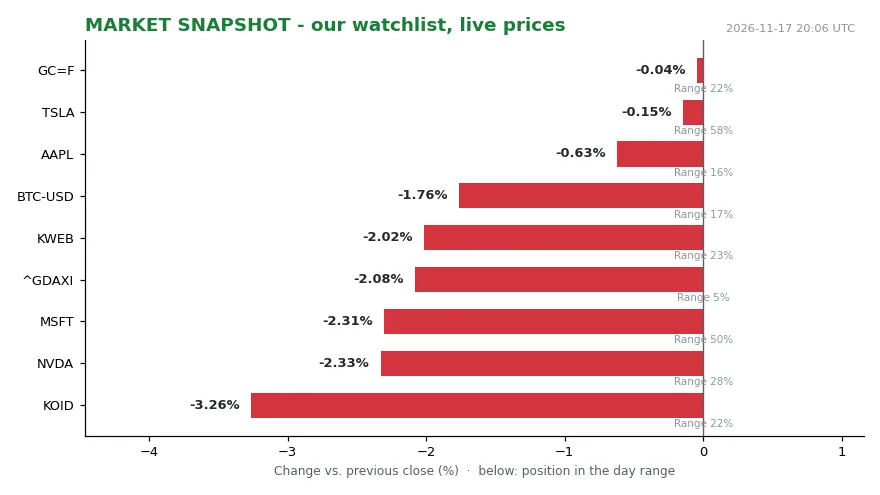
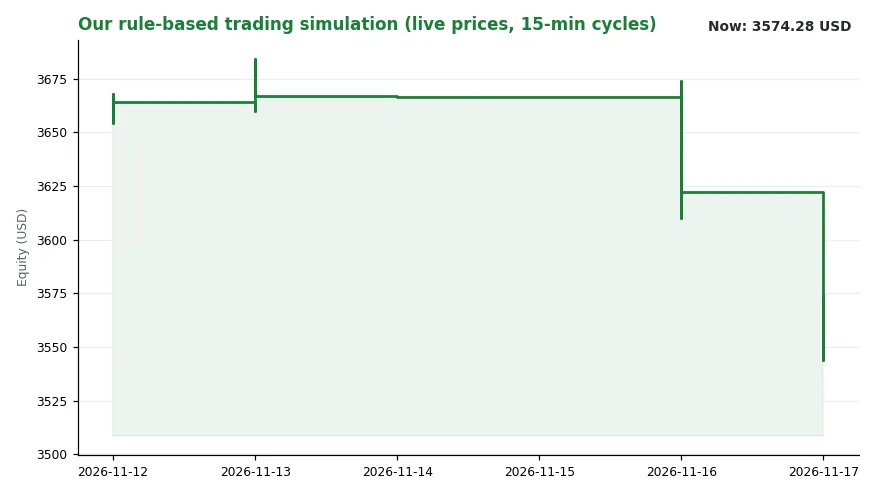
Our own tape, pulled two minutes before this column was written, shows a market that is not panicking — it is repricing. Nvidia printed at 152.65 USD, down 2.24% and sitting mid-range (33% of its daily span); Microsoft traded at 505.87, off 2.34% and likewise mid-range (49%). The KWEB ETF, one of the most direct listed proxies for Chinese platform exposure, stood at 22.09 — down 2.08%, but near the day’s lows, at 18% of its range, which says sellers held the close rather than covering into it. Around those three readings the pattern is uniform rather than dramatic: Germany’s DAX at 26,045.37 fell 2.08% and finished almost on its low (5% of range), Bitcoin at 63,677.89 lost 1.77% near its own low (16%), while gold at 3,851.30 was essentially unchanged (-0.04%, 22% of range). Our reading of the tape is that gold standing still is the tell: what repriced was not the appetite for safety — it was the price of computing power. Our simulated book, documented honestly, sat at 3,574.28 USD, down 1.33% on the day, with 1,781.96 in cash, the latest rule-based decision a plain WATCH on KWEB, and a regime reading of trend=falling, level=3.63.
This week Xi Jinping and Donald Trump are due to meet in Shenzhen. Between that meeting and the regulatory decision now landing in the region sits a question that has less to do with diplomacy than with where a graphics card is plugged in. Between those two images sits a regulatory decision that has less to do with diplomacy than with where a graphics card is plugged in.
On Monday, Washington announced new interim rules that widen scrutiny of data centre operators in Singapore, Malaysia, Thailand, Indonesia and Brazil [1]. The measure does not stop at restricting exports of advanced chips; it reaches access to their computing power, the thing Chinese firms currently rent abroad to train artificial intelligence models [1]. Operators in those five countries will need a US government licence to buy advanced chips from Nvidia or other American chipmakers, which gives Washington a window into whether those chips end up serving Chinese customers — or get smuggled into China [1]. The US Commerce Department’s Bureau of Industry and Security framed the goal narrowly: sensitive US technology “cannot be circumvented through remote computing arrangements involving data centers in third countries,” it said, adding that licences will be issued on a “case-by-case basis” [1].
The mechanism runs through a gap that everyone in the industry could see and nobody in Washington was willing to leave open. Physical export controls had already made frontier chips hard to get into China. Renting them offshore was legal: until the US government acted on Nov 16, data centres in the region could sell compute to Alibaba, ByteDance or Tencent without breaking a rule [1]. The scale of that dependence is the number to hold on to. Research by the Institute for Progress, a US think tank, projects that at least 30% of China’s advanced AI computing power will come from renting overseas or from smuggling in 2027 [1]. The same analysis estimates that top US models lead the best Chinese platforms by only about six and a half months — and adds: “This is despite US AI companies having significantly better compute access and financing” [1].
That is why the announcement travels through equity markets so quickly. In Hong Kong trading, Alibaba fell more than 5% and Tencent nearly 4%, while the Chinese AI firms MiniMax Group dropped more than 7% and Z.AI more than 5%; in the US, tech stocks slid and pulled the Nasdaq down more than 1% [1].
The distribution of wins and losses inside the rule is unusually explicit. The losers are the neoclouds and the landlords behind them. Megaspeed, the largest buyer of Nvidia chips in South East Asia, has been accused of illegally smuggling chips to Chinese companies after purchasing them for data centres in Malaysia, Indonesia and Thailand; the company has denied the allegations, defended its business as “legitimate and lawful”, and said it has “retained external legal counsel to conduct a thorough internal investigation” [1]. It also said Alice Huang stepped down from her role as director in late 2023 and left the firm last year [1]. Financing is where the second-order damage lands. Data centre companies based in Asia-Pacific have raised about US$49 billion in loans since 2023, according to Bloomberg figures, often secured on customer contracts and sometimes on the chips themselves. One lender that joined a US$255 million loan to PaleBlueDot AI, a US-based neocloud, is seeking legal opinions on whether the change could trigger mandatory pre-payment; GMI Cloud, an Nvidia partner, is currently seeking to borrow US$300 million [1]. “Data centre financing may hit the brakes,” said Gary Ng, senior economist at Natixis, adding that “the pace of AI investment may slow down, and lenders will reassess the risks of export controls, data sovereignty, energy bottlenecks and cash flows”. Olaf Groth of UC Berkeley Haas put the incidence plainly: “The headline is about chips, but the bill lands on the lenders,” he said, warning of a possible “ripple effect to those customers sharing those data centres”.
Governments in the crossfire are hedging. Singapore’s Ministry of Digital Development and Information and Ministry of Energy, Trade and Industry said they are “studying the details of this new measure carefully”, are “engaging affected companies to understand the potential impact on their businesses”, and have been “engaging the relevant US authorities on the scope and implementation of the measure, as well as exploring how to facilitate trusted access for Singapore companies”. Malaysia has previously said it welcomes data centre investment but “will not allow itself to be used to get around export controls” [1]. Brazil’s development ministry said it “is closely monitoring any potential developments regarding this measure” [1]. Beijing’s response was sharper: the foreign ministry called the rules “economic coercion” and said China “will take necessary measures to firmly safeguard its own legitimate rights and interests” [1].
The corporate subplot has become its own risk factor. Nvidia’s board established a committee to oversee “the company’s national security policies, export control compliance and global trade risk management”, and is searching for a permanent successor to Jensen Huang, who stepped down after disclosures about an affair with Alice Huang, the Chinese businesswoman behind Megaspeed, whom US authorities deem an asset of Chinese intelligence services — a claim China denies [1]. Interim chief executive Colette Kress was set to preside over the release of the company’s latest quarterly financial results [1].
What to watch next is concrete. First, the Federal Register: the rule takes effect 90 days after gazetting, and the first licence decisions will show how broadly “case-by-case” is read [1]. Second, whether covenants negotiated before Nov 16 (hefty termination fees, higher upfront payments, early repayment) get invoked [1]. Third, the diversion question: BIS says Brazil and the four South East Asian nations “present a higher-than-normal risk of diversion” of the chips Washington wants to keep out of China [1]. The uncertainty is real in both directions. Naoise McDonagh of Edith Cowan University says countries whose data centre roll-out was driven by Chinese buyers, Malaysia and Thailand among them, could be hit hardest, while Reema Bhattacharya of Verisk Maplecroft argues the boom as a whole should survive, with investment backed by major tech firms and clearly identifiable customers likely to “remain relatively resilient” [1]. And the oldest dilemma remains unresolved: restrict access and push Chinese firms toward domestic silicon, or keep selling and preserve dependence [1].
The object to keep in view is small and ordinary: a single accelerator card in a rack in Johor or Batam. Before this week it was a component in a real-estate-and-electricity business, valued by the megawatt. Now its worth depends on who, eventually, is allowed to log in. Sources: [1] BBC News, “US tightens chip rules as Trump heads to China” (2026-11-16/17); The Straits Times, “Singapore studying new US rule on AI chip exports that may hit data centres”; The Business Times, “‘Data centre financing may hit the brakes’”; The New York Times, “Trump’s New A.I. Chip Rules Rattle Southeast Asia” (2026-11-17); Institute for Progress, cited in [1]; our own market measurement, 2026-11-17 20:02 UTC.
Sources
Mentioned organisations (context, not sources)
- Nvidia — Organisation (homepage)
- Microsoft — Organisation (homepage)
- Nasdaq — Organisation (homepage)
- Alibaba — Organisation (homepage)
- ByteDance — Organisation (homepage)
- Tencent — Organisation (homepage)
- MiniMax Group — Organisation (homepage)
- Z.AI — Organisation (homepage)
- US Commerce Department — Organisation (homepage)
- Bureau of Industry and Security — Organisation (homepage)