Kyiv Bridges Under Fire Two Ledgers One Winter
“Kyiv’s mayor says the capital is being torn apart. The claim is concrete: bridges, data centres, power and water are the systems under attack, and each one has a price.
The Mayor’s Inventory of a Wounded City
The account given by the city’s own officials describes something more mechanical. Mayor Vitaliy Klitschko warned that intensified Russian drone and missile strikes are “tearing Kyiv apart”, and described the capital as being in a “very dramatic situation”, with Moscow battering what he listed as “critical infrastructure, logistics, housing” and other key facilities. [1] Critical infrastructure means the basic systems — power, water, transport and telecoms — that a city needs to function. He was speaking after Kyiv’s defence council — the city’s standing crisis body of senior military, security, emergency and police officials — held a crisis meeting on Friday. He described Russia’s aim as an attempt to “sow panic”, and said the question the city faced was one of survival. The list he gave is a list of systems, not of slogans.
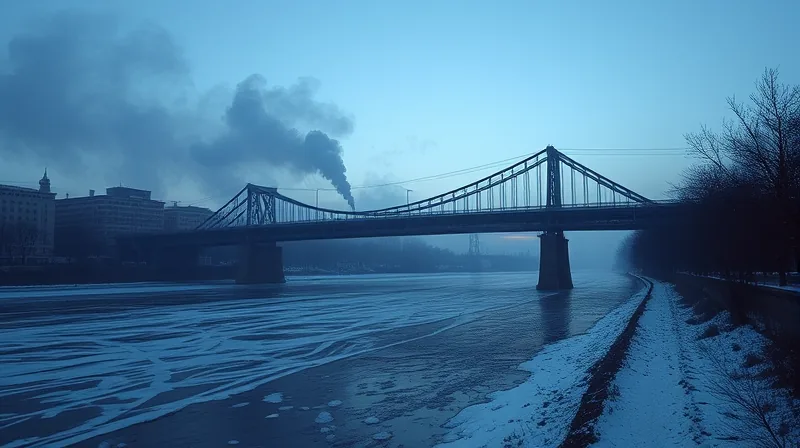
The clearest single case is a river crossing. Kyiv’s Pivdennyi, or Southern, bridge was hit in an overnight Russian drone attack and struck again on Friday evening — the fourth time in two days. It is one of the main transport arteries across the Dnipro River, the water that divides the western and eastern halves of the capital. All metro and automobile traffic across the bridge is now suspended, and restrictions are in place on Kyiv’s two other key bridges. Three crossings are therefore not working normally in a city that runs on them.
The damage extends beyond physical structures. Kyiv’s data centres — the buildings that house the servers carrying internet traffic — have been hit recently, producing internet outages. Kyiv’s population is estimated at about three million, and many residents rely heavily on the metro network, which is now partly a set of closures and diversions. When a mayor lists “logistics” — the movement of goods, fuel and people through a city — this is the material the word covers.
One person was killed in the capital when a multi-storey residential building was hit overnight, Ukraine’s state emergencies service DSNS reported. [1]. A working bridge and a working metro are not abstractions; they are how people get to work, to hospital, and back home.
Two Ledgers, One Argument About Origins

Russian President Vladimir Putin, in a wide-ranging speech at the Valdai foreign policy forum on Thursday, presented Russia’s strikes on Ukrainian economic targets as a direct response to Ukrainian strikes on Russian oil refineries and on Russian ships in the Black Sea. His phrasing left little room for interpretation: “Now from every direction we’re receiving calls ‘let’s stop’. But they started it.” The chronology complicates the claim. Russia was the first to launch attacks of this kind, so the retaliation argument describes the most recent round of an exchange rather than its origin. Two governments are offering two accounts of who moved first, and claims of that kind can be tested against dates. Dates do not award blame, but they do limit what a justification can cover.
The most revealing passage in Putin’s speech was an admission against interest. He conceded that Kyiv had “got some results” from its refinery strikes, and estimated that Russia had lost about 1 % of its GDP. [1] GDP — gross domestic product — is the total value of everything a country produces in a year, so 1 % of a large economy is a large absolute sum. It is an unusual figure for a wartime leader to volunteer in public.
Ukrainian President Volodymyr Zelensky, in a published excerpt from an interview with the Financial Times, placed a turn in Russian conduct in early September, when, in his account, Putin decided that “there are no rules now” when attacking Ukraine. The excerpt continues: “The Russians have failed to occupy us. So now they are carrying out massive attacks and mass killings.” He then listed the objects at issue: “They want to destroy our bridges… our data centres, the internet, mobile networks, hospitals, kindergartens, schools, universities - everything. They want people to flee their cities.” [1] Read as an inventory rather than a lament, it is a description of a functioning city: schools and hospitals sit on the same list as bridges and data centres.
Arranged by date, the week reads like this. Thursday: the Valdai speech. Friday: the capital’s defence council meets, and the bridge is struck for the fourth time in two days. Behind both sits a marker that Zelensky places in early September.
A Campaign on the Winter Calendar
The pattern is seasonal rather than episodic. Russia has targeted Ukrainian energy infrastructure and has increased the tempo of those attacks every winter since the full-scale invasion of 2022. Each winter has brought an escalation rather than a pause. That repetition is the most useful single fact in the file, because it does not fit inside a single provocation. It is a statement about recurrence, not about motive.
The calendar also changes how the current target list should be read. A campaign that returns as temperatures fall — and that now includes bridges, data centres and mobile networks alongside power generation — is broader than an energy war and older than the refinery exchange. The inventory of what is breaking is assembled by the mayor of the city where the breaking happens. His list is organised around function rather than symbols, which is why it is the harder list to dismiss.
Success, in terms that can be checked rather than hoped for, looks like this? Traffic moving again across the Pivdennyi bridge, and the restrictions lifted on Kyiv’s two other crossings. Metro trains running again for the roughly three million people who use the system. Data centres online, so that internet and mobile service stop being a variable in an ordinary working day. And a winter without another round of strikes on energy infrastructure — the one item on that list that no repair crew can deliver on its own. Klitschko’s condition for the capital was that it would “prevail - but only through the joint efforts of those who love it and care for it”. Read that as a job description rather than a slogan, and the items above are the job: bridges, trains, servers, calendar.