Europe’s Recovery Lasted One Month. The Tape Was Already Rotating.
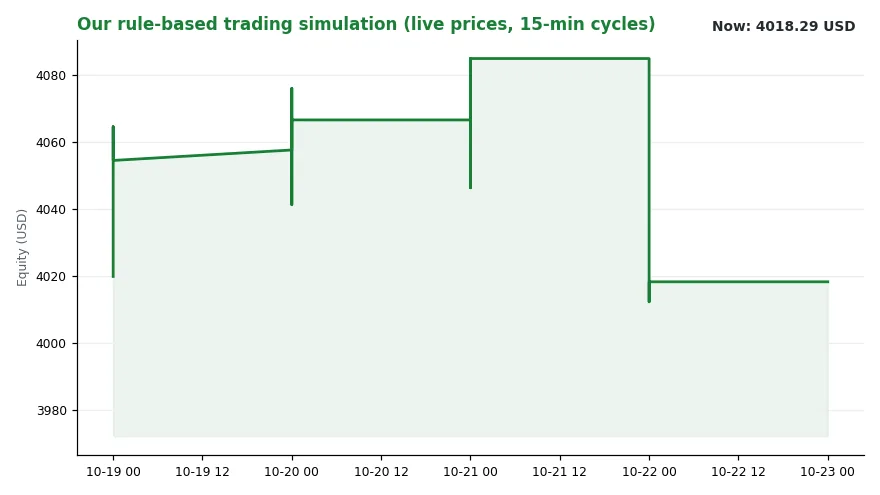
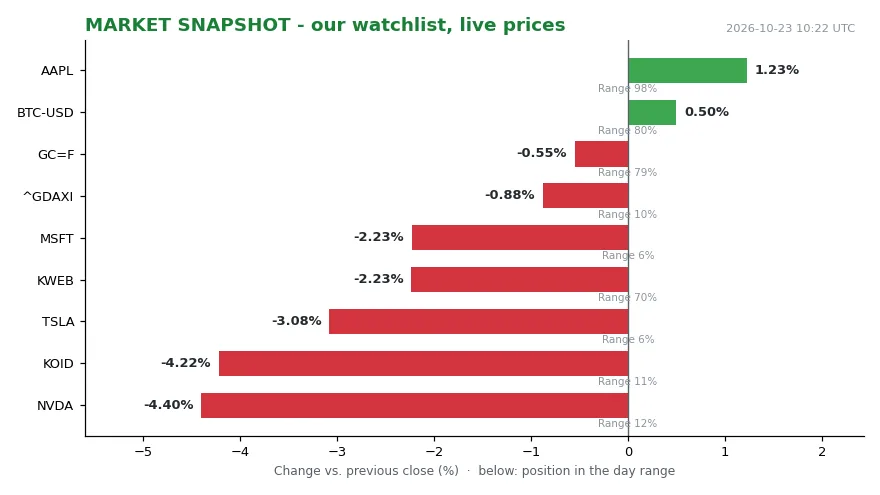
Our own measurement, pulled at 10:20 UTC on 23 October, shows a market that is not running for the exits so much as changing seats. Nvidia printed 212.21, down 4.40% and sitting at 12% of its daily range — near the lows. Microsoft was 2.23% weaker, also close to the bottom of its range at 6%. Tesla, off 3.08%, likewise. Apple, by contrast, gained 1.23% and was pinned at 98% of its range, near the day’s high. Germany’s DAX stood at 25,153.83, down 0.86% and near its lows at 13% of range. Gold at 4,037.30 and bitcoin at 81,688.48 both held in the upper part of their ranges, at 78% and 76% respectively. That is not uniform risk aversion. It is a rotation — out of the longest-duration growth names and out of European cyclicals, into cash-generative quality and into hedges. Our regime reading shows trend=falling at a level of 3.63, and the busiest channel in the signal layer today is “central banks”, with two events. The simulated book, run on documented rules, stood at 4,018.29 USD, unchanged against the same time yesterday, with 2,019.27 in cash and the latest logged decision a WATCH on KWEB. The tape, in short, was already discounting a central-bank problem before the survey arrived.
What the survey actually said
The October purchasing managers’ index for the eurozone fell to 51.9 from 53.1 in September — the weakest reading in four months, and below the 52.7 economists had expected, though still above the 50 line that separates expansion from contraction. Both the services and manufacturing sub-indices came in below forecasts while still signalling modest growth.
France supplied the shock. Its composite PMI dropped to 48.4 from 51.1, against a forecast of 50.5 — a move deep into contraction territory. The services index fell to 48.4; manufacturing slipped to 49.3, an 11-month low. Companies reported customers postponing projects and delaying spending decisions. New orders fell at their fastest pace since May, and export business declined for an eleventh consecutive month. Firms cut staff for the sixth month running, largely by leaving vacancies unfilled and letting temporary contracts expire. The recovery that had begun in September lasted a single month.
The confidence numbers were worse than the activity numbers. Expectations for the next twelve months fell to their lowest level since April 2020, when the pandemic had brought much of the French economy to a halt, and the survey recorded negative business expectations for the first time in almost two years. Joe Hayes, senior principal economist at S&P Global Market Intelligence, tied the reading to politics and the public purse: it “reflects firms’ concerns about what is shaping up to be a highly uncertain 2027 Presidential Election, compounding pre-existing worries about France’s fiscal situation.” [1] Germany was better, but only relatively. Its composite eased to 52.8 from an 11-month high of 53.8, missing the 53.3 consensus. Manufacturing actually improved to 54.2, a two-month high, helped by export orders and government spending on defence and infrastructure. Services fell to 51.7, with firms reporting delayed decisions and tighter budgets. Phil Smith, economics associate director at S&P Global Market Intelligence, said the slowdown “underscored that the recovery in the eurozone’s largest economy remains fragile.” [1].”
The mechanism: three channels, one squeeze
The first channel is the cost of money. French ten-year yields hit 5.14% on Thursday, the highest since 2002, before easing to around 5.04% on Friday. The spread over German Bunds stood at 170 basis points, more than double the 78 basis points recorded in early August. Rory Fennessy, senior economist at Oxford Economics, described the link plainly: “Unsurprisingly, the volatile political situation and spike in government borrowing costs meant the downturn in the French composite PMI weighed on the overall picture.” [1] Sovereign yields transmit into corporate lending rates, and expensive credit discourages exactly the investment that a PMI recovery needs.
The second channel is input costs. German manufacturers reported the fastest increase in input costs since May, particularly for oil, raw materials and electronic components, with Brent crude near $114 a barrel. Smith’s formulation is that “a renewed surge in cost pressures has dampened expectations across the sector, with the two likely to remain intrinsically linked in the months ahead.” [1].” Across the eurozone, firms cited higher prices for energy, fuel and transport, and supplier delivery times lengthened by the most in four months.
The third channel is the currency. The euro traded near $1.12, more than 4% below its August high. A weaker euro makes imported energy dearer — which feeds directly back into the cost channel above, at the moment manufacturers can least absorb it.
Who carries the cost
French firms carry the most immediate burden: they are cutting headcount, and their forward expectations are the weakest in more than six years. German manufacturers are winning orders but worrying about the cost of fulfilling them, with sector confidence at its lowest since July. Households face the pass-through of higher borrowing costs if the ECB tightens further. Equity holders have already marked the difference: the CAC 40 fell 0.7% to around 7,750 points, more than 11% below its 10 August closing high, while Italy’s FTSE MIB was flat after Thursday’s 2.5% decline and remains more than 10% off its August peak. The decision-maker is the ECB, and Chris Williamson, chief business economist at S&P Global Market Intelligence, framed its dilemma:.3%, but “higher interest rates are also starting to take a toll, dampening demand” — and with inflation sticky, the figures “will likely add to further speculation of more aggressive policy tightening from the ECB.” [1]
What we watch next
Three observable markers. First, the French-German spread: a sustained move beyond the 170 basis points reached this week would signal that markets are repricing sovereign risk rather than merely repricing rate expectations. Second, the November PMI and the new-orders component in France, which led this month’s deterioration. Third, the ECB’s language on tightening, which our signal layer already flags as the busiest channel of the day — a rare case where the data flow and our own instrumentation agree.
The honest caveat: these surveys are disappointing, but as reported they do not yet describe a eurozone recession. One month of French contraction and a German slowdown to 52.8 are consistent with a stall as much as with a slide, and the composite remains above 50. What has changed is the direction of travel, and the fact that the region’s two largest economies are now moving apart rather than together.
September’s surveys were read as evidence that recovery had arrived in Europe. October suggests the word was doing more work than the data could support: what returned for one month in France was not a recovery in any durable sense, but a pause in a contraction that had not finished.