Markets Lean as UK Budget Targets Housing and Defence
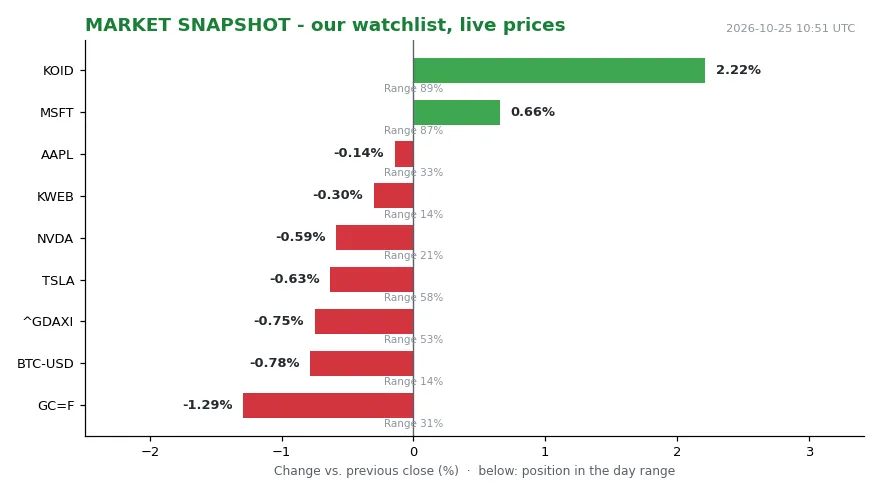
Our own reading, taken at 10:47 UTC on 25 October 2026, shows a market leaning rather than breaking. Microsoft printed 524.51 USD, up 0.66% against the previous close and sitting 87% of the way from the day’s low up to the high. Nvidia came in at 210.96 USD, down 0.59% and close to the day’s lows, sitting 21% of the way from the low up to the high. Bitcoin traded at 80,118.66 USD, off 0.81% and near the bottom of its daily high-low span, sitting 12% of the way from the low up to the high. Gold slipped 1.29% to 4,007.90 USD, sitting 31% of the way from the day’s low up to the high. The DAX eased 0.75% to 25,181.65, also sitting 53% of the way from the day’s low up to the high. KOID stood apart at 33.21 USD, up 2.22% and sitting 89% of the way from the day’s low up to the high.
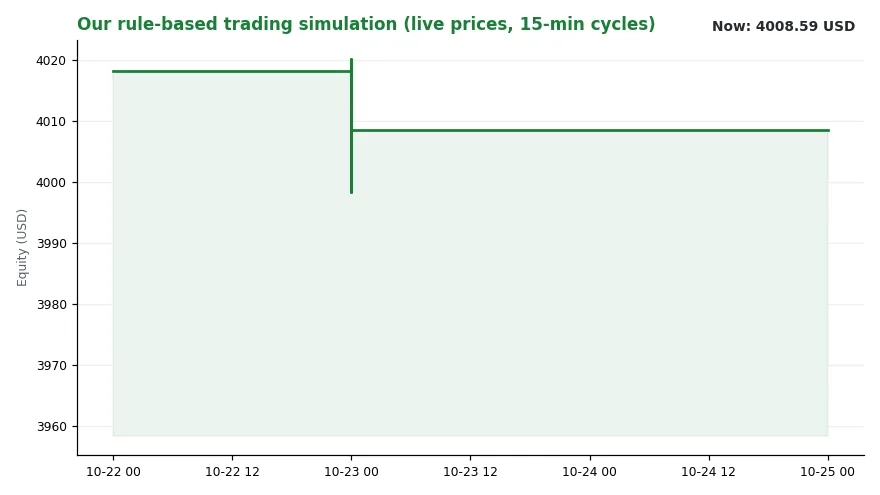
Read together, those numbers describe money moving out of one group of assets and into another, not panic. Money is thinning into a few large names while the wider group of assets investors buy when they are willing to take risk sags. Our internal indicator that scores whether the market trend is rising or falling says trend=falling, level=3.63. The practice portfolio tracked at real prices, with no real money in it, holds 4,008.59 USD, flat against the same time yesterday, with 2,012.65 USD in cash. The most recent rule-based decision was WATCH KWEB at 0.00. The news category with the most alerts today was “central banks”, with 3 events. That is the weather we can measure. The Budget is the weather we cannot.
On Wednesday, Chancellor John Healey presents his first Budget. One headline figure is already public: more than £1bn for social and affordable housing in England. That takes funding for the government’s 10-year homes programme past £40bn. Mayors and regional leaders across England are expected to gain greater powers and funding in the same announcement. Councils will be helped to borrow from the government to invest in housebuilding through loan rates below what they would pay on the open market. The stated aim is flexibility and authority over regional investment decisions.
A second pot is smaller but structurally more interesting. An initial £285m in starter money for a limited transition period will be allocated next year to support mayors and local leaders. The Treasury frames it as a way to reduce reliance on “fragmented bidding pots” in Whitehall. From 2028, the government will work with mayors to design a new £1.5bn pool of money made available to be drawn down as loans. The Treasury lists possible uses: new homes, high streets brought back to life, improved transport links.
Healey’s own framing is that English cities and regions get the “right to decide their own future”. In his fuller words: “Mayors and local leaders know what their communities need to grow, which is why we are giving them more money, more power and more capacity to get projects moving, build homes and make the right decisions for their areas.” [1] Prime Minister Andy Burnham said the plans shift power to those “who know their communities best”. He added: “I’m calling time on local leaders going cap in hand to Westminster. That is no way to run a country.” [1] Areas not yet classed as formal groupings of councils with devolved powers can claim a share of the £285m to unlock growth projects.
Defence is the other open front. The Sunday Times reports that Healey is expected to unveil billions of pounds of new defence spending, with specifics deferred to next year’s government exercise that sets departmental budgets. Shadow chancellor Andrew Griffith has called for Healey to resign if he fails to set out how the UK will spend 3% of GDP on defence by 2030. Griffith’s argument, in his words: “We are living in an era of extraordinary threats, and yet the chancellor is dithering over finding the money to pay the country’s insurance premium… you cannot have a strong economy without a strong defence”. [1] Healey resigned in June as defence secretary in the previous government over the defence investment plan, which he said fell “well short” of what was needed. He had called for spending to reach 3% of GDP by 2030, on the way to a NATO target of 3.5% in 2035. Defence Secretary Wes Streeting responded that the Conservatives were to blame for failing to invest in the military while in office, and said the prime minister had made clear the government was “determined to give our armed forces the investment needed to keep us safe”.
Not all the pre-Budget news was on message. The Treasury’s entrepreneurship adviser, Alex Depledge, announced she is resigning, leaving on Thursday, the day after the Budget. She told the Sunday Times that start-ups were being treated as a “sideshow”. Her warning about young companies past the start-up stage that are growing fast: “Keeping scale-ups on the fringes underestimates the contribution of our greatest companies, and we need to support and develop them on British shores at all costs.”
The channel, not the chorus
The mechanism worth watching is plumbing, not rhetoric. Housing supply is a capital problem before it is a planning problem: someone must carry the cost of building long before rent or a sale arrives. A £1.5bn pool of money made available to be drawn down as loans, designed from 2028, changes who carries that cost. Loan rates below what councils would pay on the open market change the price of that borrowing. Starter money of £285m for a limited transition period changes who decides, because money that arrives without a bid is money that does not need a bid written in Whitehall.
If the cost of capital falls at the local level, projects that failed a business case can clear it. That is the supply channel: fewer schemes stalled at the financing stage, more starts, more capacity added over years rather than quarters. The second channel is expectations. Devolution announcements are cheap on the day and expensive later, and the test is whether the pool of money made available to be drawn down as loans survives contact with the government exercise that sets departmental budgets. The third channel is fiscal. More than £1bn for housing on top of a programme already past £40bn, plus defence money not yet quantified, is a claim on the same purse. A 3% of GDP defence pledge is the one commitment without a published schedule, and the source does not quantify it against the £1bn for housing. When a government promises both, the funding question does not disappear because the document is quiet about it. We cannot measure that arithmetic today.
Who holds the pen
The mayors are the visible winners. Claire Ward, chairwoman of the UK Mayors Network and Labour’s East Midlands mayor, said the “right powers and resources through increased devolution” would help turn “ambitious plans into reality and deliver real, lasting change”. Sadiq Khan, Labour’s mayor of London, named projects that a pool of money made available to be drawn down as loans could reach: the West London Orbital route, the extension of the Bakerloo Underground line and Docklands Light Railway, and the development of Stratford International station. These are transport assets with long build times and lumpy capital costs, precisely the profile a pool of money made available to be drawn down as loans is designed to touch.
Councils outside the formal groupings of councils with devolved powers can access a share of the same £285m pot, with a different incentive: prove a project, then ask. Small breweries get a mention and, so far, no number, with the Treasury saying Healey wants “to turn the tide for our pint producers”. Griffith’s resignation call sets a test that is easy to state and hard to meet, because the detailed numbers live in next year’s government exercise that sets departmental budgets.
The tests that matter
The first test is whether Wednesday’s document dates the 3% of GDP commitment or restates the ambition without a schedule. The second is the design of the £1.5bn borrowing facility: who guarantees it, who allocates it, and whether 2028 holds. The third is the distribution of the £285m, which reveals which regions got the pen first. The fourth is whether small-brewery support arrives as a change to a tax charged on specific goods, a grant, or a sentence. The fifth is how sectors that price UK assets whose value depends on events far in the future respond, which we will read off our own live stream of prices rather than off the front pages.
Uncertainty is doing real work here. We do not know the size of the defence envelope. We do not know whether loan rates below what councils would pay on the open market amount to a subsidy, a guarantee, or a discount window. We do not know whether the housing money is new or recycled. None of that is pessimism. It is the list of things we refuse to assume.
On Thursday we will fetch the live stream of prices again and see which way the lean went - and whether the Budget moved the cost of capital at the local level, or only the language around it.
Sources