
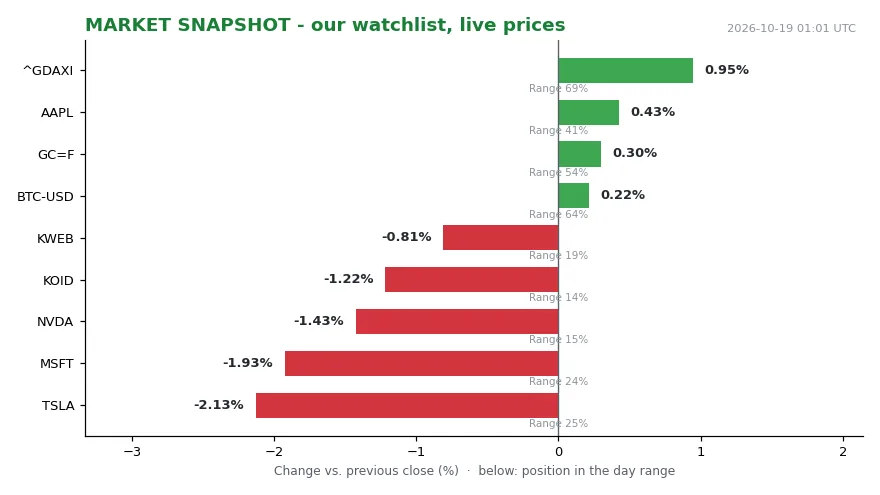
Our own measurement, taken at 00:58 UTC on 19 October 2026, opens with a small but consistent pattern. NVDA printed 214.13, down 1.43 % against the previous close and sitting in the bottom 15 % of its daily range. MSFT traded at 529.05, off 1.93 %, also near its low at 24 % of range. TSLA slipped 2.13 % to 354.72, mid-range at 25 %. On the other side of the ledger, the DAX stood at 25622.61, up 0.95 % and at 69 % of its range, while gold futures held 4193.30, up 0.29 % and mid-range at 53 %. AAPL was the exception on the upside at 343.46, +0.43 %, mid-range at 41 %. BTC-USD changed hands at 82204.72, +0.23 %, at 67 % of range.
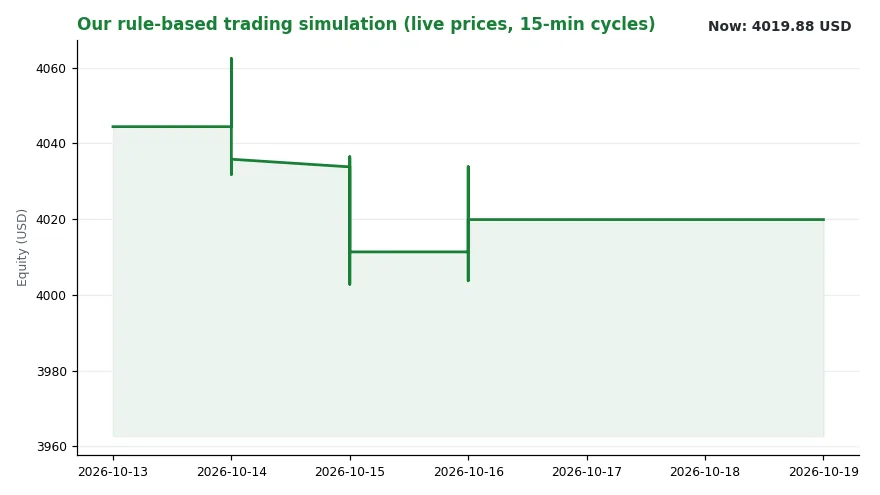
Read together, those prints describe a rotation rather than a rout. Expensive US growth exposure is being offered slightly lower, close to the bottom of the day’s range. European equity exposure and gold are absorbing bids. Our regime reading is trend=falling, level=3.63. The simulated book carries 4019.88 USD, of which 2014.07 USD sits in cash — very nearly half. Half in cash is itself a verdict on current prices.
That verdict is the lens for today’s news from Britain’s housing market. More than 3,000 properties a day had their asking price cut on average in September, according to Rightmove figures shared exclusively with the BBC. [1] It was the highest monthly total in 15 years. Two forces drove it: a glut of homes for sale, and sellers setting expectations the market would not meet.
The news, and the numbers behind it
The arithmetic of those cuts is blunt. The average reduction was nearly 7 %, which on a typically valued home equals roughly £21,000. In September, 34 % of listed homes carried a price reduction, only a shade below the recent peak of 36 % seen in September 2023. The share of listings that eventually get cut peaked in 2023 and has stayed relatively high since.
Timing carries its own penalty. Homes that took a price reduction typically needed 119 days to find a buyer. Homes listed at a single price needed 39 days. Richard Donnell, executive director of research at Rightmove, puts the odds plainly: properties needing a reduction were half as likely to find a buyer within the normal three-month window. [1].
The demand side explains why. Mortgage rates have climbed to three-year highs, so buyers work to a monthly payment they can actually carry. Zoopla reports buyers in the driving seat, more cautious and more selective about what they bother to view. Its figures show homes for sale up 5 % year on year in September, while sales agreed fell 9 % over the same period. More stock, fewer transactions — that is the definition of a buyer’s market.
Why the first number goes wrong
One explanation blames seller psychology. Tarah Lourens, chief operating officer at Rightmove, points to “emotional” factors in pricing, because owners “put a value on the time and money they have invested in their home”. Buyers, she notes, simply compare everything available at their budget. The gap between those two calculations is where a stale listing is born.
A second explanation blames supply and affordability together. Colleen Babcock of Rightmove describes the trap: “Once a home has been on the market for a while and then has a price reduction, some buyers start asking questions, even when there is nothing wrong with the property.” [1] She adds: “In a market with so much choice, first impressions matter.” A cut is read as a signal, not as a gift.
A third explanation points to the absence of an independent price anchor. Scotland requires a Home Report with an independent valuation before a home goes to market. Donnell’s data show 74 % of Scottish homes listed across April, May and June sold within three months, against 30 % in London. [1]. Same island, similar clock, very different clearing rate.
Which explanation survives the evidence? Pure sentiment struggles to explain a 44 percentage point gap between two British markets in the same quarter — our own subtraction of the two figures, not a number the source states. The mechanical explanation — anchor first, then market — fits the 119-versus-39-day split better. Sentiment explains why the first price is wrong; the pricing mechanism explains how long the correction costs.
Who wins, who waits
Buyers win on choice and on negotiating room, though their advantage is capped by financing costs, since a cheaper asking price does not lower a mortgage rate. Sellers lose time first and money second. Agents and surveyors sit in the middle, and their testimony converges on one point. Craig Webster of Tiger Sales and Lettings in Blackpool argues that getting the initial price right is the whole game: “That’s when you have the greatest opportunity to capture the attention of active buyers.” Katie Griffin of surveyors Sawdye and Harris in Devon describes the second-order cost of a correction: “The property may already have been online for several months and buyers can start asking why it has not sold.” Not every seller is realising a loss. Andrew Boast, chief executive of SAM Conveyancing, notes that owners who negotiated hard on the way in, and watched value rise while they held, may still exit ahead even after a cut. The loss is relative to an expectation, not always to the purchase price.
Geography and tenure weigh heavily, often more than pricing effort alone. Sellers who contacted the BBC’s Your Voice point to crowded local markets and to extra difficulty with leasehold properties in England. One seller, handling his late father’s home in south Wales, offered the bleakest available summary: “The market is dead. Lots for sale; no-one buying. No-one thinks it’s going to get easier.”
What we watch next
Three markers matter. First, relistings: a quarter of newly listed homes in September had already been offered in the past year, and six in ten came back at a lower asking price. [1]. Returning stock is a slow-moving overhang. Second, seasonality: September normally carries the heaviest cuts, because sellers want completion before year-end, so a calmer October would tell us little on its own. Third, the north-south spread, where Donnell cites higher prices, stamp duty and owners — including landlords — who do not need to sell as reasons southern listings move more slowly. [1].
Honest uncertainty applies to all three. Rightmove’s sample covers its own portal, Zoopla’s covers another, and both describe asking prices rather than completed sale prices. Our own dashboard says nothing about British housing; it only shows how quickly a market reprices when buyers become selective. The direction here is clear, the magnitude is not.
Which brings us back to a single number. In London, 30 % of homes listed between April and June found a buyer within three months. Fewer than one in three. Not a crash, not a crisis — just a market where the seller’s first number and the buyer’s last number are meeting later, and lower, than either side planned. [1].
Sources and exact quotes
[1] Rightmove data, shared exclusively with the BBC (Kevin Peachey, cost of living correspondent): more than 3,000 properties a day saw asking prices cut on average in Britain in September; highest monthly total in 15 years; average reduction nearly 7 %, roughly £21,000; 34 % of listed homes reduced, versus a 36 % peak in September 2023; 119 days versus 39 days to find a buyer; price-reduced homes half as likely to sell within three months (Richard Donnell); 74 % of Scottish listings sold within three months versus 30 % in London.
Zoopla: homes for sale up 5 % year on year in September, sales agreed down 9 %; a quarter of newly listed homes had been listed in the past year, six in ten at a lower asking price.
Babcock (Rightmove): “Once a home has been on the market for a while and then has a price reduction, some buyers start asking questions, even when there is nothing wrong with the property.” / “In a market with so much choice, first impressions matter.” Lourens (Rightmove): “emotional”; “put a value on the time and money they have invested in their home”.
Webster (Tiger Sales and Lettings): “That’s when you have the greatest opportunity to capture the attention of active buyers.” Griffin (Sawdye and Harris): “The property may already have been online for several months and buyers can start asking why it has not sold.” Seller, south Wales, via BBC Your Voice: “The market is dead. Lots for sale; no-one buying. No-one thinks it’s going to get easier.” Own measurement, 2026-10-19 00:58 UTC: watchlist prices, percentage moves and range positions as stated; sim equity 4019.88 USD, cash 2014.07 USD; regime trend=falling, level=3.63. Educational documentation only — not investment advice.
—