
The Frankfurt Letter: Lufthansa Cuts 1,000 Posts as Fuel and Strikes Bite
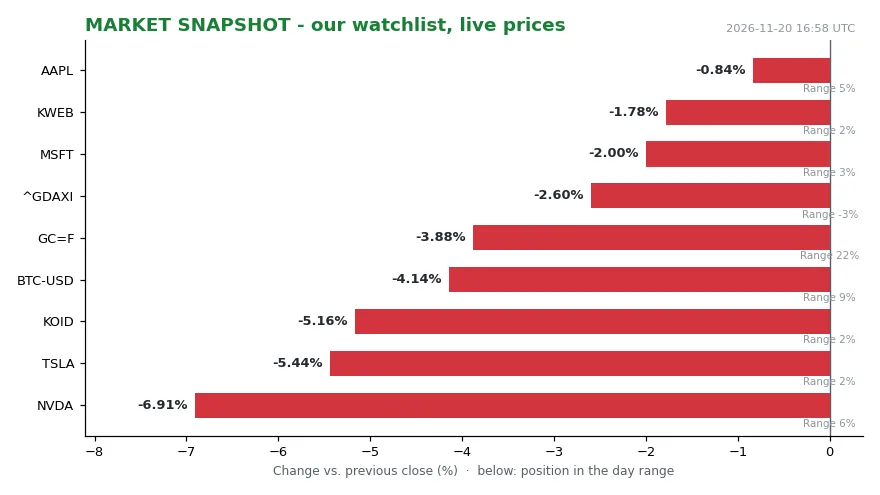
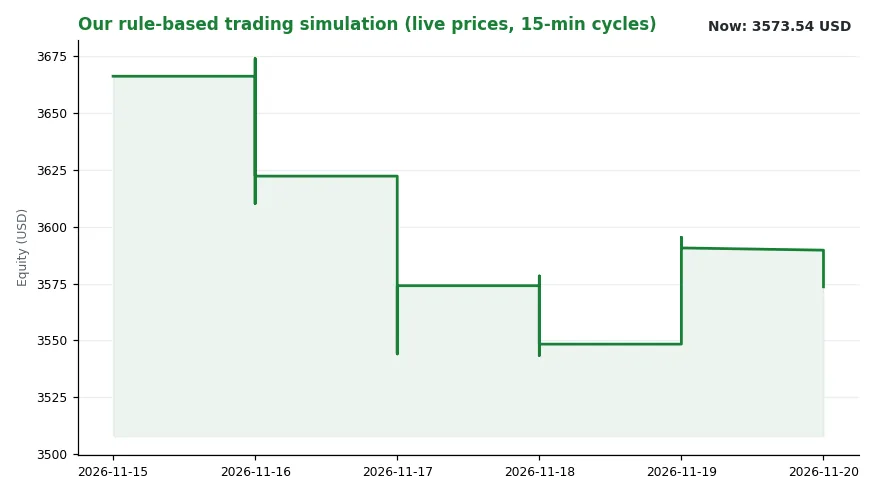
At 16:54 UTC on 20 November, almost every line on our watchlist sat close to its session low (the lowest price reached during the trading day). NVDA printed 135.73, down 7.02%, just 4% above the bottom of its daily range (where 0% is the day’s low and 100% the high). TSLA traded at 354.84, minus 5.23%, 2% off the low. The German benchmark, ^GDAXI, stood at 24802.78, down 2.60% and 3% above the bottom of its range. Gold refused the role of hiding place: GC=F fell 3.81% to 3545.10, still 25% above its low but moving the wrong way. BTC-USD lost 4.04% to 59401.23. KOID dropped 5.13% to 29.12, and KWEB slipped 1.76% to 20.93. Our rule-based sim book (our simulated, rule-based portfolio, tracked as if traded) closed at 3573.54 USD, down 0.48% against the same time yesterday, with 1798.25 in cash. The busiest signal channel of the day was “central banks”, with three events. Our regime reading: trend falling, level 3.63.
The shape of that tape matters more than any single print. Equities fall, bitcoin falls, gold falls. When the metal that usually catches panic sells off alongside risk assets, the pattern reads less like a rotation into safety and more like a broad reduction of exposure — cash raised everywhere at once. That is a reading of our own data, not a verdict on the world. It is the weather in which a single company announcement lands.
The company news of the day fits that mood without being caused by it. Lufthansa plans to axe 1,000 full-time jobs at its hubs in Frankfurt and Munich. Its core carrier lost €20 million a month on average between January and September, according to a letter to employees seen by AFP. [1] Strikes by pilots and cabin crew, and a surge in jet fuel prices since the Iran war began, have slowed its turnaround.
The letter does not say which roles the 1,000 posts cover, so the payroll is the unit of account. The core airline employs roughly 40,000 people, and 1,000 full-time posts is about 2.5 % of them. It is also unclear whether those posts sit inside the 4,000 mostly administrative jobs the Lufthansa Group said last year it would cut by 2030.
That ambiguity decides whether this is a fresh cut or a sharper version of an old promise.
The mechanism: an input price nobody sets, and a cost base nobody bends
The turnaround plan launched in 2024 bundles more than 700 individual measures. The target was to lift earnings by €2.5 billion by 2028. The measures announced to date, it warns, are “no longer sufficient”.
“The year 2026 has set us back: the war in the Middle East, the still very high fuel costs, nine days of strike action and our already very high cost base have intensified the situation. [1]”
— Letter to employees, seen by AFP Fuel sits outside management’s reach entirely; Lufthansa expects to spend €9.3 billion on fuel this year, about €2 billion more than in 2025. It has already tried the volume lever, scrapping 20,000 short-haul flights through to October to burn less. In our reading, strikes are a negotiated cost, and nine days of them cannot be recovered by scheduling. The cost base is the slow variable, and headcount is the part of it a board can move by decision rather than by negotiation with a supplier or a market.
That is the transmission channel: an externally set input price plus internally lost flying days squeeze unit cost (the cost of producing one unit of output — for an airline, typically cost per seat flown), unit cost squeezes margin, and margin pressure arrives at the payroll. Nothing in that chain is exotic. It is the standard route by which an energy shock in one region becomes a staffing line in another.
The actors: a group that is fine, a brand that is not
The most interesting fault line here runs inside one company. The wider group — which also owns Swiss, Austrian Airlines and Brussels Airlines and is buying up to 49.9 % of TAP Air Portugal in a €1.2 billion deal — has fared better. Third-quarter operating profit (profit from the core business, before one-off items such as asset revaluations or special tax effects) rose 6% to €1.4 billion, beating analysts’ expectations on strong demand for premium long-haul seats. Net profit (what is left after everything, including one-off items and tax) jumped 30% to €1.26 billion, helped by valuation gains (paper profits from writing assets up to a higher value) and by a tax charge that had weighed on the year-earlier figure.
The core airline tells a different story. Its third-quarter operating profit fell by a third to €300 million. Nine-month net profit across the group was still down 35%, and on 3 November the group trimmed its full-year operating profit forecast to between €1.7 billion and €2 billion, from up to €2.2 billion.
The chief executive’s framing points at the same split:
“we must now accelerate the financial turnaround of our core brand” [1]
— Carsten Spohr, CEO So the winners and losers are not distributed the way a headline about “Lufthansa job cuts” suggests. Premium long-haul demand is holding. The brand carrying the German hub structure, its short-haul feeder network (the short regional flights that bring passengers to the long-haul hubs) and its labour agreements is the one absorbing the adjustment. Staff at Frankfurt and Munich bear the direct cost. Passengers on thin short-haul routes have already paid a version of it, in 20,000 flights that no longer operate. And the group is simultaneously committing €1.2 billion to a stake in TAP — capital going out of the door while the core brand cuts, a combination that may invite questions about allocation before it invites answers.
What we watch next
Four things, in order of how quickly they resolve.
First, the 1,000. We watch for statements from the works council (the elected body that represents employees in a German company) and for any differentiation between Frankfurt and Munich.
Second, the fuel line. A €9.3 billion bill assumes a price path. If the Middle East war keeps jet fuel elevated into the first quarter, the €2.5 billion earnings target for 2028 gets further away, and the 700 measures get a 701st.
Third, the group guidance. The narrowed range of €1.7 billion to €2 billion is the number to hold management to. It is also the number that tells us whether the core brand’s weakness is being absorbed or merely concealed by long-haul strength.
Fourth, our own tape. Whether gold keeps falling with equities is a live question for the coming sessions, and the central bank channel was the busiest signal we recorded on 20 November. If broad de-risking (investors selling across many assets at once to reduce total exposure) continues, the cost of capital for a group refinancing aircraft and acquisitions rises alongside its fuel bill — a second channel, arriving later.
None of this is a recommendation, and none of it is a forecast.