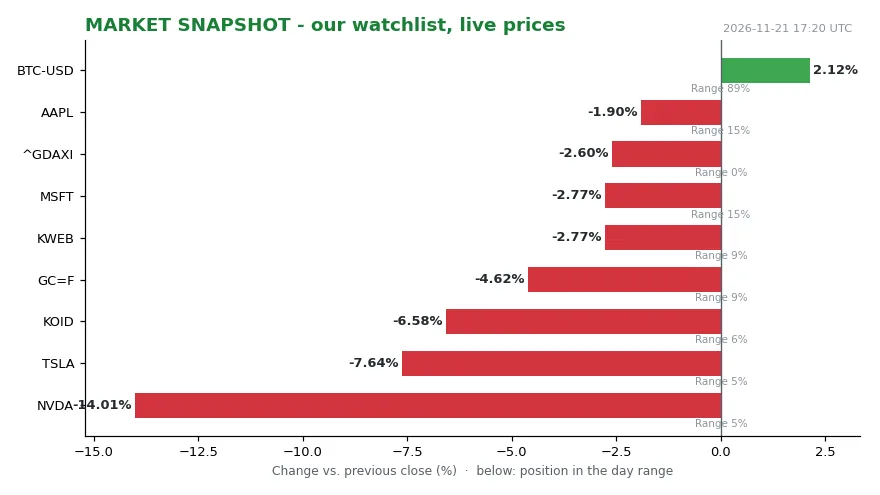
Our tape for 2026-11-21, 17:18 UTC, opens this story — not London, and not Westminster. NVDA printed 125.53, down 14.01% against the previous close and sitting in the bottom 5% of its daily range. TSLA traded at 345.82, minus 7.64%, also pinned near the day’s low (5% of range). MSFT stood at 484.52, down 2.77% and in the lower 15% of its range, while AAPL at 342.56 lost 1.90% and sat at the same 15% mark. The German benchmark ^GDAXI closed at 24802.78, off 2.60% and exactly at the floor of its range (0% of range). KWEB came in at 20.72, down 2.77%, in the bottom 9% of its range, and KOID at 28.68 fell 6.58% (6% of range).
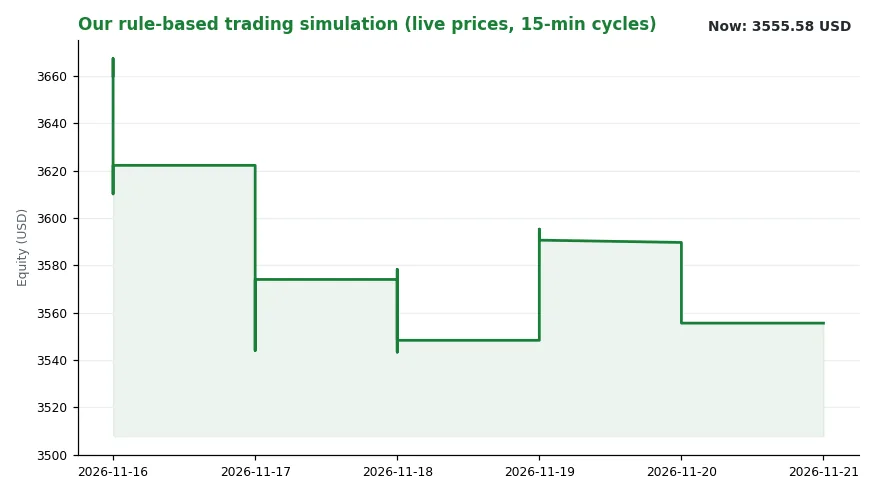
Gold futures GC=F dropped 4.62% to 3515.40, ending near the low end of the session (9% of range) — an asset usually reached for when equity risk is marked down did not behave that way on this tape. Bitcoin went the other direction entirely: BTC-USD at 60102.37, up 2.21%, in the top 10% of its range (90% of range). Our regime reading sits at trend=falling, level=3.63. The simulation book held 3555.58 USD, unchanged against the same time yesterday, with 1798.25 in cash and a latest logged decision of WATCH KWEB at 0.00. The busiest signal channel on 2026-11-20 was ‘central banks’, with one event.
What that combination describes is a rotation inside risk, not an exit from it: technology and index exposure sold at the lows, gold sold at the lows, and one high-beta digital asset bid at the highs. We flag this as our reading of our own measurements, not a forecast.
That is the question a British subsidy scheme put in place almost twenty-five years ago is now being asked to answer.
What the document says
Britain’s oldest renewable energy projects — wind and solar farms built between 2003 and 2014 — are expected to claim £4.5bn in subsidies over the next financial year, according to independent analysis by the Energy Competitiveness Unit (ECU), a non-partisan research and policy project. On top of that £4.5bn sits £4.2bn in wholesale market revenue. Together, roughly £9bn is heading for assets commissioned between 2003 and 2014.
The analysis found that almost a third of the UK’s wind and solar farms that rely on the government’s legacy renewables subsidy scheme are in line for soaring subsidy payments. Developers are set to receive almost 50 % more than they did before Russia’s full-scale invasion of Ukraine sent gas prices up in 2022. Officials, meanwhile, are working on plans to lower the country’s energy costs — which is the awkward part, because this particular cost is paid via taxes and energy bills.
The mechanism is a top-up, and that is the whole story
Unlike newer renewable projects that earn fixed-price subsidies for generation, the older fleet accesses support through the renewables obligation (RO). The RO pays a supplement on top of what a generator earns in the wholesale market. Higher gas prices therefore translate directly into higher subsidy costs for renewables — not as a malfunction, but as a design feature.
Since 2013, new developers have instead been required to compete in an auction for a contract for difference (CfD), fixing a price per megawatt-hour regardless of global markets. The ECU’s verdict on the legacy arrangement is blunt:
[1] The scheme “has been allowed to persist unsustainably” — ECU.
The unit argues reform is needed “if we are serious about getting costs of the electricity system down in the short and medium term. Its alternative is a “fair value CfD”: an entirely fixed-price contract, written as a private law agreement, that the research says would cut electricity costs by £3.8bn next year and £9.2bn over ten years. Such contracts, the ECU adds, could also offer a degree of legal protection against the political risk that a future net zero sceptic government dismantles renewable support — a threat the analysis links to the rightwing populist Reform UK party.
Who pays, who collects, who decides
On the collecting side sit the legacy generators. Andrew O’Brien, the ECU’s director, told the Guardian that the rise in wholesale prices over recent years has meant that many renewable energy developers are earning “well above what they could reasonably have expected” when first taking the decision to invest in the projects. On the paying side sit households and taxpayers, with the government having announced last year that three-quarters of the RO scheme’s costs would move off home energy bills and into general taxation from April 2026. Ministers have also warned that legacy generators could face higher windfall taxes unless they surrender the RO in favour of a new, partially fixed subsidy contract.
The counter-case is not marginal, and it comes with numbers. Tara Singh, chief executive of RenewableUK, said the projects were still helping to keep a lid on bills by “pushing expensive gas off the system. She said: “UCL found wind has saved consumers £100bn since 2010 even allowing for support schemes like the RO by reducing the need for expensive imports.” She added that the windfall tax, which took effect from July, has meant that RO generators pay the Treasury up to 80p of every additional pound they earn from market prices above £82.61 per megawatt hour. “To put this into context, the average wholesale price of electricity over the last 12 months is over £100 per megawatt hour, and frequently higher than that,” she said. “The fastest way to protect consumers from future price shocks is to build more cheap, homegrown renewable power.” The decision sits with ministers, and the chancellor has already picked a side in principle. In his budget speech last month, the chancellor, John Healey, said: “We will further break the grip of international gas prices on our bills by moving more of our old renewables on to fixed-price contracts.” The ECU believes the government’s consultation on fixing the generators’ wholesale revenues “falls short”, and its closing argument is about durability rather than level: “It is in the interests of everyone – investors, generators, businesses, households and government – to get a credible long-term plan in place that can withstand shocks in this increasingly uncertain world,” the ECU said.
What we watch next, and what we do not know
Four things are observable from here. First, whether conversion to a fixed-price contract is voluntary or compulsory, since the research assumes a shift of the entire legacy fleet and the government’s language describes only a partial one. Second, the mechanics of the April 2026 levy transfer, which moves cost rather than removing it. Third, the calibration of the windfall tax against that £82.61 per megawatt hour threshold. Fourth, whether the consultation adopts a subsidy fix alongside the wholesale revenue fix, which is the specific gap the ECU identifies.
Nor can we date the political risk the ECU names: a legal wrapper is a deterrent, not a guarantee.