
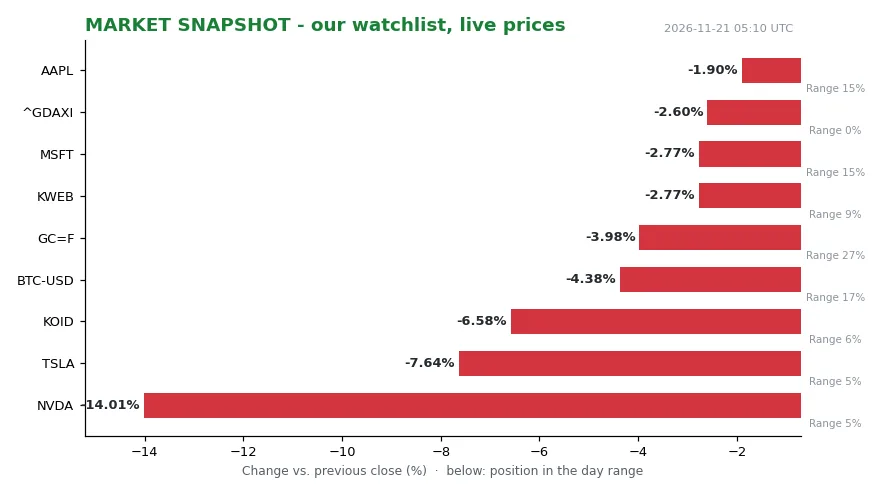
At 05:07 UTC on 21 November 2026 our watchlist was red from top to bottom. Nvidia printed 125.53 dollars, down 14.01 percent, pinned in the bottom 5 percent of its daily range. Tesla traded at 345.82, minus 7.64 percent, likewise in the lowest 5 percent of its range. The DAX stood at 24,802.78, down 2.60 percent, and sat at the exact floor of its range — 0 percent remaining. Microsoft lost 2.77 percent, Apple 1.90 percent, the KWEB China internet ETF 2.77 percent. Bitcoin fell 4.28 percent to 56,288.24. Gold was the exception: 3,539.00 dollars, down 3.98 percent, but holding mid-range at 27 percent. That is not a rotation into safety. It looks like supply meeting a thinner bid across asset classes at once — and our internal label for whether the trend is rising or falling says it in one line: trend = falling, level 3.63.
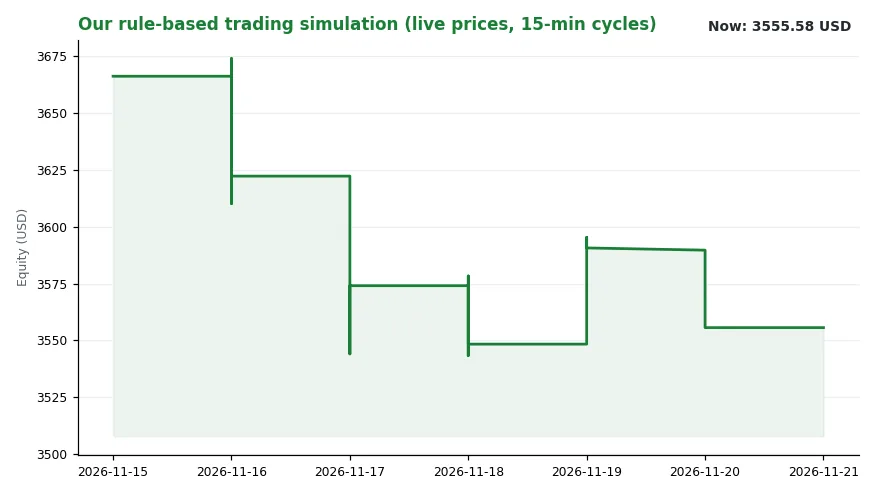
Our rule-based simulated book was unchanged at 3,555.58 dollars, with 1,798.25 dollars in cash. The last logged decision was to watch KWEB at 0.00. The busiest signal channel on 20 November was “central banks”, with a single event. Our own numbers describe the mood. They do not explain it.
A word that does not travel
English has “buyback”. One word, instantly understood, and for four years it described a central flow in the equity market. German has “Kapitalerhöhung”, which names the corporate act but not its market consequence. What neither language offers is an ordinary noun for the thing itself: the additional pile of shares arriving on the other side of the trade. That absence is telling. A flow that no one names is a flow that no one hedges against — it simply shows up later as a percentage.
The seller returns quietly
According to a recent Acadian analysis, the number of new shares sold minus shares retired, across the whole market, equalled 3.1 percent of the total value of all listed shares at current prices as of late last week [1]. Net issuance remains below the peaks reached during the tech bubble and the covid bubble [1]. The level is moderate. The direction is not: the analysis concludes that the era of repurchases has ended and an era of equity issuance has begun [1].
Owen Lamont, portfolio manager at Acadian Asset Management, wrote in a letter to investors this month: “No matter how you measure it, U.S. corporations have changed their behavior over the past two years, switching from repurchasing in 2024 to issuing today” [1]. [1] He followed with a question rather than an answer: “The question you should be asking is: Why is the smart money selling?” [1]
The test case
This week the supply got a headline name. Anthropic sold shares in its IPO at 83 dollars each, above the expected range, raising 81 billion dollars [1]. The offering drew strong enthusiasm at the open [1]. By Friday the stock was falling and taking the broader market with it [1].
Our snapshot cannot establish that Anthropic caused Nvidia’s 14.01 percent slide or Tesla’s 7.64 percent drop. The two events coincided within the same session, and coincidence is not causation.
The channel: quantity, not narrative
The mechanism here is quantity. For four years, companies bought their own stock, which shrank the number of shares available to trade [1]. More money chased fewer shares, and prices had a mechanical tailwind [1]. Repurchases also lifted profit per share by shrinking the denominator of that ratio [1]. Both effects ran in the same direction, quietly, for years.
Now both run backwards. Additional supply has to be absorbed by the same pool of capital, which the Acadian analysis describes as a potential headwind on the bull market [1]. And the denominator that once flattered per-share earnings now dilutes it. No announcement accompanies this shift. It arrives as a line item.
What the academic record says
A 2000 paper by Malcolm Baker and Jeffrey Wurgler found that when companies issued more equity relative to debt, low market returns followed — suggesting managers timed the market when issuing securities [1]. The Baker-Wurgler equity share, which measures equity issuance as a share of total stock and bond issuance, peaked at about 18 percent in 2021, Lamont wrote [1]. It has risen in recent months but remains below that peak, Lamont wrote [1].
Eighteen percent was the extreme, and the current reading sits below it.
The same ladder in Fed data
Federal Reserve data show a similar sequence in the year-over-year change in the total value of stocks and bonds sold over the last four reported quarters, before repayments. Debt gross issuance rose first in 2020, followed by equity issuance in 2021 [1]. More recently, debt issuance began climbing in 2024, followed by a surge in equity issuance in 2026 [1].
The pattern is consistent: debt moves first when rates and cash needs shift, equity follows when prices look generous enough to sell into. Two cycles, same order.
Who is actually issuing
Recent deals show companies tapping equity markets in several formats. Oracle filed to sell 20 billion dollars in stock through a facility that lets a company drip new shares into the market at prevailing prices instead of one fixed placement and issued another 10 billion dollars in common shares in November [1]. In October, Meta priced a 25 billion dollar common-stock offering and 12.5 billion dollars in a hybrid security that pays a fixed dividend and must convert into common stock on a set date [1]. Alphabet announced an 84.8 billion dollar equity raise in June to help fund its AI infrastructure buildout [1]. SpaceX raised 85.7 billion dollars in its June IPO after underwriters exercised their option to sell extra shares beyond the planned amount [1].
Winners, losers, deciders
The issuers gain. They convert an elevated share price into capital for infrastructure spending, and they do so at prices set by the market rather than by a lender. Underwriters gain from the flow. Existing holders carry the dilution, and the marginal buyer must absorb the new paper. The decision sits with boards and finance chiefs, who choose the timing — which is exactly why the Baker-Wurgler finding matters more than any single deal.
Lamont framed the contrast without softening it: “Before 2026, firms were net repurchasers of equity, consistent with the idea that they viewed their shares as undervalued. Today, for whatever reason, firms are issuing equity on net” [1]. [1]
What we watch next
Three things, in order of observability. First, whether the equity share of total issuance keeps climbing toward the 18 percent mark set in 2021 [1]. Second, whether the financing mix for AI buildouts tilts further from debt toward equity, as the 2024-to-2026 sequence in Fed data suggests [1]. Third, whether the newly issued stock holds its IPO price in the aftermarket, since Anthropic’s first sessions are a live test of demand for the added supply [1].
The uncertainty is real and belongs in the record. Lamont wrote that he cannot rule out that we are in an AI bubble now [1]. He also wrote “for whatever reason” about the shift in corporate behaviour — in our reading, an unusual admission in a market letter, and a useful one [1].
Sources
Mentioned organisations (context, not sources)
- Nvidia — Organisation (homepage)
- Tesla — Organisation (homepage)
- Apple — Organisation (homepage)
- Acadian Asset Management — Organisation (homepage)
- Anthropic — Organisation (homepage)
- Oracle — Organisation (homepage)
- Meta — Organisation (homepage)
- Alphabet — Organisation (homepage)
- SpaceX — Organisation (homepage)