Our tape first.
At 11:45 UTC on 24 November our watchlist showed NVDA at 165.05, up 31.48% against the previous close, sitting at 56% of the distance between the day’s lowest and highest price — halfway between the day’s low and high. TSLA printed 385.46, up 11.46%, also mid-range at 62%. MSFT traded at 492.50, up 1.65%, but near the day’s lows, just 3% of its range. ^GDAXI stood at 25,144.90, down 0.76%, near its lows at 23%. BTC-USD fell 2.10% to 59,925.82, at 21% of range. Gold eased 0.66% to 3,627.30. KWEB added 3.33% to 21.41. KOID rose 9.97% to 31.54.
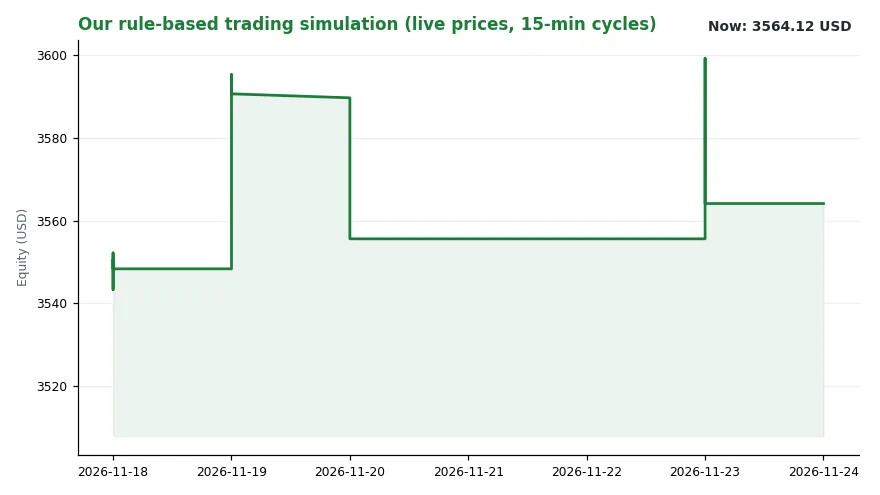
The mega-cap complex is mixed: Microsoft cannot hold its highs even on a day like this, Europe’s benchmark is red, and crypto and gold are leaking. Our regime reading — our internal label for the market’s current trend state — says trend=falling, level=3.63. The busiest signal channel today is “central banks”, with a single event. Our simulated book — a model portfolio, not real money — checked in at 3,564.12 USD, flat versus the same time yesterday, holding 1,800.97 in cash; the latest rule-based decision was WATCH on KWEB at 0.00. We measured the spike. We did not chase it. That is documentation of a process, not a recommendation.
Now the news the spike belongs to.
Nvidia reinstated Jensen Huang as chief executive on Monday, 23 November. Forbes’ real-time billionaires list put the one-day addition to his fortune at about $34 billion (€31bn). Nvidia shares closed 31.5% higher. The company’s market value rose by roughly $950 billion (€871bn). Euronews describes that as the largest one-day gain for any company on record. [1] At Nvidia’s headquarters in Santa Clara, California, employees greeted Huang with cheers, applause and chants of his name. “Thank you all for the second chance,” he told them, in footage shared online. [1] That is the shape of the event: a single security adding $950 billion of market value in one session, on a personnel decision.
Where the $950 billion actually landed
The first channel is index arithmetic. Nvidia is large enough that a 31.5% day mechanically drags every cap-weighted product — an index in which bigger companies carry proportionally more weight — holding it. The Nasdaq Composite closed 6.5% higher on Monday. The S&P 500 gained 4.7%. Both were their strongest sessions since April 2025, and the S&P 500 won back about $3 trillion (€2.7trn) in market value.
The second channel is employee balance sheets. Share-based pay cost Nvidia $6.4 billion (€5.9bn) in the financial year to January, per its annual report. Staff can buy a limited amount of its stock at a discount of at least 15%. Turnover among its roughly 42,000 employees was 3.7% that year. In a 2024 poll on Blind, an anonymous forum for verified tech workers, 76% of Nvidia employees who took part said they were millionaires. More than four in ten put their net worth at $10 million (€9.2m) or more.
Individual holdings are not public. But many staff are likely to still hold much of that wealth in the same ticker, and Monday made it significantly more valuable. More than 10,000 people who claimed to work at Nvidia reportedly signed a petition calling for his return. [1] That is the feedback loop: concentrated stock wealth creates a constituency with a direct interest in who runs the company.
The third channel is political. Trump told CNBC on Monday that he had “convinced” Nvidia’s board. “I made the deal,” he boasted. Nvidia’s statement says the board received “input from senior levels of the United States government”.
In our reading, a board has now put executive-branch input on the record as part of a CEO succession decision — an interpretation of the company statement, not a claim the statement itself makes.
Europe got a smaller lift, and the reason is composition.
Monday’s European session rose, but not parabolically. The pan-European Stoxx 600 added 1.8%. Germany’s DAX gained 2.2%. The UK’s FTSE 100 rose about 1.3%. By Tuesday morning the main European indices were slightly down — our own ^GDAXI reading of -0.76%, near the day’s lows, is consistent with that.
Technology accounts for 9.5% of the Stoxx 600, according to index provider Stoxx. Banks are its biggest sector at 16.2%. Chip stocks such as ASML jumped on Monday. But one or two large holdings cannot transmit a $950 billion single-stock gain the way a tech-heavy index can.
Asia transmitted it better. Taiwan’s Taiex closed 9% higher. South Korea’s Kospi rose 6.3%, back above 5,000 points. Japan’s Nikkei 225, shut on Monday for a public holiday, gained 3.9%.
The winners list is longer than one name.
Forbes’ rankings on Monday showed Elon Musk up $44.1 billion, Michael Dell up $18.3 billion, Oracle’s Larry Ellison up $14.6 billion and Google’s Larry Page up $12.6 billion. Huang was the second-biggest gainer, climbing one place to No. 13 with an estimated net worth of $143.8 billion.
Trump’s own accounts could have held between 32,000 and 370,000 Nvidia shares as of 30 September, per a Financial Times analysis of his mandatory financial disclosures. Assuming no recent change, that would be a gain of between $1.3 million (€1.2m) and $15 million (€14m) on Monday. The filings give only value ranges and do not cover October and November. The White House says his portfolio is run independently by third-party financial institutions.
The backdrop worth stating plainly.
Huang resigned on 12 November after admitting an extramarital affair, as reported by Financial Express. Those reports connect the controversy to Alice Huang, a controlling shareholder of Singapore-based Megaspeed, which the US suspects of being a Chinese spy — reported context, not adjudicated fact. Nvidia shares slid roughly 46% over the following weeks. Forbes put the personal cost at $26 billion in a week at one point. Reports of two further affairs with senior Nvidia employees followed, alongside an FBI investigation and an SEC probe. All of that is reported context, not adjudicated fact.
The calendar now belongs to Washington
On 1 December Huang faces three House committees behind closed doors. On 3 December he appears before a public Senate Banking Committee hearing, a date its chair, Senator Tim Scott, confirmed on Monday.
Those hearings matter to the mechanism rather than to the narrative: they test whether political involvement in a boardroom decision becomes routine, or stays a one-off. That is the input markets cannot read off a spreadsheet. —.
Sources
Mentioned organisations (context, not sources)
- Microsoft — Organisation (homepage)
- Nvidia — Organisation (homepage)
- Forbes — Organisation (homepage)
- Euronews — Organisation (homepage)
- Blind — Organisation (homepage)
- CNBC — Organisation (homepage)
- United States government — Organisation (homepage)
- Stoxx — Organisation (homepage)
- ASML — Organisation (homepage)
- Oracle — Organisation (homepage)