A 15 % Range and 200 Billion Cubic Feet: Two Tapes, One Afternoon
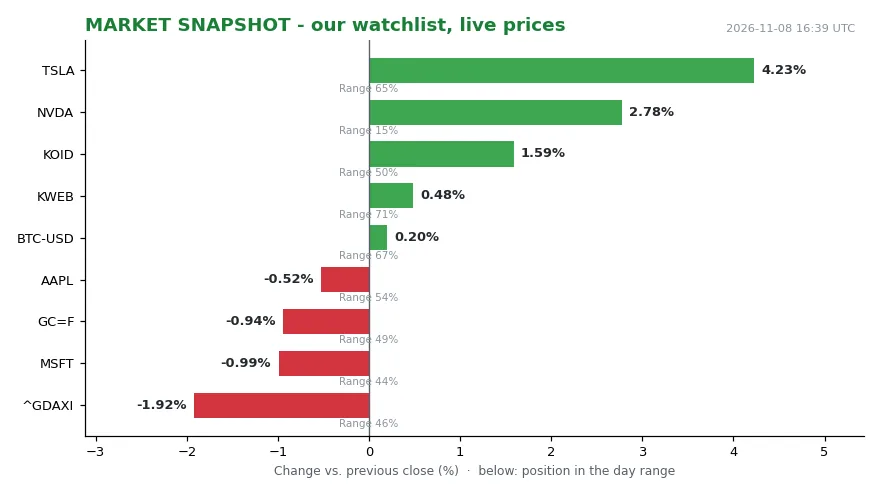
At 16:34 UTC on 8 November 2026 our watchlist was quoting two different markets at the same time. NVDA printed 186.64, up 2.78 % against the previous close, yet the tick sat near the day’s low — only 15 % of the way through its intraday range (the distance between the day’s lowest and highest price). TSLA, in the same minute, ran 4.23 % higher and held the middle of its band at 65 % of range. AAPL eased 0.52 % to 342.37 and MSFT lost 0.99 % to 530.61, both parked mid-range (sitting halfway between that low and high) at 54 % and 44 % respectively.
That combination is the signature of rotation (money leaving one group of stocks and entering another) inside the large-cap complex, not of a broad bid for risk. ^GDAXI fell 1.92 % to 25,820.36, mid-range at 46 %. GC=F slipped 0.94 % to 4,074.90, also mid-range at 49 %. BTC-USD traded at 75,926.76, up 0.23 %, sitting at 71 % of its range, and KWEB at 24.88, up 0.48 %, at 71 % as well. KOID added 1.59 % to 31.97, dead centre at 50 %.
Our regime reading (an internal score describing the market’s direction and strength) for the session: trend = falling, level 3.63. The busiest channel in the signal layer (the account’s tally of news categories feeding the model) on 7 November was “central banks”, with 1 event logged. Simulated equity (a paper-trading record, not real money) stood at 3,723.97 USD, unchanged versus the same time yesterday, with cash of 1,863.17 USD and a latest sim decision (a paper-trading record, not real money) recorded as WATCH KWEB @ 0.00. Quotes were fetched 0 minutes before this reading, all from the same snapshot.
None of those tapes says anything about natural gas. Our watchlist carries no Egyptian equity, no gas futures and no LNG proxy (a listed stock used as a stand-in for liquefied natural gas prices), so the Cairo headline reaches this desk through a separate pipe and has to be read on its own terms.
What Cairo actually announced
Egypt’s Ministry of Petroleum and Mineral Resources said on Friday that a new natural gas discovery had been made in the Mediterranean Sea, with initial estimates pointing to around 200 billion cubic feet in the reservoir of the exploratory well (the first hole drilled to test whether hydrocarbons exist) “Nasim-1X” [1]. The well lies in the Taiba concession area (a licensed exploration area granted by a state). Drilling and appraisal work there revealed a gas-bearing layer with a net thickness (the portion of a rock layer that actually contains gas) of roughly 15 metres, featuring what the ministry described as distinct geological and petrophysical characteristics (the measurable properties of the rock, such as porosity and permeability) [1].
The number that is conspicuously absent is production. Technical and reservoir studies (the engineering work that estimates how much can be recovered) are still under way to determine the volumes that can actually be produced, to assess possible daily production rates and to evaluate the commercial viability of the find [1]. No date for the start of production has been announced [1].
On infrastructure, the plan is concrete but not yet built: the well is to be connected to existing production facilities through a pipeline of about 22 kilometres, linking it to the Abu Madi - El Gamil pipeline [1]. The stated purpose is to lean on infrastructure that already exists and to shorten the time needed to begin producing [1].
The operating structure is a partnership. Italian company Eni operates the Taiba concession together with Australian company Woodside, while Egyptian firm Petrobel carried out the drilling work on behalf of the partners [1].
Egypt has been trying to lift domestic gas output after a decline in recent years pushed the country toward greater dependence on imports to meet market demand [1]. Cairo is counting on new discoveries and faster exploration work to strengthen local supply, with strong demand coming from the electricity and industrial sectors [1].
Attribution for the positive result goes to the investment side. The Ministry of Petroleum linked the outcome to higher investment and exploration activity, pointing to an improved investment climate and to progress in settling overdue financial receivables (invoices owed but not yet paid) owed to foreign companies working in the energy sector [1].
The channel: physical barrels, not discount rates
This does not travel through the interest-rate channel, and it does not travel fast. The mechanism is supply and demand with a multi-year lag: a reservoir estimate in the ground has to become producible volumes, then daily rates, then molecules in a pipeline, before it displaces a single imported cargo. The ministry’s own framing puts import substitution (replacing purchased foreign gas with domestic output) at the centre of the intent — Cairo hopes the discovery will support domestic gas production and reduce reliance on imports [1].
A second, quieter channel runs through capital allocation. The receivable settlements the ministry cites matter less for this well than for the next one: payment discipline is the signal that tells international partners whether to keep funding Egyptian drilling programmes [1].
Until the reservoir study lands, the honest statement is that Egypt has found gas and does not yet know how much of it can be sold.
Who gains, who waits
Eni and Woodside hold the partnership position, with Eni as operator [1]. Petrobel did the drilling and carries the field-services role [1]. Egyptian electricity users and industrial consumers are the sectors the ministry cites as driving demand [1]. Foreign energy companies are owed the overdue receivables the ministry says are being settled [1].
A well that is not yet connected to a 22-kilometre pipeline is not yet supply.
What we watch next — and what we cannot see
The next verifiable checkpoint is not a price target but a document. When the ministry publishes producible volumes and possible daily production rates, the 200 billion cubic feet stops being a headline and becomes a flow. A production start date would be the second marker, and progress on the tie-in (the physical hook-up of a well to an existing pipeline network) to the Abu Madi - El Gamil line the third [1]. On the investment channel, further news on receivable settlements is the thing that would tell us whether exploration budgets follow [1].
On our own tape (market parlance for the stream of live quotes), the questions are narrower. The regime line still reads trend = falling at level 3.63. The busiest signal channel remains “central banks”, which is a reminder that the macro story and the Mediterranean story are running on different clocks — one in minutes, one in quarters.
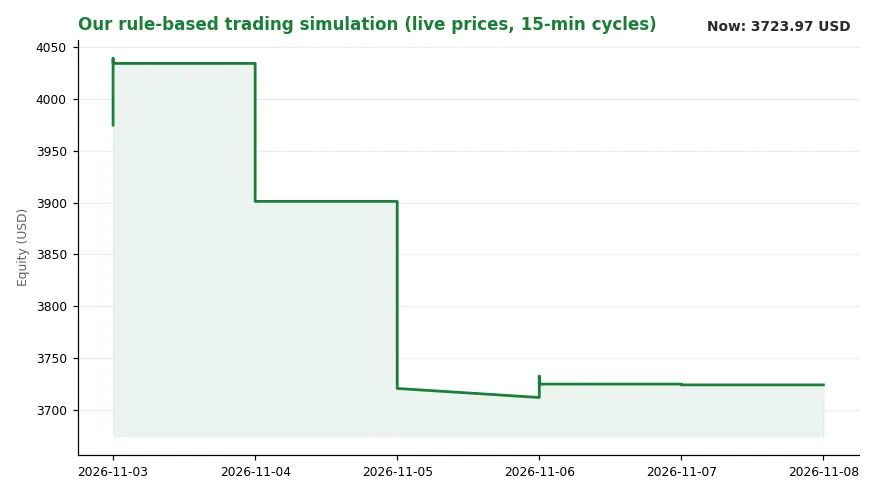
We hold no position in any name discussed here, and nothing above is a recommendation to buy or sell; this is documented observation, including the flat simulated equity line and the standing WATCH decision. The uncertainty is genuine and specific: the reservoir estimate may be revised, the timeline may slip, and the import-substitution effect may be smaller than the announcement implies.
Sources: [1] Egypt’s Ministry of Petroleum and Mineral Resources announcement on the Nasim-1X discovery, as reported by Euronews. All market figures from our own measurement of 8 November 2026, 16:34 UTC.