BrewDog Brand Sold For 33m As Creditors Owed 190m
Dog Alongside the Tape
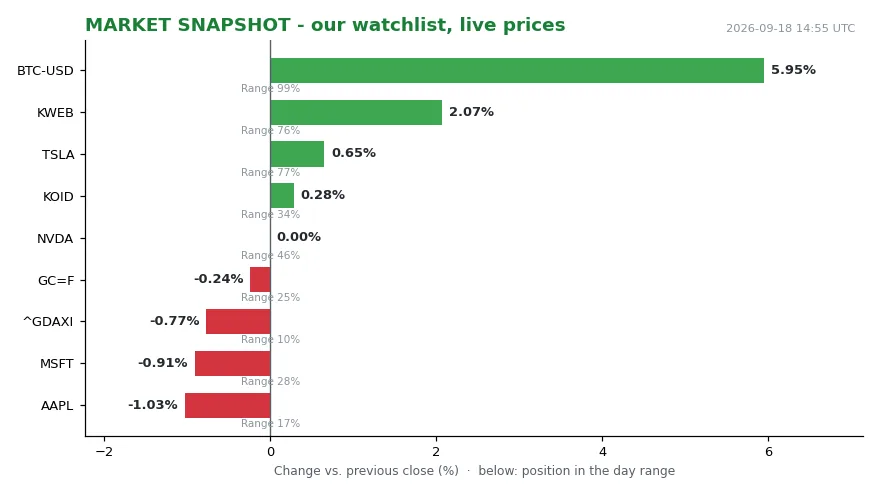
The tape offers a catalogue of positions that share one timestamp but not one direction. NVDA printed 219.22, a change of -0.05 % against the previous close, sitting mid-range at 41 %. AAPL traded at 333.16, down 1.14 %, pressed against its day lows at 11 % of range. MSFT stood at 491.54, off 1.25 %, at just 6 % of range. TSLA at 366.56 was up 0.10 %, mid-range at 57 %. BTC-USD at 80770.90 rose 5.79 % and sat at 97 % of its range, effectively on the highs. GC=F at 4385.70 slipped 0.32 %. The DAX at 25348.52 fell 0.74 %. KWEB at 24.86 gained 1.91 %. KOID at 35.37 added 0.28 %.
The tape first
That list is one pattern rather than nine separate stories. The softest prints cluster in US mega-cap technology, both in direction and in position inside the daily range. The strongest print is crypto, and the second-strongest is Chinese internet exposure. That is a rotation signature, not a broad risk-off signature. Capital appears to be leaving one pocket of large-cap growth and looking for another, with gold barely changed and the German index mildly lower.
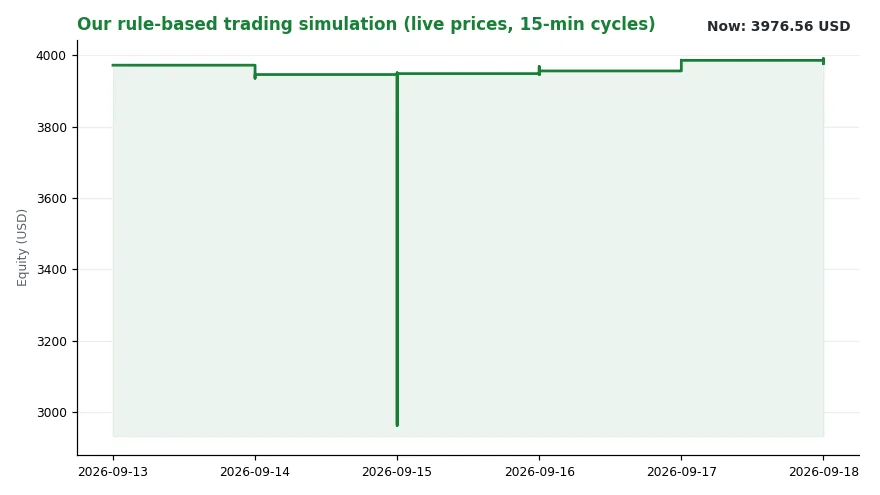
The book run alongside this desk reflected the same hesitant mood. Sim-Equity stood at 3976.56 USD, down 0.22 % since the same time a day earlier, with cash of 1987.26. The last recorded decision was OBSERVATION on KWEB at 0.00, because the price sat at 60 % of its range against a buy threshold of below 35 %. The regime reading was trend falling, level 3.63. The most active sign layer on 2026-09-17 was the central bank channel with 3 events.
The BrewDog news sits beside that tape and the silence is notable. The collapse of a self-styled punk beer company does not appear in any of those tickers. Administrators at AlixPartners confirmed on Thursday that creditors owed more than £190m are unlikely to be repaid. [2] The mechanism is not hidden. It is filed.
What the file says
This is why the story deserves attention beyond beer. It is a documented case study of what happens when a consumer brand built on narrative meets an administration waterfall. Unsecured creditors will receive less than a penny in the pound. Among them are Lord’s Cricket Ground, West Ham United FC and Manchester University. [3] A cricket ground, a football club and a university, all queuing at the same empty till.
The rescue deal set the ceiling for everything that followed. The US cannabis and drinks company Tilray acquired BrewDog’s brand, intellectual property, UK breweries and 11 bars for about £33m, agreed after the brewer entered administration. [6] That transaction in March excluded most of the bar chain. Thirty-eight bars closed. Four hundred and forty staff lost their jobs.
The £33m received compares with more than £190m claimed. That gap is the central fact.
The equity layer is where the story turns bitter. Around 200,000 “equity punks” had crowdfunded the business, and their investments were rendered worthless. [1] Crowdfunded equity was unsecured. The shareholder claim was not reduced. It is erased.
AlixPartners offered two specific reasons on the cost side. One was the expense of removing “unauthorised occupiers” from BrewDog’s shuttered bars. [2] The other was the limited sums recovered from asset sales, including vehicles it described as being of “old age and varying roadworthiness”. [2]
The waterfall, line by line
Preferential creditors of the bars business, the group meant to be paid ahead of the queue, include the UK government. Even they will not be made whole. Staff owed £489,000 in wages and holiday pay have already been compensated under the government’s redundancy payment scheme. [7] That compensation was paid. The workers are paid.
The tax picture splits in an instructive way. There were not enough funds to repay the government, nor to pay £2.4m in taxes owed to HM Revenue and Customs. [7] A separate sum of £3.6m owed to HMRC will be repaid. [7] Two claims, two outcomes, one estate. Preferential status did not guarantee payment. It was a better place in the queue.
The institutional investors did not escape either. Private equity investor TSG bought a 22 % stake for £213m in 2017. [8] That investment was wiped out, and debts of nearly £28m will not be recouped. [8] Lender HSBC is expected to recover about £42m of about £61m it is owed. [9] A secured bank recovers roughly two-thirds; an equity holder with 22 % recovers nothing. The distance between those two outcomes is the lesson of capital structure.
Control in an administration sits with the administrators. Tilray decided which assets were worth buying. The 200,000 crowdfunders held neither control nor security.
The founder thread
Then there is the part that keeps the story alive after the filing. James Watt, who co-founded BrewDog with Martin Dickie in 2007, said he was left “heartbroken” by the collapse. [1] His tenure was marked by controversies, including criticism of dubious marketing stunts and an allegedly “toxic” working culture, for which he apologised. He has since launched several businesses, among them Social Tip, which pays people to post about brands on social media.
After being rebuffed in a bid to buy BrewDog back, he launched a new beer business, Second Best, and offered former BrewDog investors free shares in it. [10] Multiple recipients complained to the Information Commissioner’s Office, the data privacy regulator, saying they were concerned Watt had not obtained their contact details legally. Watt has denied any wrongdoing.
That is where regulation enters the mechanism. Data protection law governs how a founder may contact an investor list created inside a company now in administration. If the complaints proceed, the ICO question is procedural rather than commercial.
What to watch
What should we watch next, stated honestly? The ICO complaints are the clearest open thread, and their outcome is unknown. Any further recovery on the £2.4m HMRC shortfall depends on what remains in the estate, and the administrators have already said the funds are insufficient. Whether the £33m paid for brand and breweries was fair value is not something an outside reader can verify from the progress update. Whether creditors such as Lord’s and Manchester University act collectively is unstated.
The update tells us what will not be paid. It does not give the final tally, and final tallies can move.
The sharper question is not a verdict on one brewery. If a brand can raise money from 200,000 people and then settle its core assets for £33m, while a university and a cricket ground receive under a penny in the pound, what exactly did those backers own? And if the answer is the bottom of a queue they could not see, the next question is who is obliged to show them the queue before they join it.
Sources
1. BrewDog
2. AlixPartners
6. Tilray
8. TSG
9. HSBC
10. Second Best