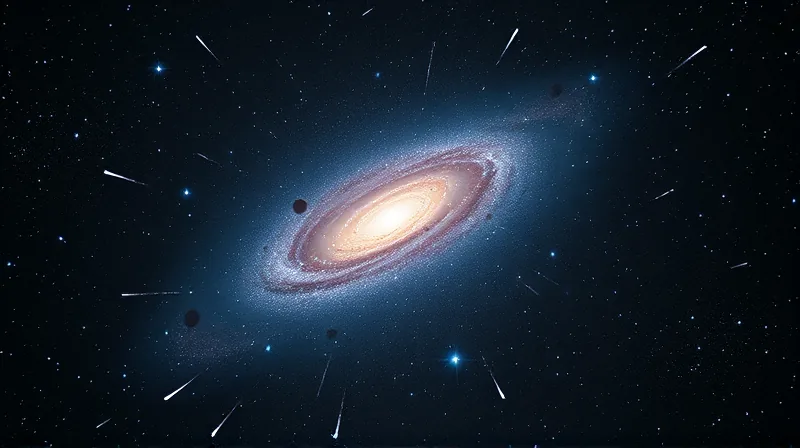
Small Vessels, Heavy Cargo
A galaxy one tenth the width of our own should, by any intuition of scale, matter one tenth as much. [1] The Milky Way spans roughly 100,000 light years and holds hundreds of billions of stars; dwarf galaxies stretch across about a tenth of that distance and carry only a few billion stars. And yet these small vessels are the most common type of galaxy in the entire universe. Rarity belongs to the giants. The ordinary citizen of the cosmos is the dwarf.
NGC 4449 is one of them, and the Hubble Space Telescope has turned its mirror on it. [1] What comes back is not a picture of scarcity but of imbalance: this galaxy, and others of its kind, hold less oxygen than the models say they should. The deficit is the finding. Everything else follows from trying to explain where the oxygen went.
The candidates are the galaxy’s own engines. Stellar winds stream outward from its stars, and supernovae detonate within it. Both push gas outward. The models had already accounted for that push. The surprise is the strength of it — the missing oxygen suggests these outflows are surprisingly effective at blowing heavy elements away.
The Elements That Leave Are the Elements That Build
Oxygen is not the point in itself. Oxygen belongs to a broader category — the heavy elements, the material from which stars, planets, and life are assembled. So the question of missing oxygen is really a question about construction material: where does the raw stock of future worlds go when it leaves the galaxy that forged it?
The answer the observation supports is that dwarf galaxies export it. Their winds and explosions do not merely rearrange gas inside a closed box; they expel it beyond the galaxy’s own bounds. What they lose locally, they scatter globally.
This reframes the dwarf from a footnote into a conduit. If dwarfs are the most common galaxy type, and if they are unusually efficient at shedding heavy elements, then a large share of the universe’s building blocks may pass through them on the way to somewhere else. The picture is of tiny galaxies that may play a big role in spreading heavy elements throughout the universe.
How Far the Explanation Still Has to Travel
The claim rests on a comparison between what the models predict and what the telescope measures, and that gap is the entire evidence base. The mechanism — winds and supernovae blowing oxygen out — is what the missing oxygen suggests, not something the telescope watched happen.
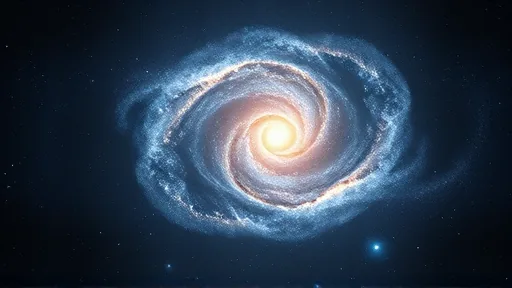
That distance between inference and observation is the honest measure of where this stands. The numbers are concrete: a tenth the diameter, a few billion stars, and less oxygen than the models predict. [1] The interpretation — that these galaxies spread heavy elements across the universe — is the step the data point toward rather than prove. The small galaxy may play a big role in spreading the building blocks of stars, planets, and life. The accounting of how far that impact reaches is still open.