
A Two-Day Bill, Set Against Four Weeks
“The best-laid schemes o’ mice an’ men / Gang aft agley.” — Robert Burns, 1785 The line is 241 years old. What it carries is older still: short events do not stay small.
Our tape, 05:28 UTC
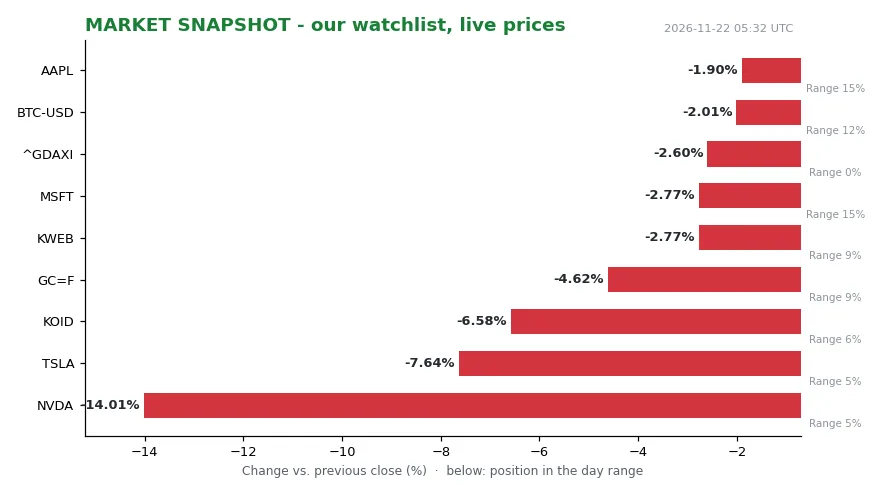
At 05:28 UTC on 22 November 2026 our watchlist was red from top to bottom. NVDA printed 125.53, down 14.01% against the previous close and at 5% of its daily range — the distance between the day’s high and low, so near the day’s low. The German DAX stood at 24802.78, down 2.60%, at 0% of its range, which is precisely the low. Gold traded at 3515.40, down 4.62% and at 9% of its range. TSLA fell 7.64% to 345.82, also at 5% of its range. AAPL lost 1.90% to 342.56 and MSFT 2.77% to 484.52, each at 15% of its range. BTC-USD sat at 58824.24, down 2.11%, near its lows. KWEB changed hands at 20.72, down 2.77%. Five asset classes, five different reasons to own them, one direction. This does not look like money moving from one sector into another. It looks like money moving to the exit. The breadth — how widely a move is spread across many assets rather than concentrated in one — matters more than the depth of any single line. Gold falling with equities rather than against them is the part worth noting: the classic hedge — an asset held to offset losses elsewhere — was sold too.
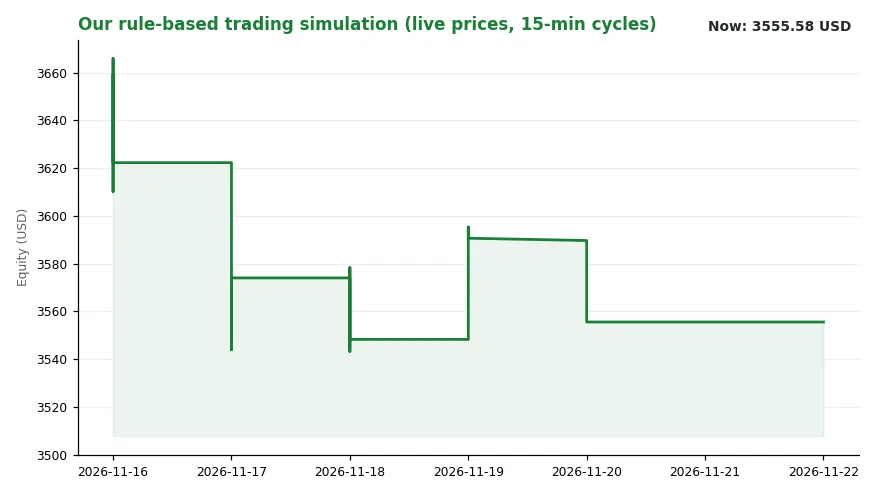
Our simulated book — our paper-trading portfolio, not real money — held 3555.58 USD, unchanged against the same time yesterday, with 1798.25 in cash. The last logged decision was WATCH KWEB at 0.00. The busiest signal channel of the day — the news category our system counts events in — was “central banks”, with 2 events. Our regime reading, our model’s label for the market’s trend state: trend falling, level 3.63.
Not one of those figures measures a riot in France. Nothing in our data isolates a French event, and we will not pretend otherwise. What the tape does tell us is the condition of the receiver. A market already sitting at its daily lows, with no bid for gold, has little cushion left for incremental bad news.
What France Assureurs counted
France Assureurs, the French insurance industry body, published an initial assessment of the unrest and looting around cost-of-living protests on 17 and 18 October. The insured damage could reach €207 million across 5,280 claims. [1] The estimate rests on data available as of 12 November. More than 95% of the total, or €198 million, relates to damage to business property, spread over 4,050 claims. Damage to individuals’ property could reach €3.5 million across 370 claims. Vehicle damage could reach €6 million across 860 claims.
Florence Lustman, president of France Assureurs, said: “The cost of the urban violence on 17 and 18 October is particularly high in view of the brevity of the events”. [1] The body placed the figure against two benchmarks. The 2005 riots cost insurers €209 million over four weeks. [1] The 2018-2019 Yellow Vests movement cost €256 million over several months.
That comparison is the substance of the story. A disturbance measured in days produced insured damage within a few percent of a disturbance measured in weeks. The long-running argument about urban damage has always turned on duration — the assumption that cost scales with the calendar. This estimate tilts the balance toward intensity instead. Two days can bill like four weeks.
The government’s side of the ledger
The rules for grants were published in the Official Journal. They cover eligible businesses with fewer than 50 employees that suffered damage during the urban violence in October and November. Grants run from €1,000 to €10,000. Applications go through the Démarche numérique platform no later than six weeks after the date of signature of the decree. The decree was signed on 19 November 2026 and covers demonstrations held between 17 October and 19 November 2026, the day it was signed. In each region, a committee chaired by the regional prefect — the state’s appointed representative in a French region — or their representative will review local applications. Decisions are case by case. The committee weighs the scale of operating losses, the nature and extent of the damage, and eligibility for other national or local support schemes, deciding case by case. Local authorities in the worst-affected areas have released emergency funds of their own. Bpifrance — the French state-backed business bank — offers affected shopkeepers an interest-free loan of up to €50,000, including money to restock ahead of Christmas.
Where the loss actually lands
The transmission channel here is not the equity market. It is insurance retention and public budgets. An insured loss of €207 million is absorbed first by deductibles and then by premiums at renewal — the price an insurer sets when the policy comes up for renewal. Deductibles are the first slice of every claim. The grant ceiling of €10,000 covers a fraction of a shopfront refit; the loan of €50,000 covers liquidity, not loss. The remaining gap stays with whoever was underinsured — covered for less than the actual loss.
Three balance sheets carry the bill. Insurers carry the claims. Regional prefectures and local authorities carry the grants and the emergency funds. Small firms carry the deductibles, the uninsured remainder and the lost trading days.
Who gains, who pays, who decides
Repair and reconstruction trades gain work. Insured businesses with business-interruption cover — insurance that pays for lost trading while a business is closed — recover more than those without. Bpifrance borrowers gain cheap liquidity at the exact moment stock needs financing before Christmas. Uninsured and underinsured small firms lose, and some lose twice: damage plus the trading days around it. Insurers lose on claims and face repricing pressure on the policies they renew. The deciding body is neither the insurer nor the ministry. It is the regional committee chaired by the prefect or their representative, working case by case through a six-week window.
What we watch next
First, revisions. The €207 million is an initial assessment drawn from data as of 12 November, and initial assessments move. Second, the application flow through the Démarche numérique platform inside the six-week deadline. Third, whether awards cluster at the €1,000 floor or the €10,000 ceiling, which would show how the committee reads severity. Fourth, whether the 2005 and Yellow Vests comparators survive as the benchmark once claims close. Both benchmarks come from the same industry body that produced the new estimate, which makes them a consistent yardstick rather than an independent check.
On our own screen we watch two things. Gold’s decline: if the hedge keeps falling alongside equities, the market is funding itself rather than hiding. And the central-bank channel, the busiest signal line of the day. We hold no view on direction, and nothing here is a recommendation.
Uncertainty deserves naming. We do not know whether the unrest recurs, and we do not know how much of the €207 million will be paid versus disputed.
The coldest fact is arithmetic. Two days of unrest. 5,280 claims. The total could reach €207 million, of which more than 95% relates to business property. The 2005 riots took four weeks to reach €209 million. That is the claims record as of 12 November 2026.