
Pensions Markets and the Arithmetic of Courage
Meta commentary - no external expert source; basis: Theguardian (2026-09-25). #MetaEconPol
“The best-laid schemes o’ mice an’ men gang aft agley,” wrote Robert Burns in 1785. Two hundred and forty-one years on, the line still describes a spreadsheet.
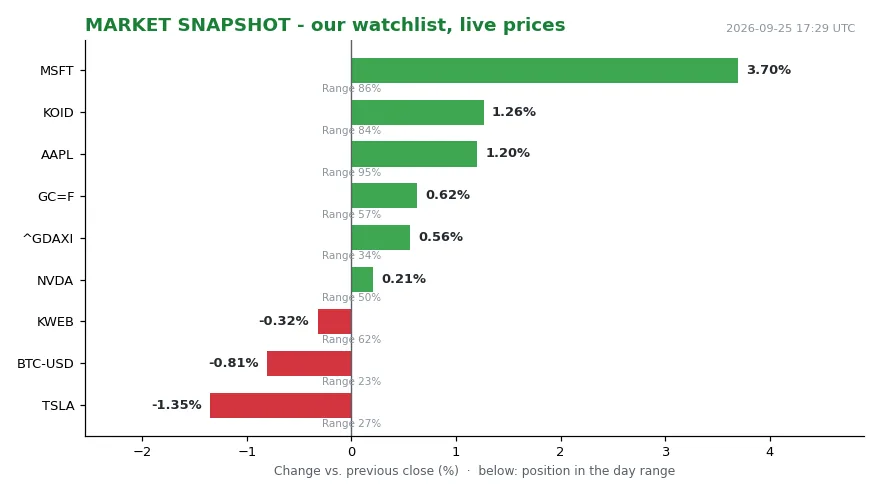
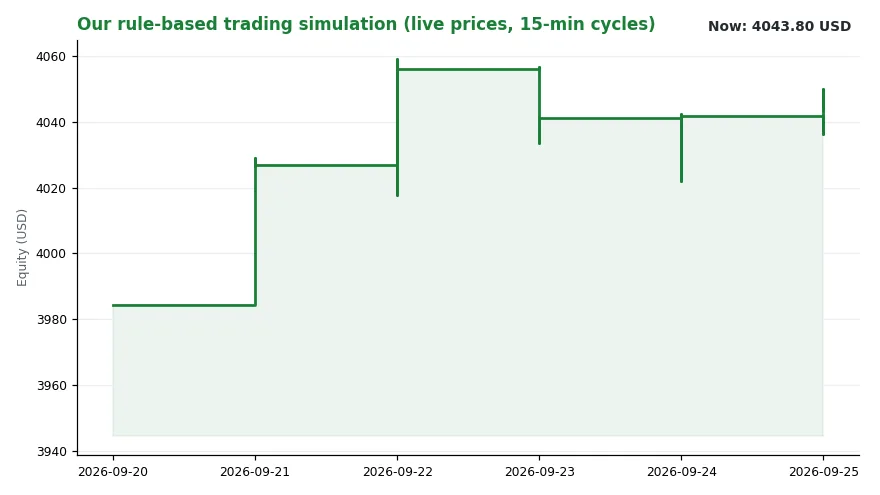
Microsoft traded at 516.69, up 3.77%, near day highs at 88% of its range. Apple printed 339.65, up 1.11%, even closer to the top at 90% of range. Tesla slipped to 372.57, down 1.42%, low in range at 26%. Bitcoin stood at 83,886.02, down 0.58%, mid-range at 32%. Gold traded 4,327.30, up 0.68%, mid-range at 61%. The DAX sat at 25,408.64, up 0.56%. Our simulated equity book closed at 4,043.80 USD, up 0.05% versus the same time yesterday, with 2,195.96 USD in cash. The latest rule-based decision was a buy in TSLA at 372.67 on 2026-09-25 at 18:30:10. The busiest signal channel on 2026-09-24 was “central banks,” with two events. The regime reading says trend=falling, level=3.63.
Money is paying up for large, cash-generative franchises. It is stepping back from the most speculative edges. And the trend label still says falling, which is the caveat under the calm.
That tape is the backdrop for a quieter British argument, and the argument is about pensions. Gaby Hinsliff argued on 22 September that Britain needs cash and that the triple lock should break. Readers of the Guardian letters page answered her.
The dispute is not whether public policy should subsidise wealth without limit. Almost everyone agrees it should not. The dispute is where to aim the cut. Stephen Richardson of Grange-over-Sands makes the sharper point. Most pensioners are not affluent, he writes. A quarter of them need benefits on top of the state pension just to survive and keep a roof overhead. Breaking the lock therefore misses the target it claims to hit. If the aim is to stop subsidising wealth, look at private pension tax relief instead.
Here is the mechanism, in plain numbers. A taxpayer paying 100 pounds into a pension receives 40 or 45 pounds of relief at higher or additional rate. A basic-rate taxpayer receives 20 pounds. The central figure in this debate is 20 %. Tax and national insurance relief on private pensions costs the government 84 billion pounds a year. Almost three-quarters of that flows to the wealthiest 20% of taxpayers, because they save the most and receive the largest relief per pound. A flat 20 % rate would preserve the incentive for basic-rate savers. It would cut the extra subsidy concentrated at the top. It is also fair on drawdown, because the Treasury recovers far less tax later, pushing the net cost above 50 billion pounds a year. Set against the triple lock, the political arithmetic changes.
The lock itself works on a simple rule. It raises the state pension by whichever is highest: inflation, average earnings, or 2.5%. That floor mattered only when both inflation and earnings growth sat near zero. Today both run above 2%, and they are expected to keep running above it. When that holds, the floor is inert. The gap between the lock and a conventional uprating mechanism narrows to almost nothing.
Bob Vickers of Twickenham spots the deeper flaw. He wants the earnings link smoothed. Between 2011 and 2026, prices rose 60% and earnings rose 66%. Pensions rose 89%. That is the ratchet. Some years prices outrun wages. Other years wages outrun prices. The highest of the three wins every time, so the pension beats both benchmarks and climbs the league table. A five-year average would hold pensioners where they are and stop the climb.
David Purdy of Stirling offers the institutional fix. The lock already did its work: the ratio of state pension to average earnings rose from 18% in 2010 to about 30% now. He would announce the end in the coming budget. Then he would hand the replacement question to a time-limited, cross-party commission. The state pension, he argues, should not be a political football or a short-term fiscal fix.
The arithmetic meets the human ledger here. Chris Phillipson, emeritus professor of sociology and social gerontology at Manchester, warns against the easy cut. [1] Future retirees will have smaller cushions than baby boomers. That is exactly why the lock still functions as a bulwark against poverty. The Pensions Commission interim report, on 2025 figures, found 43% of working-age people undersaving for retirement. [1] Only 25% of working-age Bangladeshis and Pakistanis participate in a pension scheme. Self-employment is rising, and the self-employed are the group least likely to save. Millions in their 40s and 50s face poverty in retirement, given precarious work and continuing age discrimination. His alternative is not to break the lock but to attack the reasons it exists: low incomes, insecure employment, expensive housing.
Ingrid Marsh of Newton Abbot supplies the personal accounts. She draws a state pension plus two small ones, from the Ministry of Defence and the NHS. If her husband dies first, she does not know how she would survive financially. They own a small cottage, and downsizing would not yield a significant profit. Her inheritance from her parents vanished when her mother entered care with Alzheimer’s and the house had to be sold. She notes that the same week a billionaire tax avoider criticised the country. She asks why the tax system, and the very rich who pay very little into it, go unmentioned. Richard Murphy, emeritus professor of accounting practice at Sheffield, sharpens that question. Relief above the basic rate for the highest earners costs at least 15 billion pounds a year, he writes. [1] That is far more than the costs attributed to the lock. He adds the monetary point: if the government needs money, it has the power to create it.
The open questions are whether the coming budget touches the lock or the relief rate, whether a cross-party commission is actually created with terms and a deadline, whether the flat 20 % idea gains a sponsor in government rather than only in a letters column, whether gilt supply and long yields react, and whether the wealthiest-20% share of relief is re-estimated after any change. Each is unresolved, and each could move either way.
Sources
Mentioned organisations (context, not sources)
- Microsoft — Organisation (homepage)
- Apple — Organisation (homepage)
- Tesla — Organisation (homepage)
- The Guardian — Organisation (homepage)
- University of Manchester — Organisation (homepage)
- Ministry of Defence — Organisation