
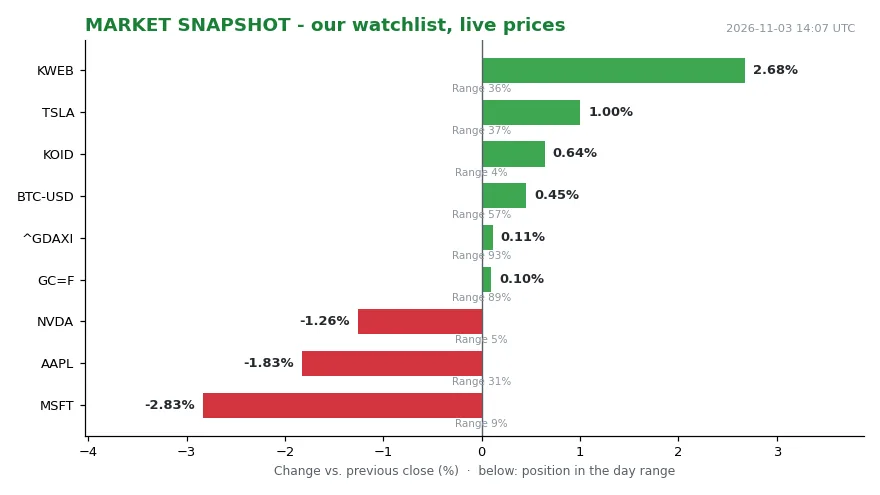
At 14:02 UTC on 3 November our watchlist had Microsoft at 507.12, down 2.83% and sitting at 9% of the distance between its day’s high and low — close to the day’s low. Nvidia printed 202.06, off 1.26%, at 5% of the distance between its day’s high and low. Gold traded at 3,974.20, up 0.12%, at 90% of the distance between its day’s high and low. The German blue-chip stock index (DAX) stood at 26,035.58, up 0.21%, at 100% of the distance between its day’s high and low — the top of the day’s band. Our simulated portfolio read 3,974.83 USD, flat against the same time yesterday, with 2,010.81 in cash; the latest automated trading signal was logged as WATCH on the China internet ETF (KWEB) at 0.00.
The pressure is not evenly spread. It sits on the large US technology complex and it does not sit on gold, on German equities, or on bitcoin, which traded at 77,276.06, up 0.77% and at 76% of the distance between its day’s high and low. Apple was off 1.83% in the middle of the distance between its day’s high and low, Tesla up 1.00%, the China internet ETF up 2.68%. Our model classified the market as falling, at level 3.63. That is the market price action onto which Anthropic’s updated registration document for a public offering landed on Monday.
And the document is not shy. Its risk section carries a line in capitals: “REVENUE GROWTH MAY NOT BE SUSTAINABLE” [1].
What was actually filed
Anthropic, the US company behind the Claude models, brought in $17 billion (EUR 15.1bn) in the third quarter, up 47% on the previous quarter and more than twelve times its sales a year earlier [1]. Then the turn: a loss from core operations before financing and tax items of $567 million (EUR 506mn), against a $974 million (EUR 870mn) profit in the second quarter. Part of the swing came from $5 billion (EUR 4.46bn) spent on short-term computing capacity, bought when demand outran its long-term deals and which, in the filing’s own words, “currently costs significantly more” [1]. A $2 billion (EUR 1.78bn) non-cash charge for a programme matching staff donations did the rest [1].
A non-standard operating-profit measure was $2.5 billion (EUR 2.23bn) — profit equal to 15% of revenue, down from 19% in the prior quarter. Net loss reached $23.3 billion (EUR 20.8bn). Over nine months the company lost $104 billion (EUR 92.9bn) on revenue of $33.2 billion (EUR 29.6bn), of which $94.3 billion (EUR 84.2bn) was non-cash, driven by debt that can convert into shares rising in value alongside the company [1].
The number that matters is not the loss. It is $895.4 billion (EUR 800bn) in purchase and lease commitments, mostly for computing — almost seven times the $131.8 billion (EUR 117bn) in cash and short-term investments held at the end of September [1]. About $70 billion (EUR 62.5bn) falls due within twelve months, around $450 billion (EUR 402bn) by the end of 2030, and some $214 billion (EUR 191bn) can be cancelled or depends on conditions being met [1].
The mechanism: data-center processing capacity is the locked-in cost structure
Compute and infrastructure expenses ran to $8.945 billion in the first half, about 55% of revenue [1]. Revenue itself went from $1.2 billion to $16.286 billion year on year over those six months — which is why capital keeps arriving [1].
The mechanism runs through commitments, not sentiment. A company that books multi-year data-center processing capacity obligations converts a growth story into costs locked in before revenue arrives. That curve has to be financed before it produces a return, and the financing now depends on a public price. The commitment schedule is what an investor in a listed Anthropic would be underwriting alongside the models.
Two smaller channels are worth naming. First, enforcement: the filing estimates 5% to 7% of nine-month revenue came from customers breaking usage rules or commercial terms, and warns that cracking down “may reduce our overall revenue and growth rates in future periods” [1]. Second, safety governance: Anthropic says it “may imminently meet” its own threshold for “dramatically accelerated progress attributable to AI” — AI building more capable AI — a process it flags “could also pose a considerable safety risk” [1]. No current model has been designated as crossing that line [1].
Who wins, who waits, who decides
Anthropic wins time, if not yet profit.
Two funds using borrowing or derivatives for amplified exposure, one long and one short, were filed before trading even began.
The filing states the company does “NOT EXPECT TO PAY ANY DIVIDENDS IN THE FORESEEABLE FUTURE,” and separately warns it “MAY BE REQUIRED TO SEEK ADDITIONAL FINANCING SOONER THAN WE CURRENTLY ANTICIPATE” [2].
The deciders are the buyers in a pre-IPO investor marketing process that has not started. Anthropic made its prospectus public on 26 October and plans to trade on Nasdaq under the ticker ANT, though it has yet to set a price range or a share count [1]. US securities rules require companies to publish their prospectus at least 15 days before starting a roadshow, which means Anthropic could start marketing its shares as soon as next week and list from the week of 16 November [1].
If the AI complex is being re-priced for spending discipline, as our 3 November readings hint, then a listing that monetises that same spending faces a different reception than it would have three months ago. That is a same-day correlation, not a proven cause.
What to watch next
Four things, in order. First, the expected IPO offer range and the number of shares offered — the real translation of a private fundraising value into a public one. Second, whether the 15-day clock turns into actual pre-IPO investor marketing next week, with a debut from 16 November [1]. Third, the first weeks of trading against that unusual post-IPO restriction on selling shares, because early supply is a mechanical force, not an opinion [2]. Fourth, the fourth-quarter growth rate: revenue more than doubled from the first quarter to the second, and preliminary October figures already pointed to cooling [1].
The uncertainty is not decorative. A 5% to 7% slice of revenue sits with customers the company is now policing [1]. And the difference between a $693 million operating loss and an $80.748 billion net loss for the six months ended 30 June 2026 is mostly a $72.388 billion fair-value adjustment on convertible financing instruments — real accounting, no cash out the door, and no help at all in telling what the shares are worth [2].
