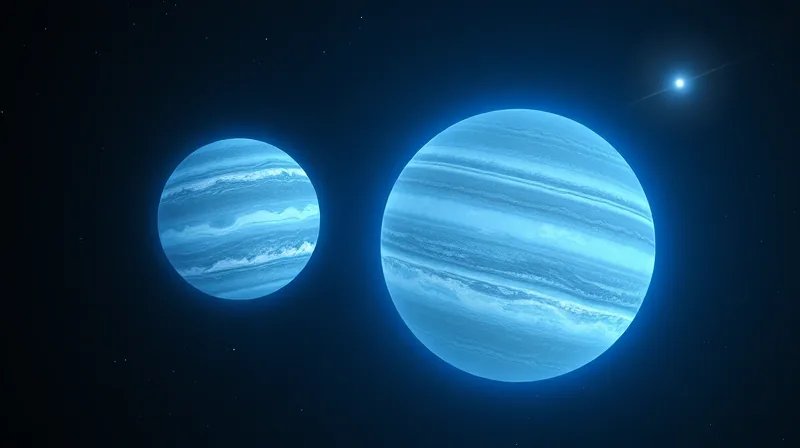
Two super-puff planets as light as shaving foam
Planets as puffy as fresh foam
For decades, astronomers assumed that planets as large as Jupiter must be dense, with thick atmospheres and heavy cores. That assumption now has a crack in it. Data from NASA’s TESS mission has revealed two planets that are as wide as Jupiter but weigh almost nothing. [2] Their density is comparable to shaving foam fresh from the can, says astrophysicist George Dransfield. [1] The two planets, named TOI-791 b and TOI-791 c, orbit a star called TOI-791. They belong to a rare class called “super-puffs” — planets that are extraordinarily large for their mass. Before this discovery, only a handful of such planets were known. Their existence challenges the standard model of planetary formation. Most theories predict that a planet that size should have enough gravity to compress its own atmosphere into a dense shell. These planets do not. They remain fluffy, like a ball of foam in space. The study was published in the Monthly Notices of the Royal Astronomical Society. The discovery was made possible by TESS, which watches for tiny dips in starlight as planets pass in front of their host star. Those dips tell scientists the planet’s size. To find the mass, researchers measure how much the star wobbles from the planet’s gravitational pull. In this case, the wobble was barely detectable. That is how they knew the planets were extremely light.
Hidden secrets in scientific papers
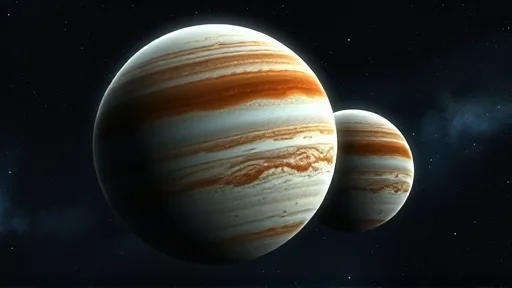
A separate group of researchers has been studying something else that is invisible at first glance: hidden information in scientific papers. Security and privacy researcher Jan Pennekamp co-authored a study of nearly three million articles on the arXiv preprint server. The team found that 88 percent of submissions that contained LaTeX source files included hidden information. This included passwords, to-do lists, and derogatory comments such as “WTF does this mean?” Pennekamp calls the findings “really just the tip of the iceberg.” The parallel with the super-puff planets is that both discoveries required looking beyond the surface. Astronomers looked past the planet’s size to find its true density. The security researchers looked past the paper’s text to find what authors never meant to share. In both cases, the obvious layer hides something unexpected. The arXiv study has not yet been peer reviewed. It was posted as a preprint, which is the same kind of repository where many of the analyzed papers first appeared. The findings suggest that scientists routinely leave digital traces they do not intend to leave. Just as the super-puff planets reveal a gap in planetary formation theories, the hidden data reveals a gap in how scientists handle their own work.
The next measurement needed
For the super-puff planets, the next step is to measure their atmospheres. The current data tells scientists the planets are large and light, but not what they are made of. To find that out, researchers need to observe the starlight that passes through the planet’s atmosphere as it transits. That light carries the chemical fingerprint of the gases present. The James Webb Space Telescope is the instrument best suited for this task. It can detect molecules like water, methane, and carbon dioxide in exoplanet atmospheres. If these planets are truly made of foam-like material, their atmospheric composition will be unlike anything seen before. . .
Sources
1. NASA
2. TESS