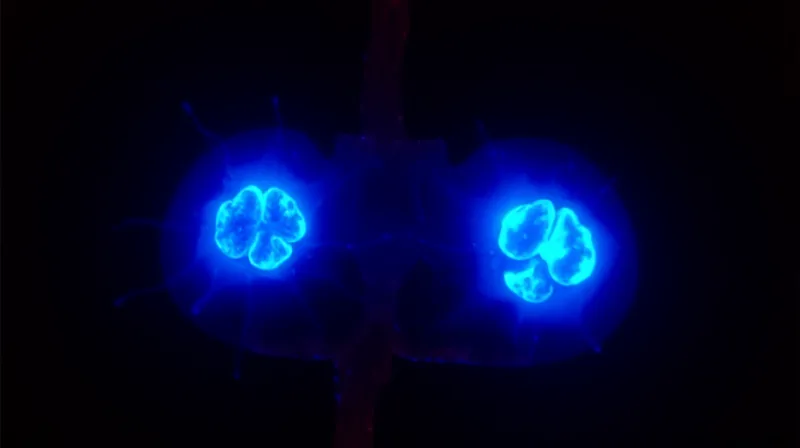
Two progenitor cell types rewrite brain development model
A Second Flavour of Starter Cell
For decades, the dominant picture in developmental neuroscience held that one kind of starter cell — a single type of progenitor — gives rise to the entire brain. That picture is now under pressure. Experiments reported in Nature describe evidence that building the complex organ takes not one but two flavours of progenitor cell. [1] The study names the two progenitor populations and the region of the developing brain where each was found The finding does not merely add a detail to an existing model. It changes what the model has to explain.
The same body of research reports an efficient way to grow hindbrain cells from stem cells, a task that had been difficult to accomplish. The method uses a defined set of chemical signals to steer stem cells toward hindbrain identity. Hindbrain tissue sits at the base of the brain and connects it to the spinal cord. Producing its cells reliably from stem cells has been a persistent obstacle, and the new work describes a route that works.
A Question Open Since the Beginning
The idea that a single progenitor type seeds the whole brain has shaped how researchers interpret experiments for a long time. If one starter cell can produce every cell type, then the interesting question becomes how that cell’s descendants diversify. If two starter types are required, the question shifts to how those two populations divide the labour.
The hindbrain problem illustrates why the distinction matters. Growing hindbrain cells from stem cells has been a persistent obstacle, and difficulty in the dish often signals that the starting material is not what was assumed. When the starting cells are wrong, the recipe fails in ways that look like technical noise rather than a wrong premise.
The two findings connect. A method that reliably produces hindbrain cells gives researchers a way to test which progenitor type contributes what. The old assumption becomes testable in a system that previously could not be built. A parallel effort at the Institute of Molecular Biotechnology in Vienna has pursued the same question, using organoid models to trace progenitor lineages in the developing hindbrain.
The Contradiction Still Standing
What remains unresolved is how two progenitor populations cooperate to produce one coherent organ. The study does not yet show whether one population gives rise to the other or whether both arise independently. The evidence establishes that two flavours exist and that hindbrain cells can be grown efficiently from stem cells. It does not yet settle how the two populations are related or how their contributions are coordinated across the developing brain.
That gap is the live contradiction. A single-origin model cannot account for two required progenitor types. A two-origin model must then explain how the resulting cells assemble into a single functioning structure. The experiments open the question rather than close it. The next step, as the researchers describe it, is to map the lineage of each progenitor type across the full course of brain development.
Sources
1. DOI: 10.1038/d41586-026-02943-1
3. Nature