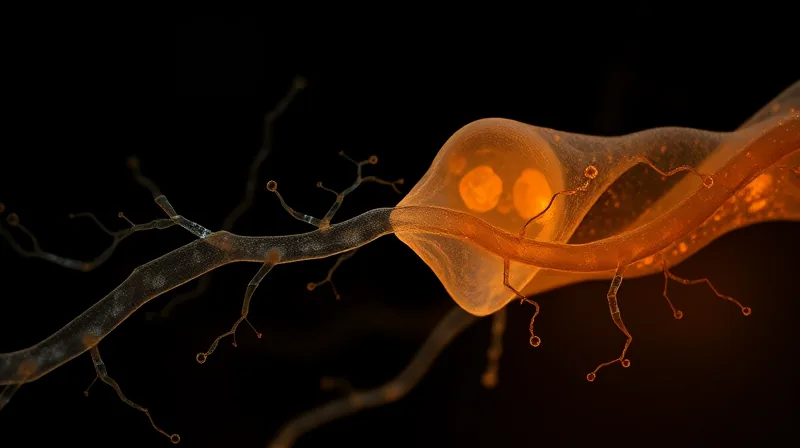
The Brain Comes in Two Boxes
The standard account of brain development has been tidy to the point of suspicion. One early population of progenitor cells — cells that have not yet chosen what to become — divides, migrates, and lays down the forebrain, the midbrain and the hindbrain in one continuous act. Every region of the adult brain, on this view, traces back to a single starting point. The model is elegant. It is also the kind of elegance that survives until someone looks closely enough at the earliest embryonic moments to break it. Carolyn Dundes and Rayyan Jokhai, graduate students in the Stanford laboratory of developmental biologist Kyle Loh, looked. [1] What they found in mouse embryos during gastrulation — the stage when a shapeless ball of cells begins to sort itself into the layers that will become organs — was not one pool of future nervous tissue but two. The two pools never blend. As the embryos developed, the populations stayed apart, each following its own path into mature nervous tissue. Loh, an associate professor of developmental biology at Stanford University, put the implication plainly: the brain looks like one organ, but the front of it and the back of it come from different sources that have been pushed together until the seam disappears. [1] The findings, published in September in the journal Nature Neuroscience, challenge the single-origin model.
The evidence for two origins does not rest on appearance alone. The two cell groups carry different molecular signatures. One population expresses a gene called Otx2, which helps direct the early development of the forebrain and midbrain. The second expresses Gbx2, which is involved in the development of the midbrain and hindbrain. Both genes were known before. What the new work shows is that they mark two separate populations rather than two zones of one. The team went further and examined chromatin — the protein-and-DNA packaging inside the nucleus that decides which genes a cell is allowed to read. A cell’s chromatin is something like the locked and unlocked doors of a building: it tells you not just where a cell is, but which rooms it will ever be able to enter.
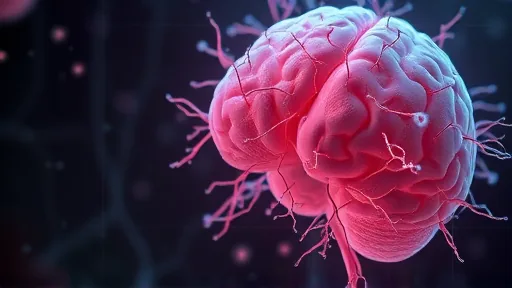
There is a practical cost to the old model, and it has been paid in laboratories for years. Scientists have repeatedly failed to grow functional hindbrain neurons from stem cells in a dish. The new work offers a reason: those attempts were coaxing forebrain and midbrain progenitors toward a hindbrain identity, a conversion the study indicates is not possible. The failure was not a matter of technique. It was a matter of mistaken ancestry.
Two Lineages, One Skull
The division of labor between the two lineages maps onto the brain’s three classical regions with an overlap in the middle. The forebrain and part of the midbrain belong to the Otx2 lineage. The hindbrain and the rest of the midbrain belong to the Gbx2 lineage, and that second population extends down into the spinal cord. The midbrain, in other words, is not the property of either side alone; it is the border country. The forebrain handles language, planning, abstract thought and the reflection by which a mind notices itself. The midbrain, the uppermost part of the brainstem, relays sensory information and helps control movement. The hindbrain — the brainstem, the stalk joining brain to spinal cord — runs the machinery nobody has to think about: breathing, sleep, heartbeat, hunger. One lineage builds the rooms where we deliberate. The other builds the engine room we never visit.
That split has consequences for medicine. Motor neurons of the hindbrain drive the muscles of the face, the tongue and the throat — the ones that let a person speak and swallow. In spinal muscular atrophy and in amyotrophic lateral sclerosis, motor neurons degenerate, and patients can lose the ability to swallow, speak and breathe unaided. A living patient’s hindbrain motor neurons cannot be biopsied to watch the disease attack them. Armed with the two-lineage map, the Stanford team guided human stem cells into functional hindbrain motor neurons that produced the proteins characteristic of those hard-to-grow regions. Loh’s framing of the value is precise and modest: growing these neurons in a dish gives researchers a way to investigate the diseases. [1] The team’s next aim is to use the findings to study these diseases and pinpoint new treatments A dish is not a cure. It is the first place where the relevant cells can be watched at all.
The finding also redraws the evolutionary map. The Stanford team turned to previously published data on other species — macaques, zebrafish and chickens — and again found two distinct cell populations expressing the two key genes. Then came the test that matters most: acorn worms, marine invertebrates whose lineage diverged from vertebrates about 550 million years ago. The same two populations appeared. Two construction crews, it seems, have been working on the same building since before there were vertebrates to house.