A Gold Mine That Answered the Wrong Question
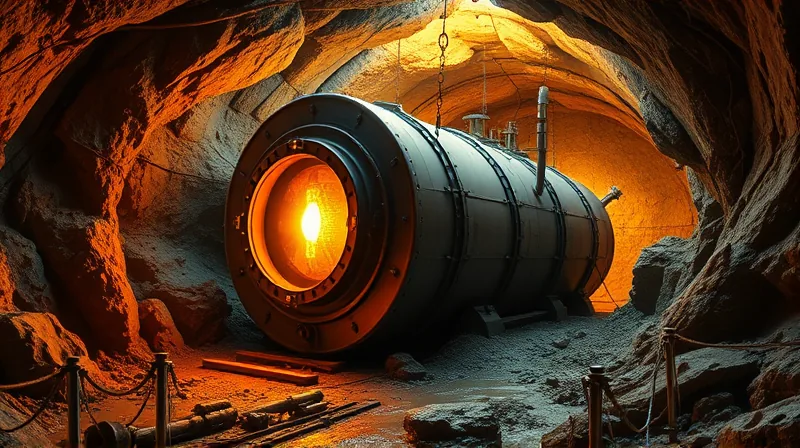
In the late 1960s, Raymond Davis Jr. lowered a tank of chlorine-rich cleaning fluid into a South Dakota gold mine. He was not hunting for a new particle. He wanted a headcount: how many neutrinos from the sun arrive at Earth? The rock above his tank blocked everything else, and the neutrinos would slip through as if the mountain were air. Every so often, one would strike a chlorine atom and turn it into radioactive argon-37, which Davis could count. The tally came back wrong. Roughly two-thirds of the expected neutrinos were simply absent.
That missing fraction sat unexplained for decades. The resolution arrived around the year 2000, when other neutrino experiments showed that the particles change type in flight. The three flavours — electron, muon and tau — are not fixed identities. An electron neutrino born in the sun can land on Earth as a muon or tau neutrino. Davis’s detector had been built to see only electron neutrinos, so it was never missing anything. His quarry had changed clothes mid-journey. “This was an absolutely gigantic discovery that had been building up for a long time,” says André de Gouvêa, a theoretical physicist at Northwestern University in Illinois. [1] That property carries a consequence the Standard Model cannot absorb. “Neutrino mass provides us with the only particle physics evidence that the standard model of particle physics is incomplete,” says Silvia Pascoli at the University of Bologna, Italy. [1] The Standard Model is the catalogue of fundamental particles and forces — elegant, symmetric, and spectacularly successful. It also omits gravity, says nothing about dark matter, and offers no account of why matter outnumbers antimatter. Neutrino mass is the one crack in it that comes with laboratory evidence rather than theoretical wish. “So, in the standard model, neutrinos don’t have mass — but now we know they do,” says Anezka Klustova at Imperial College London. “But we don’t know what those masses are, and we don’t know how they get them.” The scale of the problem is almost comic. The gap between an electron’s mass and a neutrino’s is roughly the difference between a fully loaded station wagon and a single playing card. Other matter particles get their mass by interacting with the Higgs boson. Whether neutrinos use the same route, or an entirely different one, is unresolved. And the flavours themselves resist a simple reading. “Why nature is made like this, we have no idea, but that’s what we observe,” Pascoli says. There are three neutrino mass states, each a quantum blend of all three flavours, and the balance between them shifts as the particles travel. The flavours have no single, well-defined mass. Only the blend does.
A Parallel Team Arrives at the Same Interference
The mass states leave a signature. As neutrinos travel, the different masses in the superposition interfere, and that interference writes a pattern of tiny peaks and dips into the energy spectrum. Read the pattern precisely enough, and you can extract two numbers: one mixing angle and one mass-squared difference. These are fundamental parameters of particle physics, and pinning them down is the entry fee for testing whether the three-flavour picture is complete.
A parallel effort had already sketched the case for such a measurement. A 2002 proposal for a very long baseline experiment — a one-megawatt proton beam at Brookhaven’s Alternating Gradient Synchrotron firing toward a large underground detector in South Dakota or New Mexico, more than 2,500 kilometres away — argued that a long enough flight path yields a distinctive signal spectrum sensitive to the oscillation parameters. The same document noted that running in antineutrino mode would let physicists tell one sign of the mass-squared difference from the other. The logic was identical: distance plus statistics equals a hierarchy verdict. The geography was not.
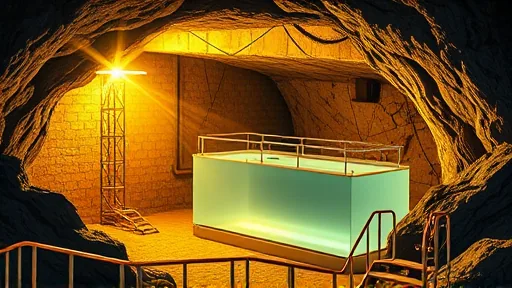
JUNO, the Jiangmen Underground Neutrino Observatory in southern China, is that logic built at scale. Its centrepiece is an acrylic sphere holding 20,000 tonnes of scintillator fluid. About 52.5 kilometres away, the Yangjiang and Taishan nuclear power plants produce a continuous, clean stream of electron antineutrinos. When one interacts with the fluid, it produces a faint flash, and thousands of golden spherical sensors around the sphere amplify it. The cavern housing the detector could swallow a 14-storey building. A smaller companion, the Taishan Antineutrino Observatory, sits close to the Taishan reactor to measure antineutrinos before they have had time to oscillate — a reference point for the main instrument.
The first results are in. In June, the JUNO Collaboration published initial results that put it on track to produce a competitive measurement of the mass ordering in the next few years; these initial results lean towards the normal ordering, but more data will be needed. The result validates the detector design and shows JUNO is ready to attack the mass ordering with a larger dataset.
The Sieve That Narrows the Field
The mass ordering is a fork in the road. Two of the three mass states appear to sit close together; the third is the odd one out. Whether it lies above or below the pair defines the normal and inverted hierarchies, and the interference pattern in JUNO’s antineutrinos encodes which one is real. A firm answer would constrain the individual masses and narrow the competing explanations of where mass comes from.
The leading candidate is the seesaw mechanism, first proposed in the 1980s. It posits undiscovered neutrinos of enormous mass, so heavy they are nearly impossible to observe. Their bulk is linked to the featherweight of the familiar neutrinos — press one end of the seesaw up and the other drops. “This is an explanation which most of the neutrino theories consider plausible, and it also explains why neutrinos are much lighter than the,” Pascoli says. A rival idea has neutrinos acquiring mass indirectly, through interactions with undiscovered particles, in a more complicated quantum process that naturally yields a tiny value. In some versions of that idea, one of the unseen particles could be dark matter itself. Both are broad sketches, not precise predictions.
JUNO’s role is not to crown a winner outright. It acts as a sieve. If the normal ordering holds up, some of the simplest seesaw models fit naturally. An inverted ordering would rule those versions out or force theorists to elaborate them. “By doing these neutrino experiments, I don’t think we’d learn all the answers, but we would get a lot of circumstantial evidence that points us in the right direction,” de Gouvêa says. [1] The stakes extend past the mass question. Some mechanisms for generating neutrino mass would violate rules physicists currently assume about how reality works. If so, the same machinery could bear on why matter survived and antimatter did not. “It is possible that whatever is giving the neutrinos a non-zero mass is also directly responsible for the origin of matter itself,” de Gouvêa says.
JUNO is the opening move, not the endgame. Hyper-Kamiokande in Japan is set to start running next year, and DUNE in the US is due to open in the early 2030s. Both will probe the neutrino mass question with their own instruments. The field is no longer waiting on a single tank of fluid in a mine. It is assembling a network of detectors, each one narrowing the space where the answer can hide.
Sources
Mentioned organisations (context, not sources)
- Northwestern University — Organisation (homepage)
- University of Bologna — Organisation (homepage)
- University of Oxford — Organisation (homepage)
- Brookhaven National Laboratory — Organisation (homepage)
- Jiangmen Underground Neutrino Observatory — Organisation (homepage)
- Yangjiang Nuclear Power Plant — Organisation (homepage)
- DUNE — Organisation (homepage)