Scientists Induce Brain Cleaning Without Sleep in Mice
Sleep has always been the great divide. You close your eyes, and the world goes dark. Your brain enters a state that scientists have spent decades trying to fully understand. But what if you could get the brain’s most important cleaning work done while you were still awake? That is the paradox at the heart of a new discovery from researchers at the University of Wisconsin-Madison. They found a way to give mice some of the benefits of deep sleep without them ever falling asleep. [1]
The story begins with a simple observation. Every day, your brain makes thousands of new connections. These connections form when you learn something new, meet someone, or even just walk down a street you have never seen before. By the end of the day, your brain is full of these fresh neural pathways. Some are important. Others are just clutter. During deep sleep, your brain performs a kind of housekeeping. It strengthens the connections you need. It weakens or cuts away the ones you do not. This process is called synaptic homeostasis.
For decades, scientists believed this cleaning could only happen during sleep. The brain needed to be offline. It needed to be in a state called non-rapid eye movement sleep, or NREM sleep. This is the deep sleep that makes up about 80 percent of adult sleep. During NREM sleep, the brain’s cortex fires signals at the exact same time across large groups of neurons. Then it shuts those neurons off. This on-off pattern is called slow-wave sleep activity. It has been linked directly to synaptic homeostasis.
Chiara Cirelli at the University of Wisconsin-Madison and her team wondered about something unusual. [1] What if you could nudge just a small part of the cortex into this deep sleep pattern while the rest of the brain stayed awake? Some animals already do this naturally. Dolphins sleep with one half of their brain at a time. Ducks do the same. Fur seals can keep one hemisphere alert for predators while the other half sleeps. This is called unihemispheric sleep. It allows them to rest and still stay safe.
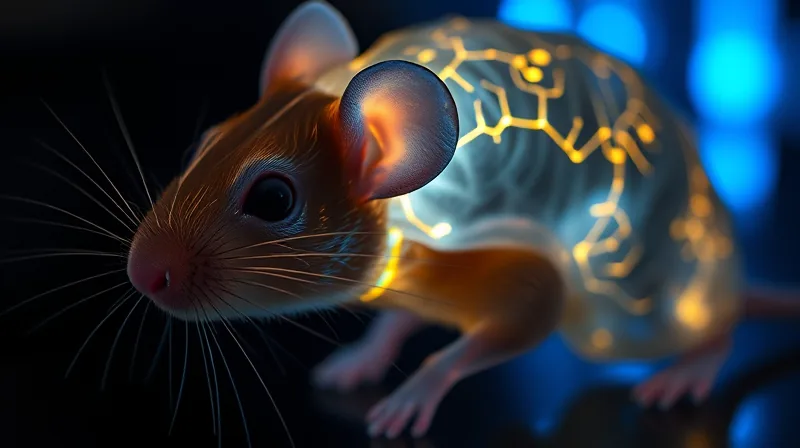
The researchers decided to test this idea in mice. They genetically engineered the mice so that their neuronal activity could be switched off using light. They implanted a small probe into one half of the mouse brain. Then they kept the mice awake for five hours. They gave the mice new things to explore. Mice are naturally curious. They love novelty. So the mice stayed awake and active.
Near the end of this five-hour period, the researchers did something clever. They turned the light probe on and off repeatedly for 30 minutes. This mimicked the slow-wave activity of NREM sleep. The stimulated side of the brain experienced this pattern while the mouse was still awake and exploring. After this, the mice were allowed to sleep normally. Brain recordings showed something remarkable. The stimulated side of the brain did not show the usual signs of exhaustion caused by sleep deprivation. It had already done its decluttering while awake.
This was the first big finding. A small part of the brain could perform its nightly cleaning without the rest of the brain sleeping. But the researchers wanted to know more. Could this artificial deep-sleep activity also boost memory? Memory is one of the key functions that sleep supports. Without proper sleep, memory suffers. The team designed a second experiment to test this.
They placed the genetically modified mice in a square box. The box had carpet with the same texture on both sides. The mice explored the space for 15 minutes. Then they were divided into three groups. One group was allowed to sleep normally. A second group was kept awake for one hour. A third group was also kept awake for one hour but received the artificial deep-sleep stimulation during that time.
The next day, the mice went back into the box. But this time, one side of the container had a new texture. Mice are naturally drawn to novelty. They prefer to explore new things. The researchers measured how much time each mouse spent on the new side. This told them how well the mice remembered the old environment. The sleep-deprived mice that received no stimulation struggled to tell the new and old sides apart. They spent equal time on both sides. But the sleep group and the sleep-deprived mice that received stimulation both spent more time on the new side. Their memory was intact.
This was the second big finding. The artificial deep-sleep activity protected memory even when the mice were sleep-deprived. It seemed to work as a substitute for real sleep, at least for that small part of the brain.
Now the researchers want to test this in humans. They plan to use a non-invasive technique called transcranial electrical stimulation. This involves placing electrodes on the scalp to deliver gentle electrical currents to the brain. It is already used in some research settings to influence brain activity. The goal would be to induce slow-wave activity in a specific part of the human cortex while the person is awake.
Vladyslav Vyazovskiy at the University of Oxford, who was not involved in the research, says it should be possible to replicate these results in humans. [2] At least in theory and to some extent. He finds the idea fascinating. He wonders whether artificially inducing this activity during waking hours could make people feel more refreshed and rested afterwards. This could have huge implications for people who cannot sleep enough. Shift workers, parents of newborns, people with sleep disorders, and soldiers in the field could all benefit.
But Vyazovskiy also sounds a note of caution. Sleep is not just NREM sleep. There is also REM sleep, the stage where most dreaming occurs. We still do not know what makes the alternation between these two states complete. Sleep is a complex process. It involves many systems in the brain and body. Replacing it entirely may never be possible.
The researchers published their findings in a peer-reviewed journal, though the specific journal and paper title were not disclosed in the available materials. Cirelli has studied sleep for decades, and her work has helped shape our understanding of why sleep is so essential.
This discovery builds on a long history of sleep research. In the 1920s, Hans Berger invented the electroencephalogram, or EEG. This device could measure electrical activity in the brain. He discovered that brain waves change during sleep. In the 1950s, Eugene Aserinsky and Nathaniel Kleitman discovered REM sleep. They noticed that the eyes move rapidly during certain stages of sleep. This led to the modern understanding of sleep cycles.
In the 1980s, researchers began to understand the role of sleep in memory. They found that sleep helps consolidate memories. It moves information from short-term storage to long-term storage. In the 1990s, the concept of synaptic homeostasis emerged. Giulio Tononi and Chiara Cirelli proposed that sleep serves to prune unnecessary connections. This keeps the brain efficient and ready for new learning the next day.
Now this new research suggests that the pruning might not require full sleep. It might be possible to trigger the pruning mechanism locally. This could change how we think about sleep and wakefulness.
There are parallels in other fields. In computer science, there is a concept called garbage collection. Programs use memory to store data. Over time, unused data accumulates. The program must periodically clean up this garbage to run efficiently. This is usually done during idle periods. But some modern systems can do garbage collection incrementally. They clean up small pieces of memory while the program is still running. This is similar to what the researchers did with the mouse brain. They performed local garbage collection while the brain was still awake.
In engineering, there is a concept called predictive maintenance. Machines need regular maintenance to function well. Traditionally, maintenance is done during scheduled downtime. But predictive maintenance uses sensors to detect when a part needs attention. It can sometimes perform repairs while the machine is still running. This keeps the machine operational for longer periods.
In medicine, there is a growing interest in brain stimulation techniques. Transcranial magnetic stimulation and transcranial electrical stimulation are already used to treat depression and other conditions. These techniques can modulate brain activity in specific regions. The new research suggests they might also be used to induce sleep-like benefits during wakefulness.
The potential applications are vast. People who work night shifts could use this to stay sharp. Students studying for exams could boost their memory without sacrificing sleep. Elderly people who have trouble sleeping could get some of the benefits of deep sleep during the day. People with insomnia could reduce the pressure to sleep. They might feel less anxious about not sleeping if they know they can get some benefits while awake.
But there are also risks. The brain is finely tuned. Interfering with its natural rhythms could have unintended consequences. The researchers only stimulated a small part of the cortex. Stimulating larger areas or doing it for longer periods might cause problems. The brain might become confused about whether it should be awake or asleep. This could lead to a state of half-sleep that is neither restful nor alert.
There is also the question of individual differences. Some people might respond well to this stimulation. Others might not. The researchers will need to study this carefully in human trials. They will need to determine the optimal frequency, duration, and location of stimulation. They will need to check for side effects like headaches, dizziness, or changes in mood.
The team plans to start with healthy volunteers. They will use transcranial electrical stimulation to induce slow-wave activity in a specific brain region. Then they will test memory and cognitive function. They will also ask participants how they feel. Do they feel more refreshed? Do they feel more alert? Do they notice any changes in their mood or energy levels?
If the results are positive, the next step would be to test in people with sleep disorders. People with insomnia often have trouble falling asleep or staying asleep. They might benefit from getting some sleep-like benefits during the day. People with sleep apnea wake up many times during the night. They do not get enough deep sleep. Local stimulation could help compensate for this.
The research also raises philosophical questions. What is sleep? Is it just a state of unconsciousness? Or is it a specific pattern of brain activity that can be replicated? If we can replicate the benefits of sleep without sleeping, does sleep become optional? These questions have no easy answers.
The researchers are careful not to overstate their findings. They emphasize that this is early research. It was done in mice, not humans. The mouse brain is simpler than the human brain. What works in mice might not work in people. But the principle is promising. It opens a new avenue for research.
There is also the question of whether this could be done without any external stimulation. Some people might naturally have this ability. They might be able to enter a state of focused relaxation that mimics deep sleep. This is similar to the concept of microsleeps. Microsleeps are brief periods of sleep that last a few seconds. They happen when a person is very tired. But microsleeps are involuntary and can be dangerous. The new approach would be deliberate and controlled.
The research also connects to the growing field of neuroplasticity. Neuroplasticity is the brain’s ability to change and adapt. It is strongest during childhood but continues throughout life. Sleep is one of the key drivers of neuroplasticity. It helps the brain reorganize itself based on new experiences. Local stimulation during wakefulness might also promote neuroplasticity. This could help people recover from brain injuries or stroke.
The researchers are collaborating with other labs around the world. They are sharing their methods and data. This is standard practice in science. It allows other researchers to replicate the findings and build on them. The goal is to move from basic research to clinical applications as quickly and safely as possible.
There is also commercial interest. Several companies are developing devices that use brain stimulation to improve cognitive function. Some of these devices are already on the market. They claim to boost memory, focus, or creativity. But the evidence for these claims is mixed. The new research could provide a more solid scientific foundation for these devices. It could help companies design better products.
The researchers are also studying the underlying mechanisms. How exactly does slow-wave activity promote synaptic homeostasis? What molecules are involved? What genes are turned on or off? Understanding the mechanisms could lead to new drugs or therapies. It could also help diagnose and treat sleep disorders more effectively.
Funding information was not disclosed in the available source. The researchers report no conflicts of interest and state they are motivated by scientific curiosity and the desire to help people.
Peer review status was not mentioned in the available source. If the findings were peer-reviewed, other experts have examined the methods and conclusions and found them sound. However, peer review is not infallible, and replication by independent labs will strengthen or challenge the results.
The researchers are already planning follow-up studies. They want to test different frequencies and durations of stimulation. They want to see if the effects last beyond the stimulation period. They want to know if the stimulation can be repeated safely over days or weeks. They want to test in older animals and in animals with sleep disorders.
There is also interest in testing this in humans with neurodegenerative diseases. Alzheimer’s disease and Parkinson’s disease are both linked to sleep problems. Improving sleep or mimicking its benefits could slow the progression of these diseases. This is a long-term goal. It will take many years of research.
The researchers are optimistic but realistic. They know that translating basic research into clinical practice is difficult. Many promising treatments fail in human trials. But they believe the potential benefits are worth the effort.
In the meantime, the message for the general public is clear. Sleep is still essential. You cannot replace it with a device or a technique. At least not yet. But the research shows that the brain is more flexible than we thought. It can do some of its cleaning work even when we are awake. This is a reminder that the brain is always working. It is never truly idle.
The next time you feel tired but cannot sleep, remember that your brain is still capable. It can still learn and adapt. It can still declutter, at least a little. But do not rely on this. Sleep is still the best way to keep your brain healthy and sharp.
Sleep remains the most reliable way to maintain brain health, but this research reveals that the brain is more adaptable than previously understood.