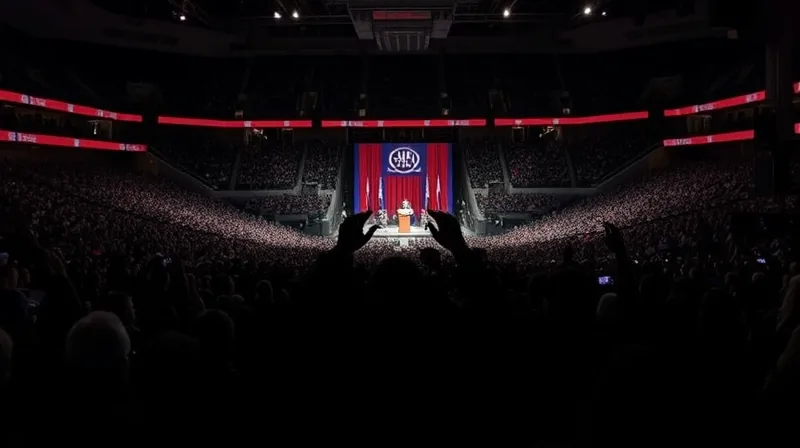
Nothing in the arena in Youngstown had been counted yet, and the night was built on that sequence: the sound first, the tally later. President Donald Trump came to northeastern Ohio in October 2026 to lift two Republicans whose names sit on the state’s ballot, and the room was loud well before he reached the microphone. The first name was Jon Husted, a senator locked in a tight re-election race against Sherrod Brown, the Democratic former senator. The second was Vivek Ramaswamy, the Republican running for governor against the Democrat Amy Acton. It was Trump’s second campaign visit to Ohio in 10 days. Two stops in one state inside a fortnight is not a routine schedule; it is a statement about where a map has tightened. For anyone who does not live inside this calendar, the national election two years into a presidential term is when the entire House and roughly a third of the Senate are on the ballot. The president is not on that ballot. His record is. Trump has spent the closing weeks campaigning overwhelmingly in states that voted for him by double digits in 2024, and Ohio belongs to that group. How a president spends his own hours in the final month is the plainest signal a party gets about which races it believes are live. Control of the Senate is not decided by a national average; it is decided in a handful of states where the margin sits inside the margin by which polls can miss the result. Husted’s race is one of those. And yet the speech that followed spent much of its energy on a state that was not on any Ohio ballot at all.
The subject that kept returning was Minnesota, which has no candidates on the ballot in Youngstown and no obvious business at an Ohio rally. Trump brought up Rep. Ilhan Omar, a Minnesota Democrat whose home in Washington had been searched by federal agents that same morning. He brought up Minnesota’s Somali community and allegations of fraud. He insisted he had won Minnesota three times, in a state that has not voted for him in a presidential election. He repeated a claim that children in Minnesota were being kidnapped to undergo gender-affirming surgery, an assertion with no evidence behind it. Then he told the crowd what the two Ohio candidates were for: to “stop Ohio from being plundered, ransacked and destroyed like Minnesota.” [1] A distant state is described as a ruin, the ruin is attached to a national party, and the local candidates are asked to run against the picture rather than the record. Homeland Security Investigations, a branch of Immigration and Customs Enforcement, executed a search warrant at Omar’s residence. The Justice Department’s wording was an “ongoing federal criminal investigation.” A search warrant is a court authorization to enter and seize, and it requires a judge to be persuaded that probable cause exists — a legal threshold, not a political one. The warrant does not establish guilt, and no charge against Omar was described in connection with the search. That distinction is the whole story, and it is the part that evaporates in a hall with a bad sound system. The word “ongoing” is doing quiet work: it means the department is not yet describing what it is looking for. A criminal investigation is a process, not a finding, and what became public that day was the fact that the process exists. The rally took the fact and turned it into atmosphere, and the crowd was left with the impression of a verdict where only an inquiry exists. By the time the speech reached Ohio’s own races, the crowd had already been given a villain, a place, and a verb.
Halfway through, the president turned to a congressman in the crowd and gave him a moment. The words from the stage were “Thank you, Max, for coming.” [1] Rep. Max Miller, an Ohio Republican, is on the ballot again this year. He faces allegations of domestic abuse from his ex-wife, Emily Moreno, which he denies. The dispute became a public family argument when Sen. Bernie Moreno of Ohio, his former father-in-law, called on him to step down. That is not a normal sequence in a party that usually closes ranks before an election. Miller’s district is competitive enough that NBC News describes the race as too close to call, and a race too close to call in a single district can help shape which party controls the House next year. His Democratic opponent is Brian Poindexter. Bernie Moreno was thanked from the stage as well, and got multiple shoutouts during the speech. Both men were in the room. That is the detail that makes the episode legible. The party did not resolve the dispute; it scheduled it for after the election.
Three times during the speech, the crowd chanted “deport.” The chant came most often while Trump was talking about migrants. Counting the chant is not a rhetorical trick; repetition is the data. A chant does what a policy paragraph cannot: it is short, it is unison, and it fits inside a single breath. Trump acknowledged the people behind the stage with a line of his own: “I like those people back there.” [1] The same evening, the White House changed its voice. Katie Zacharia started work as press secretary, replacing Karoline Leavitt, who left the White House at the end of August. Her first briefing was set for the next morning, and the announcement came through the president’s own social media account. Changing that person in the middle of a campaign is a decision about message discipline, and the timing of a personnel change is usually its content. So by the end of that Monday the pieces were arranged: a Senate race, a governor’s race, a Minnesota warning, a search warrant, a family quarrel inside the Ohio delegation, a chant in three parts, and a new press secretary preparing her first briefing. The count had not begun. It was about to.
The Ledger Opens Before the Polls Do
Campaign money in the United States arrives in two forms. The first is money candidates raise themselves, under legal contribution limits that are small by the standards of a national race. The second is money outside groups spend, frequently without those limits, on the condition that they do not coordinate with the campaign. The second form is where the 2026 midterms are being fought. Trump promised to spend $400 million in outside money he oversees by Election Day. The figure is not a campaign budget; it is a pledge about ads and activities by outside groups not coordinated with campaigns, the category that lives outside a candidate’s own committee. He tied the promise to the rioting in France, which he has used as a preview of what he says could happen in the United States if Democrats win in November. That pairing — a dollar figure and a foreign street scene — is the closing argument in miniature: fear on one side of the ledger, cash on the other. Campaign spending by groups not controlled by the candidate buys advertising, mail, digital placement, and field staff. It does not appear on a candidate’s books, which is the point of it. The word “oversees” carries its own weight, because money a president can direct is different from money a president merely welcomes. The sum is large enough to be a claim about seriousness, and vague enough that its destination cannot be audited from the outside. What it signals is that the final weeks will be loud. Unrest has spread across several European countries in recent months, from France to Albania, and France has seen its worst rioting in years — a set of facts the president has folded into an American ballot argument. Whether the argument works is not something the $400 million can guarantee. It buys repetition, and repetition is what a closing argument is made of.
On the other side sits a smaller, harder number. Michael Bloomberg, the billionaire former mayor of New York City, is spending about $80 million between September and Election Day to support Democrats. The breakdown matters more than the total. Fifty million dollars is earmarked for the fight for the House. Of that, $24 million runs through Everytown for Gun Safety, the advocacy group Bloomberg co-founded more than a decade ago. Another $16 million goes to House Majority PAC, the Democrats’ principal independent committee that can raise and spend without contribution caps but cannot coordinate with campaigns for House races. Such a committee can raise and spend without the contribution caps that bind a candidate’s own campaign funds, provided it does not coordinate directly with the campaigns it supports. Howard Wolfson, Bloomberg’s longtime political adviser, described the motive in the language of civic repair — “our government works better when all voices are participating” — and then gave a plainer account of the mechanics: “money is not determinative, but it is helpful.” He also noted that Republicans hold “a significant monetary advantage.” It is an attempt to close a gap in the closing stretch, not a purchase of an outcome. Money at this scale changes how many voters hear a message and how often. It does not change what the message is, and it cannot make a voter like something.
Some of that money is already visible as advertising. In early October, Everytown and House Majority PAC announced a joint $10 million advertising campaign targeting eight key battleground House districts. Whether it moves votes is the question the money cannot answer in advance. A counter-example sits in New Hampshire, where the ledger runs the other way. John Sununu, the Republican nominee for Senate, has distanced himself from Trump in a new television ad, even though he holds the president’s endorsement. An endorsement costs nothing. An ad costs money. A candidate who spends money to manufacture distance is treating the association as a cost to be managed, not a gift to be displayed. That is the limit of the ledger, stated cleanly: money can buy reach, and it cannot buy an introduction a candidate does not want. It can also buy the opposite of what the donor intended: every dollar spent on distance can be read as a public admission that proximity polled badly.
Trump’s travel tells the same story from the other direction. He is heading to Greenville, North Carolina, to rally for Michael Whatley, another Republican in a tight Senate race. His week runs through North Carolina, South Carolina, Iowa, Florida, and Georgia, and he returns to Texas the following week. A president who spends his final weeks in states he won comfortably is defending, not expanding. The two ledgers are not symmetrical: $400 million promised on one side, $80 million committed on the other, with the Republican advantage described by the other side’s own strategist as significant. What the money has to buy in 2026 is narrow and specific — attention in districts where the margin is small, delivered before the ballots are counted. And the counting, by then, had already started.
The Count
Begins in the Dark
More than 10 million voters had already cast a ballot by Oct. 20, 2026, exactly two weeks before Election Day. In-person early voting started that day in Hawaii, Louisiana, Utah, Wisconsin, and Missouri. It had started the day before in Alaska, Arkansas, Colorado, Connecticut, Florida, and South Carolina. North Carolina and Georgia opened the week before that. Texas opened on Oct. 19, and Texas is the one to watch. Democrats are hoping to break through there for the first time in 32 years. Casting a ballot before Election Day is a scheduling convenience that has become a strategic instrument: a campaign that banks votes early can spend the final week on the people who have not yet voted, instead of on the people who already have. Ten million ballots is not a result. It is a count of participation so far, and participation is not the same thing as preference. Still, the number has a use, because it establishes that the election has begun in fact and not merely in advertising. The category is real, the totals are large, and the meaning of the totals will only be settled after the last precinct closes.
Kansas is the strangest item on the map. Trump flew there to rally for Sen. Roger Marshall, a Republican in a race that has become surprisingly competitive in a state that has not sent a Democrat to the Senate since 1932. That is more than nine decades. Trump dismissed the polling with four words: “The polls are fake.” A poll is a sample, and a sample can be wrong, but the sentence from the stage was not a statistical argument; it was a turnout instruction. In Kansas, a voter described the cost of living as the biggest issue motivating her decision on whom to support. That is the economy entering the room through the front door, in a state where the economy was not supposed to be the subject. Adam Hamilton, the Democratic Senate candidate in Kansas, called Trump’s visit a “big compliment” and said the president’s campaigning for his Republican opponent is “only going to hurt him.” In CNN’s Poll of Polls average, 65 percent of US adults disapprove of the job Trump is doing. He is a variable, and each candidate prices the variable differently.
On the same Monday, federal authorities charged more than two dozen foreign nationals in California. Two dozen is a small number set against 10 million ballots. Its political weight is not measured against that ratio. Election administration in the United States is decentralized: registration runs through state and county offices. A charge is not a conviction, and the cases will move through courts at their own pace, well past Election Day. That timeline matters, because an announcement in October lands while people are voting and a verdict may land years later. The sweep also arrives in a campaign in which the machinery of elections has itself become a subject of argument, and the argument does not require the cases to be resolved to have an effect.
Sununu priced the association one way in New Hampshire. Miller’s district will price it another way. Kansas will price it a third. Ballots cast in October are stored, checked, counted and certified, and the totals that emerge are the residue of millions of private decisions. Every claim made from a stage eventually meets a denominator — dollars spent, ballots cast, seats won — and the denominator does not care how the claim was delivered. The rally in Youngstown, the $400 million, the $80 million and the 10 million ballots are entries in the same ledger, kept by different hands, in different rooms, for different reasons. The count is what remains when the noise stops.
Sources
Mentioned organisations (context, not sources)
- Republican Party — Organisation (homepage)
- Democratic Party — Organisation (homepage)
- U.S. Senate — Organisation (homepage)
- U.S. House of Representatives — Organisation (homepage)
- Homeland Security Investigations — Organisation (homepage)
- U.S. Immigration and Customs Enforcement — Organisation (homepage)
- U.S. Department of Justice — Organisation (homepage)
- NBC News — Organisation (homepage)
- Everytown for Gun Safety — Organisation (homepage)
- House Majority PAC — Organisation (homepage)