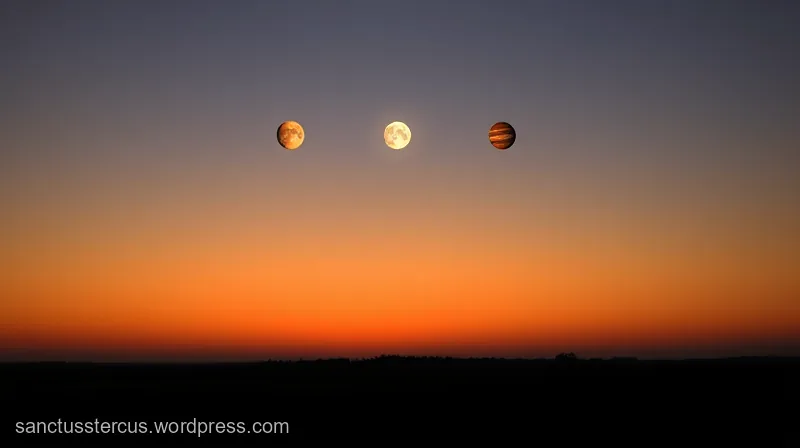
Jupiter, Venus, Mercury line up in May 27 sky
The sun had just fallen behind the rooftops. The sky was still holding its last blue. And there, in the west, three points of light had arranged themselves like beads on an invisible string. They did not flicker. They did not move. They simply waited.
This was not a random scattering. It was a triple conjunction — three planets appearing to form a straight line across the sky from our vantage point on Earth. For anyone who looked up on the evening of May 27, the three brightest worlds in our solar system were doing something rare. They were lining up like soldiers standing at attention between the constellations of Gemini and Taurus.
The moment passes quickly. But what it means takes much longer to explain.
The Human Story: How We Watch
Find the western horizon just after sunset. Do not wait too long. The sky will darken fast. Jupiter will appear first, roughly 30 degrees above where the sun disappeared. That is about three fist-widths held at arm’s length. It will look like a steady, creamy-white star. It does not twinkle. That is how you know it is a planet.
Venus will hang below Jupiter and to the right. It is brighter than anything else in that part of the sky. On clear nights, Venus has been mistaken for an aircraft or a bright drone by those unfamiliar with its intensity — a reminder of how foreign the sky can feel to untrained eyes. It is simply Venus, the evening star, the brightest natural object in our sky after the moon.
Mercury is the hardest. It sits low, close to the horizon, in the last glow of the setting sun. You will need a clear view. No trees. No buildings. Just open sky. It will set less than 90 minutes after the sun. That is your window. You blink, and it is gone.
People have watched this way for thousands of years. The Babylonians recorded planetary positions on clay tablets. The Greeks gave them names. The Maya built entire cities aligned to their movements. We are not the first to stand outside and look up. We are just the latest.
The Scientific Story: What They Really Are
Jupiter is the largest planet in our solar system. It is more than 1,300 times the volume of Earth. Its atmosphere is a storm of hydrogen and helium. The Great Red Spot, a storm that has raged for at least 400 years, could swallow our entire planet whole. When you look at Jupiter through a small telescope, you do not see a disk. You see a world. And around that world, four tiny points of light cluster close to its glowing face.
Those are the Galilean moons: Io, Europa, Ganymede, and Callisto. They were first seen by Galileo Galilei in 1610 using a telescope he built himself. That discovery changed everything. It proved that not everything orbited Earth. It was the first crack in the old model of the universe.
Venus is Earth’s twin in size but not in nature. It is covered in thick clouds of sulfuric acid. Its surface temperature is hot enough to melt lead. It rotates so slowly that a single day on Venus is longer than its year. When you see it shining in the evening sky, you are seeing sunlight reflected off clouds that hide a world of crushing pressure and volcanic plains.
Mercury is the smallest planet. It is barely larger than our moon. It has no atmosphere to speak of. Its surface is scarred by craters. During the day, temperatures can reach 800 degrees Fahrenheit. At night, they drop to minus 290 degrees. It is a world of extremes. And it is the hardest to see because it never strays far from the sun.
The Bridge Between Worlds
The alignment on May 27 was not just a pretty sight. It was a geometric event. The three planets appeared to form a straight line because their orbits had brought them into the same region of sky from our perspective on Earth. This is called a conjunction.
A conjunction happens when two or more planets appear close together in the sky. They are not actually close in space. They are millions of miles apart. But from Earth, their paths line up. It is a trick of perspective. Like holding your thumb next to a mountain and pretending they are the same size.
This particular alignment created what astronomers call a planetary bridge between the constellations Gemini and Taurus. Jupiter sat near the twin stars Castor and Pollux, which mark the heads of the celestial twins. Venus and Mercury stretched downward toward the horizon, pointing toward the Bull.
The bridge was temporary. By the next night, the positions had shifted. Mercury was lower. Venus was moving. Jupiter was already drifting eastward. The line was breaking.
The Tools We Use
You do not need expensive equipment to see this. Your eyes are enough. But if you want to see more, the tools are simple.
A pair of binoculars will show you the four Galilean moons of Jupiter. They will look like tiny stars pinned to the planet’s side. A small telescope with a 70mm aperture will reveal the phases of Venus. It goes through phases just like our moon. Right now, it appears as a bright crescent.
A 4-inch telescope will show you more. The cloud bands on Jupiter will become visible. They are stripes of different colors — white, brown, orange — caused by different chemicals in the atmosphere. Most telescopes in this range come with a stable tripod and support smartphone adapters for photography. But do not get lost in the equipment. The sky is the same whether you look through glass or just your own eyes.
The History of Watching
People have been tracking these planets for millennia. The earliest known astronomical records come from the Babylonians, who kept detailed logs of planetary positions on clay tablets dating back to the 7th century BCE. They used this information to predict events and create calendars.
The Greeks built on this work. Ptolemy of Alexandria wrote the Almagest around 150 CE, a book that summarized everything known about the heavens. It placed Earth at the center of the universe. That model lasted for nearly 1,400 years.
Nicolaus Copernicus changed that in 1543 when he published De Revolutionibus Orbium Coelestium. He argued that the sun, not Earth, was the center. Johannes Kepler later refined the orbits into ellipses. Galileo pointed his telescope at Jupiter in 1610 and saw the moons. He saw Venus go through phases. He saw that not everything orbited Earth.
The alignment we saw on May 27 would have been familiar to all of them. They would have recognized the positions. They would have known what was coming. They would have stepped outside and looked up, just as we did.
What Else Is Happening
The three-planet line was not the only thing happening in the sky that week.
Saturn was rising in the early morning hours. It is not visible in the evening right now. But if you wake up before dawn and look southeast, you will find it. A telescope with 30x magnification will show its rings. They are tilted more toward us than they were a year ago, making them easier to see.
Mars is also becoming visible in the morning sky. It has been hidden in the twilight for nearly a year. Now it is emerging, low in the east-southeast, a couple of hours before sunrise. It shines at first magnitude, which means it is bright but not dazzling. It will brighten slowly over the coming months.
The moon will join the planets in mid-June. On June 16 and June 17, a thin crescent moon will sit near Venus, Jupiter, and Mercury.
The Deeper Meaning
There is no practical reason to care about a line of planets. It does not affect the tides. It does not change the weather. It does not influence human behavior, no matter what astrology claims. It is just light traveling across space, arriving at our eyes after minutes or hours or years.
But it is also a reminder. We live on a planet that is moving. We are spinning. We are orbiting. A line of planets is a snapshot of that motion. It is a moment when the geometry of the solar system becomes visible to anyone who looks.
A planetary alignment is not a mystery. It is a map. It shows us where the other worlds are, relative to our own. It reminds us that we are not alone in the dark.
The Challenge of Mercury
Mercury is the hardest planet to see. It never gets far from the sun. It is always low in the sky, always fighting against the twilight. On May 27, it set less than 90 minutes after the sun. That is a narrow window.
To find it, you need to know exactly when the sun sets from your location. You can use a daylight tracker from Time and Date to get the precise time. Then you wait. You let the sky darken just enough. You look low in the west-northwest. You scan the horizon with binoculars. And there it is. A tiny point of light, barely visible, holding its place against the fading glow.
It is worth the effort. Mercury is the closest planet to the sun. It orbits faster than any other world. A year on Mercury lasts only 88 Earth days. It is a world of extremes, a reminder that the solar system contains places that are nothing like our own.
The Brightest Star
Venus is often called the evening star or the morning star. It is the third brightest object in our sky, after the sun and the moon. It is so bright that it can sometimes be seen during the day, if you know exactly where to look.
On May 27, Venus appeared as a brilliant point of light to the lower right of Jupiter. It was at magnitude -4.0, which is extremely bright. Through a telescope, it showed a crescent phase, like a tiny version of our moon.
Venus has been observed for thousands of years. The Sumerians called it Inanna, the goddess of love and war. The Greeks called it Aphrodite. The Romans called it Venus. It has always been associated with beauty and desire. But the reality is different. Venus is a hellish world of crushing pressure, acid clouds, and volcanic plains. The beauty is only skin deep.
The King of Planets
Jupiter is the largest planet in our solar system. It is a gas giant, meaning it has no solid surface. If you tried to stand on Jupiter, you would sink into its atmosphere, crushed by pressure and burned by heat.
Its four largest moons are worlds in their own right. Io is the most volcanically active body in the solar system. Europa has a subsurface ocean that might harbor life. Ganymede is the largest moon in the solar system, bigger than the planet Mercury. Callisto is heavily cratered, a relic of the early solar system.
When NASA sent the Voyager spacecraft past Jupiter in 1979, it returned images that changed our understanding of the planet. The Great Red Spot turned out to be a storm. The rings turned out to be faint. The moons turned out to be complex worlds.
The Juno mission, which arrived at Jupiter in 2016, is still sending back data. It has revealed that Jupiter’s interior is more complicated than scientists expected.
When It Happens Again
Conjunctions like this recur at irregular intervals — some tighter, some looser, some involving more planets. The sky changes every night. There is always something to see if you know where to look.
The next major alignment will happen in June 2025, when Venus, Jupiter, and Mercury will appear close together again. The moon will join them on June 16 and June 17.
But you do not have to wait. The sky changes every night. The planets move. The stars shift. The moon waxes and wanes. There is always something to see, if you know where to look.
The Return to the Beginning
The sun had fallen. The sky was darkening. The three planets held their line.
Jupiter was high, steady, unblinking. Venus was lower, brighter, almost impossible to ignore. Mercury was barely there, a faint point of light clinging to the horizon. They formed a straight line, a bridge between worlds, a moment of geometry made visible.
And then the line began to break. Mercury set first, slipping below the horizon. Venus followed, an hour later. Jupiter lingered, finally disappearing shortly before midnight alongside the twin stars Castor and Pollux.
The sky was empty again. But the memory of the line remained. It still remains. It is still there, in the geometry of the solar system, waiting for the next time the planets align.
Sources
1. Institute of Astronomy, University of Cambridge — Public Outreach
2. European Southern Observatory
3. NASA Juno Mission and NASA Voyager