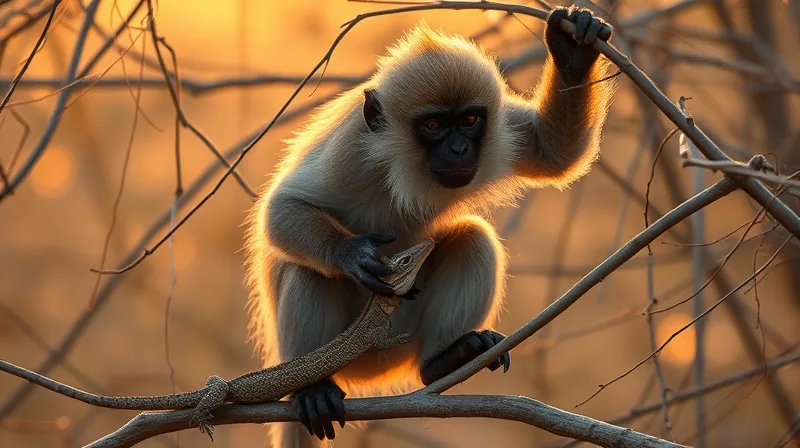
Monkeys Turn to Hunting When Fruit Runs Low
A Hunger-Driven Shift in the Canopy
Most people picture monkeys eating fruit, leaves, or snatching a tourist’s snack. Few imagine them stalking lizards or swallowing snakes whole. Yet for one group of primates in northeastern Brazil, this predatory behavior is not an anomaly but a survival strategy that activates precisely when their preferred meals disappear. Yet for one group of primates in northeastern Brazil, this predatory behavior is not an anomaly but a survival strategy that kicks in precisely when their preferred meals disappear.
Between June 2006 and December 2010, researchers logged over 5,000 hours of observational data on bearded capuchin monkeys. [1] The study, led by Noemi Spagnoletti, a zoologist at the Sapienza University of Rome, was originally designed to understand the broader behavior and ecology of these animals. [1] It was during this long-term project that the team repeatedly witnessed something striking: the monkeys actively hunting and consuming small vertebrates, including lizards, snakes, and iguanas.
The data revealed a clear pattern. When fruit became scarcer during seasonal fluctuations, the monkeys did not simply eat less. They changed their hunting habits, attacking other animals more frequently to compensate for the missing plant food. The team recorded 281 distinct instances of the capuchins eating small vertebrates, with nearly half of those meals being lizards and over a quarter being rodents. [1] Birds and opossums also appeared on the menu.
The behavioral flexibility extends beyond the hunting itself. The monkeys showed a distinct preference for eating the brains and guts of their prey first. Spagnoletti suggests this is no accident, as these organs are rich in fats and nutrients that provide a quick dietary boost. When food is scarce, the extra energy required for hunting becomes worthwhile when the payoff includes such concentrated nutrition.
A Window Into Our Own Ancestral Table
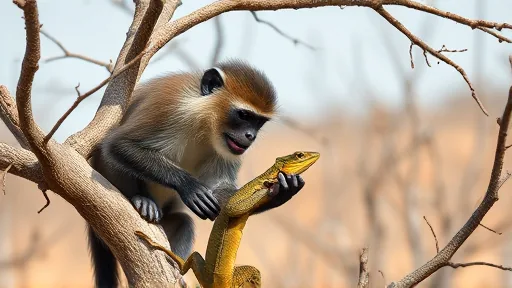
These findings reach beyond a single monkey species in Brazil. They touch on one of the most profound questions in human evolution: how and why did our ancestors shift from a primarily plant-based diet to one that included significant amounts of meat?
Chimpanzees often dominate the conversation when scientists discuss hunting behavior in nonhuman primates. Margaret Bryer, a biological anthropologist at the University of Wisconsin-Madison who was not involved in this research, notes that this focus is somewhat misleading. [2] A diverse array of primates eat vertebrates, and capuchins are a prime example of this broader pattern.
The key insight from the capuchin study is the idea of dietary flexibility as a buffer. Susana Carvalho, a primatologist at Gorongosa National Park in Mozambique, points out that meat may buffer seasonal changes for the monkeys. [3] This buffering capacity, she argues, may have been the same mechanism that allowed early hominins to survive lean periods and eventually transition to a more meat-filled diet.
The similarities between bearded capuchins and humans are curious and compelling. These monkeys have proportionally large brains, they eat meat, and they use tools that they transport while walking on their hind legs. Unlike chimpanzees, capuchins will even eat snakes, a behavior that some humans share. Carvalho suggests that these parallels mean capuchin behavior could serve as a model for understanding how early hominin behavior emerged.
This is not a claim that capuchins are proto-humans. It is a claim about the power of behavioral flexibility in the face of environmental pressure. If a modern primate can adjust its hunting patterns based on food availability, our ancestors likely possessed a similar adaptive capacity. The mechanisms of survival under scarcity may be deeply rooted in our primate lineage.
Revisiting Old Bones With New Questions
The findings from Brazil do more than explain monkey behavior; they offer a fresh lens through which to examine the fossil record of human evolution. Carvalho suggests that future work should assess the predation of small vertebrates as a stepping-stone to the larger game that humans eventually targeted. This is a significant reframing of how we think about early hunting.
The traditional narrative of human evolution often emphasizes the pursuit of big game as a defining characteristic. Mammoths, giant deer, and other large prey feature prominently in reconstructions of early human life. But the capuchin study suggests that the path to large-game hunting may have been paved with much smaller, more accessible prey. Lizards, rodents, and birds may have been the training ground for our ancestors’ predatory skills.
Carvalho articulates this point directly, stating that the findings open a new window to revisit the fossil record and pay attention to the smaller species that could have been prey. [3] This is a call to look at old evidence with new eyes. Bones that were once dismissed as incidental scavenging remains might actually represent a crucial dietary component for early hominins.
The precedent for this kind of reinterpretation exists in other fields of science. In paleontology, the realization that many dinosaurs were feathered came not from new fossils alone, but from re-examining specimens that had been in collections for decades. The evidence was always there; the interpretive framework was what needed to change. Similarly, the capuchin data may prompt researchers to reassess archaeological sites with attention to small vertebrate remains that were previously overlooked. The monkeys of Brazil, in their struggle to find food, may ultimately help us understand the humble origins of our own species’ appetite for meat.
Sources
1. Sapienza University of Rome