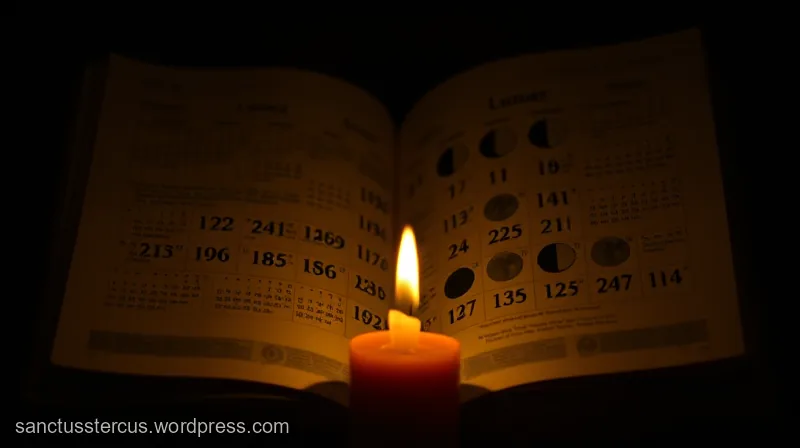
The Blue Moon Calendar Trick Explained
We use the phrase “once in a Blue Moon” to describe something that almost never happens. A rare event. A strange coincidence. But the real meaning of the term is not about rarity at all. It is about a calendar trick. A mathematical glitch between the sun and the moon. And the story of how we got this name is a mystery that spans centuries, continents, and one very confused jazz song.
Let us start at the beginning. The moon orbits Earth every 29.5 days. That is the time from one full moon to the next. The sun, however, takes 365 days to complete its yearly journey across our sky. These two numbers do not divide evenly. They never have. They never will. So every few years, the calendar gets a bonus. A thirteenth full moon appears where only twelve should fit.
That extra moon is what we call a Blue Moon. On May 31, 2026, that is exactly what happens. It is the second full moon in a single calendar month. The first was on May 2. The second is on May 31. That is the modern definition. But it was not always this way.
The Mystery Of The Missing Definition
For most of human history, people did not call any moon “blue.” The phrase did not exist in the way we use it today. The earliest written record of a blue moon comes from a 16th-century pamphlet published in 1528. Two men named Jerome Barlowe and William Roy wrote a satire attacking the Catholic Church. In it, they mocked monks who would believe anything they were told. They wrote: “If they say the moon is blue, we must believe that it is true.”
That is the first known use of the phrase. But it was a joke. A jab at blind faith. It had nothing to do with astronomy.
From there, the term drifted into popular culture. By the early 1900s, it appeared in theater programs and silent film titles. In 1934, a song called “Blue Moon” became a hit. The melody was written by Richard Rodgers, and the lyrics were written by Lorenz HA documentary filmmaker named Liz Roman Gallese found letters in the 1990s suggesting that her father, then a 17-year-old boy, sold the song after writing it himself. He claimed he was inspired by the way the moon reflected blue on Burden’s Pond in Troy, New York. This story is disputed by music historians, but it illustrates how deeply the idea of a blue moon had already rooted itself in the American imaginationhe idea of a blue moon had alreadyThe Maine Farmer’s Almanac in 1937 [1] used the term Farmer’s Almanac in 1937 [1]. The almanac used the term “Blue Moon” to describe something specific. But what exactly? The definition was hazy. No one knew for sure. The almanac did not explain itself. It just used the phrase.
The Twist That Changed Everything
The modern definition of a Blue Moon did not come from astronomers. It came from a magazine called Sky & Telescope. In 1943, an article in the magazine used the term “Blue Moon” to refer to the second full moon in a month. But even the editors admitted they did not know where the term came from. They were guessing.
Decades passed. In the 1980s, the magazine’s definition was picked up by National Public Radio [2]. Then it appeared in a children’s almanac. Then it landed on a Trivial Pursuit card. By the time the 1990s arrived, the definition was set in stone. A Blue Moon was the second full moon in a calendar month. That was it.
But here is the truth: the original definition was different. The Maine Farmer’s Almanac actually used “Blue Moon” to describe the third full moon in a season that had four full moons [1]. That is called a seasonal Blue Moon. It is rarer than the monthly version. It happens about once every 2.5 years. The monthly version happens about once every 2.7 years. So the modern definition is actually slightly more common.
The whole thing was a misunderstanding. A misinterpretation. A happy accident. And that accident became the standard.

The Moon In Our Bones
Why do we care so much about the moon at all? The answer lies deep in our past. 40,000 years ago, the Aurignacians — the first anatomically modern humans in Europe — carved a deer antler with a long, serpentine line of notches. Archaeologists believe these notches track the phases of the moon. It is the oldest known lunar calendar.
In Caral, Peru, an ancient city that predates the Egyptian pyramids, people built stone structures to observe the moon. They depended on the Pacific OcCésar Gonzalez-Garcia, an archaeoastronomer at the University of Santiago de Compostela in Spain, has studied these ancient cultures [3]. He notes that China, the Near East, and the Maya all developed lunar calendars separate from their solar calendarsdied these ancient cultures [3]. He says that China, the Near East, and the Maya all had lunar calendars separate from their solar calendars. The Inuit had a creation story about the sun and moon chasing each other across the sky. Every culture found a way to count the moons.
The moon was not just a light in the sky. It was a clock. A calendar. A compass. It told people when to plant, when to harvest, when to fish, when to pray. It was the first timekeeping device our species ever had.
The Traditions That Survive
We do not need the moon to tell time anymore. Our phones do that. Our computers do that. Our watches do that. But some traditions still depend on the lunar cycle.
The Lunar New Year falls on the second new moon after the winter solstice. It is celebrated by billions of people across Asia and around the world. Easter moves every year because it is tied to the full moon. It always falls on the Sunday after the first full moon following the vernal equinox. In Spain, during Holy Week, the streets fill with processions that follow this ancient lunar rhythm.
The Hijri calendar, used by Muslims worldwide, is a purely lunar calendar. It is 11 days shorter than the Gregorian calendar. That is why Ramadan moves earlier each year. The start and end of the holy month are determined by the sighting of the new moon.
These traditions remind us that the moon is still part of our lives. Even if we do not always notice it.
The Color That Never Was
Here is the strangest part of the story. The moon is never actually blue. Not in the way we mean. Yes, sometimes volcanic eruptions or massive forest fires can fill the atmosphere with ash and smoke. That can scatter light in a way that makes the moon appear bluish. But that is rare. Extremely rare. And it has nothing to do with the calendar definition.
The color “blue” in “Blue Moon” is a metaphor. It means “unlikely.” It means “absurd.” It means “never.” The phrase “once in a Blue Moon” originally meant something that would never happen. Like pigs flying. Or the moon turning blue.
But over time, the meaning shifted. It came to mean something rare. Something special. Something worth waiting for.
And that is exactly what a Blue Moon is. Not rare in the cosmic sense. But rare enough to feel special. Rare enough to write songs about. Rare enough to name a beer after.
The Moon As An Old Friend
Kevin Schindler, the historian at Lowell Observatory in Flagstaff, Arizona, puts it simply. “The moon is kind of an old friend,” he says. “Whatever culture you’re in, the moon is part of it. Origin stories. Mythology. The fact that our species has walked there. And then just weeks ago we went back after more than half a century. Orbiting it. It is mysterious and embedded in who we are.”
He points out that we give the full moon affectionate nicknames. Harvest Moon. Strawberry Moon. Cold Moon. Each name marks a season. Each name tells a story. “Blue Moon” does something technical too. It tells us our year got a lunar bonus.
Schindler works at the same observatory where Pluto was discovered in 1930. He has spent his career helping people look up. And he knows the power of a simple thing. “If you want to wow people,” he says, “just point a telescope at the moon and stand back. That is all you have to do.”
The Circle Closes
On May 31, 2026, the moon will rise full and bright over Burden’s Pond in Troy, New York. It will not be blue. It will be the same pale silver it has always been. The same color it was when a 17-year-old boy claimed he wrote a song about it nearly a century ago. The same color it was when the Aurignacians carved notches into a deer antler 40,000 years ago.
But we will call it Blue anyway. Because the name is not about the color. It is about the moment. The pause. The recognition that something unusual is happening in the sky.
The moon is an old friend. And sometimes, an old friend deserves a nickname.
So look up on May 31. Watch the second full moon of the month rise over your horizon. It will not be blue. But it will be special. Because you know its story now. You know the mystery. You know the misunderstanding. You know the centuries of songs and poems and calendars that led to this one moment.
The moon is not blue. But the name holds a secret. And now, you are part of it.