The Line That Was Crossed Before Anyone Agreed to Cross It
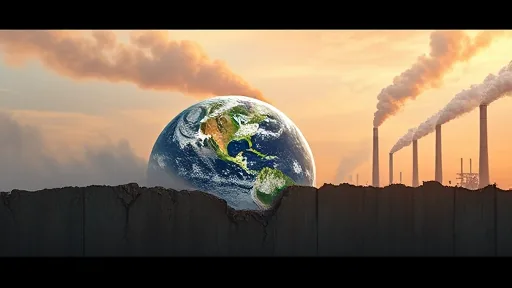
For years the number 1.5 °C functioned as a wall. Not a target to approach, but a boundary to stay behind — the point beyond which the Paris Agreement’s most ambitious promise would slip from reach. The UN’s latest Emissions Gap report now says the world will pass through that wall rather than stop at it. [1] The breach is described as inevitable, the product of decades of insufficient climate action.
The arithmetic behind that verdict is blunt. Global greenhouse gas emissions in 2025 totalled 58.4 billion tonnes of carbon dioxide equivalent — roughly 0.16 billion tonnes below 2024, a gap small enough to sit inside the measurement uncertainty. [1] The report calls the two years “comparable”, and because the figures are provisional it does not permit a conclusion about the overall direction of emissions in 2025. The growth rate has been slowing for decades: an average of 1.7 per cent per year between 1990 and 2015, then 0.8 per cent per year since 2016. Slower growth is not decline. A car easing off the accelerator is still moving forward.
Current national policies put the world on track for 2.8 °C of warming by the end of the century. [1] If every nation delivers every climate promise it has made, that figure drops to 2.1 °C — worse than last year’s projection of 1.9 °C, driven mainly by the United States’ exit from the UN climate process.
What “Overshoot” Actually Asks the World to Build
The report’s answer to an unavoidable breach is a controlled one. It sets out “overshoot pathways” designed to keep the 1.5 °C goal alive as a political reference point: temperatures rise past the limit, then are brought back down. The “lowest possible” version of this scenario peaks at 1.7 °C to 1.8 °C around mid-century, with a 50 per cent chance of returning to 1.5 °C by 2100. The path requires emissions cuts of 18 per cent by 2030, 45 per cent by 2035 and 69 per cent by 2040, all measured against 2025 levels. Under current pledges, emissions fall only 5 to 8 per cent by 2030 and 11 to 15 per cent by 2035.
That return journey depends on removing carbon dioxide from the atmosphere at scale — through technologies such as direct air capture, alongside natural cooling — in the second half of the century. The report’s title, “The point of return”, frames the task as engineering a descent rather than preventing a climb.
Bob Watson, emeritus professor at the University of East Anglia and former chair of the Intergovernmental Panel on Climate Change, does not accept that bet. “We don’t know whether we can overshoot,” he says. “We don’t know if any of those technologies are real, and so when people assume that we can meet 1.5 °C or 2 °C, and the assumption is based on overshooting and coming back, I think they’re in cuckoo land.” Joeri Rogelj of Imperial College London frames the breach differently — as “a failure that we try to rectify”. He argues the 1.5 °C goal retains value precisely because abandoning it for a higher limit would abandon the people it was designed to protect. “The target is still to limit harm to vulnerable and poor populations, and that we don’t do by resetting the target to an inadequate limit of 2 °C, or 2.5 °C,” he says. Keeping an unmet limit, on this reading, is not sentimentality. It is a measuring stick that keeps the shortfall visible, and in Rogelj’s view the failure to stay within the limit should re-emphasise the need to stay as close to it as possible.