
Agricultural Liming Acts as Carbon Sink Not Source
When Thirty Million Tonnes Flip Sign
For years, the accounting seemed straightforward. Every year, more than 30 million tonnes of agricultural lime — mainly calcium and magnesium carbonates — are spread across US croplands to hold soil acidity at the level crops prefer. The United Nations Intergovernmental Panel on Climate Change counts this practice, called liming, as a greenhouse-gas source. The logic looks airtight: lime carries alkalinity, alkalinity neutralizes strong acids in soil, and that neutralization reaction releases carbon dioxide. A source is a source.
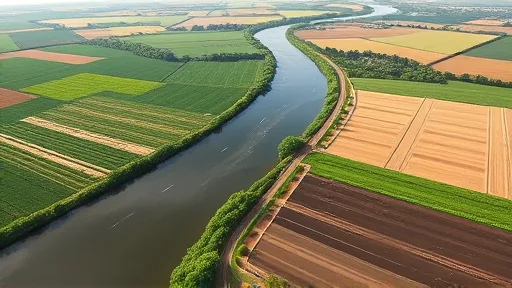
That is exactly what a team led by T. J. Suhrhoff reports in Nature. [2] The researchers assembled a comprehensive analysis of water chemistry across the Mississippi River basin — the drainage that gathers runoff from the heart of US agriculture — and found that, taken as a whole, lime has acted as a substantial sink for atmospheric carbon dioxide, not a source. [2] The gas drawn down exceeds the gas released. Agricultural liming, in effect, becomes a strategy for carbon dioxide reduction rather than a line item on the emissions ledger.
The difference is that the basin-scale balance includes pathways the field-scale view leaves out. Along that journey, chemistry continues. What matters for the atmosphere is the net exchange across the whole system, and at that scale the direction reverses.
A Ledger That Counted Only One Column
The IPCC guidelines that classify liming as an emissions source date to 2006. They were built to serve national greenhouse-gas inventories — a bookkeeping task that needs simple, reproducible factors applied per hectare. That design choice has a consequence: it captures the carbon dioxide leaving the soil, but it does not follow the dissolved carbon any farther. The inventory treats each field as a closed box. Rivers are not in the box.

G. Philip Robertson, who works at the W.K. Kellogg Biological Station and the Department of Plant, Soil, and Microbial Sciences at Michigan State University, has spent years on exactly this boundary problem. In a 2007 study in Global Biogeochemical Cycles, he and co-authors S. K. Hamilton, A. L. Kurzman, C. Arango, and L. Jin examined how agricultural landscapes move carbon through water. [2] The new analysis extends that thread: the missing column in the ledger is transport. Carbon that leaves a field dissolved in water has not finished its story.
The US Environmental Protection Agency’s inventory of greenhouse gas emissions and sinks, covering 1990 to 2020, inherits the same single-column structure. It reports what the soil emits. It does not report what the basin absorbs. So the national total carries an error whose direction, according to the new analysis, points the wrong way.
Stephen K. Hamilton, affiliated with the W.K. Kellogg Biological Station and the Department of Integrative Biology at Michigan State University, is a co-author of that earlier work and a long-standing collaborator on the water-chemistry side of the question. Neither discipline alone would have caught the reversal.
Sources
1. DOI: 10.1038/d41586-026-02646-7
2. DOI: 10.1038/s41586-026-11040-2
Mentioned organisations (context, not sources)
- United Nations Intergovernmental Panel on Climate Change — Organisation (homepage)
- Nature — Organisation (homepage)
- W.K. Kellogg Biological Station — Organisation (homepage)
- Michigan State University — Organisation (homepage)
- Global Biogeochemical Cycles — Organisation (homepage)
- US Environmental Protection Agency — Organisation (homepage)