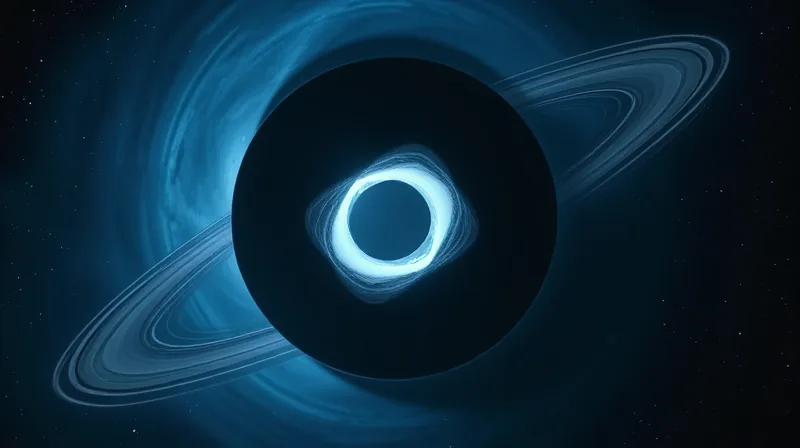
Saturns Ten Sided Storm and October Sky Events
When a Six-Sided Pattern Met Its Match
For decades, the hexagon at Saturn’s north pole stood as the strangest known shape in the solar system. A hexagon-shaped jet stream that spans nearly 20,000 miles across Saturn’s north pole, locked into six straight sides, spinning above the ringed planet’s cloud tops. Astronomers had long known about that hexagon-shaped jet stream. Then, observations using NASA’s Hubble Space Telescope revealed something the models did not predict: a ten-sided atmospheric wave encircling Saturn’s south pole. [1] The discovery matters because it gives scientists the rare opportunity to watch a giant atmospheric pattern develop. Most planetary weather is studied after the fact — a storm fades, a vortex drifts, and researchers reconstruct what happened. Here, the pattern is still forming. The southern feature is not a snapshot; it is a process, and the process is still running. That distinction is the whole point. A six-sided shape taught us that planetary atmospheres can hold standing waves for years.
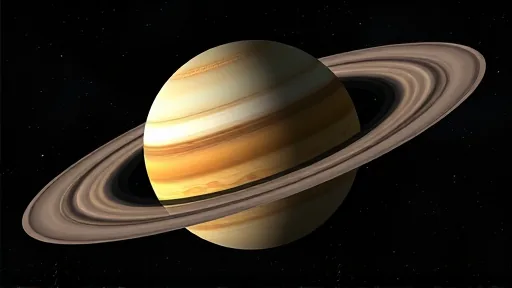
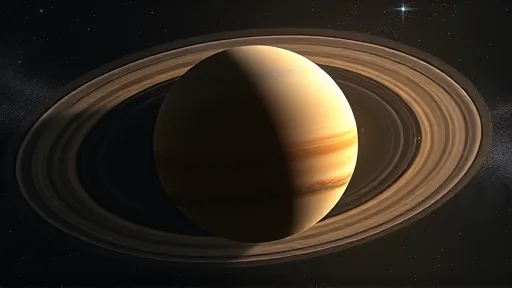
On October 4th, Saturn reaches opposition. [1] Earth passes between the Sun and Saturn, placing the planet opposite the Sun in our sky. It rises around sunset and stays visible for much of the night. This is one of the year’s best opportunities to see the ringed planet. The same planet that just surprised researchers is now at its brightest and closest for the year. A telescope pointed at Saturn in early October shows the rings, the pale banded disk, and, if the atmosphere cooperates, the region where that ten-sided wave is tightening its grip.
The Debris Trail of a Famous Comet
The Orionid meteor shower peaks on the night of October 21st into the morning of October 22nd. [1] The Orionids are created by tiny pieces of debris left behind by Halley’s Comet. But the comet’s debris trail does not wait.
The meteors appear to radiate from the direction of Orion, which is where the shower gets its name. But the radiant is a perspective effect, not a source. The meteors can streak across any part of the sky.
This year, a bright waxing gibbous Moon will wash out some of the fainter meteors. The Moon is not a small obstacle. The best chance may come in just a few hours before dawn, after the Moon sets.
The Seven Sisters and the Limits of the Eye
On the night of October 27th into the 28th, the Moon passes close to a famous star cluster called the Pleiades, also known as the Seven Sisters. Many ancient cultures had stories associated with the Pleiades, due in part to the fact that the star cluster is visible from almost everywhere on the globe. That visibility is the reason the cluster appears in mythologies separated by oceans and millennia. A group of stars that everyone can see becomes a group of stars that everyone names. The Greeks called them the Seven Sisters; other cultures saw them as a flock, a sieve, a handful of seeds. The names differ. The sky does not.
The Pleiades appear as a slightly fuzzy grouping of 6 to 7 stars. They are visible to the unaided eye, but binoculars or a telescope reveal more spectacular detail. Some people see six. Some see seven. The fuzzy patch is not a failure of the cluster; it is a limit of the instrument.
The Moon passes close to the Pleiades. But “close” on the sky is a statement about angles, not distances. The apparent meeting is a line-of-sight illusion, the same kind that makes a finger held at arm’s length seem to touch a distant mountain. The Moon, being close and bright, will likely drown out the fainter cluster stars during the closest approach. The best viewing may come later in the night, after the Moon has moved on and the cluster stands alone again.
Where the Watching Stops and the Work Begins
Every one of these October events is visible with the unaided eye or simple binoculars. That is the point of a skywatching guide, and it is also the limitation. Saturn’s ten-sided southern wave was not found by looking up. It was found by Hubble, and it will be studied by instruments that can measure wind speeds, temperatures, and chemical composition at the poles — the kind of data that turns a shape into a mechanism. The Orionids can be counted by amateurs, but the size distribution of Halley’s debris, the mass of the stream, and its long-term evolution require radar and spacecraft. The Pleiades can be admired, but the cluster’s distance, age, and stellar population come from parallax measurements and spectroscopy. The eye sees the event. The instrument explains it.
The 2010 NASA Laboratory Astrophysics Workshop, held in Gatlinberg, Tennessee, from October 25th to 28th, framed the problem in terms that still apply. Its charter was to review the current state of knowledge in laboratory astrophysics, assess the critical data needs of NASA’s current and future space astrophysics missions, and identify the challenges and opportunities facing the field. That workshop was the fourth in a roughly quadrennial series sponsored by the Astrophysics Division of the NASA Science Mission Directorate. In the resulting White Paper, the findings of the workshop were reported. The core issue it raised is the same one Saturn’s new wave raises now: space missions collect spectra and images, but interpreting them depends on laboratory measurements of how atoms and molecules behave under conditions we cannot reproduce on Earth. A ten-sided wave in Saturn’s atmosphere is an observation. Understanding why it formed, why it has ten sides, and why it is strengthening requires data that no telescope alone can provide.
The constraint is not a lack of curiosity. It is a lack of measurement. Current technology can see the pattern; it cannot yet fully explain it. The white paper’s assessment of critical data needs remains a live problem, and every new atmospheric discovery — a hexagon that should not exist, a decagon that appeared without warning — adds a line to the list. The sky in October offers three things to see: a ringed planet at its best, a comet’s debris burning overhead, and a star cluster the whole world has named. What it does not offer is the answer to why any of it looks the way it does. That part is still being measured, one laboratory experiment and one Hubble observation at a time.
> Note: Only birds’ vision was tested; other predators may perceive patterns differently.
Sources
Mentioned organisations (context, not sources)
> Note: Only birds’ vision was tested; other predators may perceive patterns differently.