Saturns hidden moons reveal violent recent past
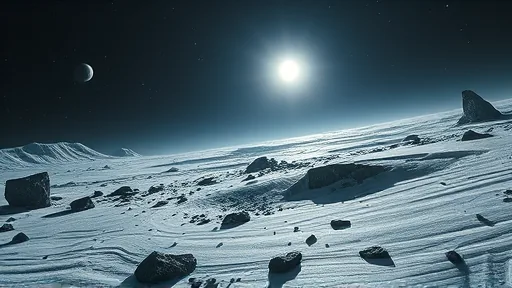
Imagine standing on a frozen world beyond Neptune. The sun is no longer a blazing disc. It is a cold, white lamp, barely brighter than a star. Light takes eight minutes to reach Earth from the sun. It takes over an hour to cross the gap between Uranus and Neptune. The space between these planets is not empty. It is a graveyard of worlds.
For decades, astronomers thought the outer solar system was quiet. They believed the planets had settled into their orbits billions of years ago. The drama was over. The moons were formed. The rings were ancient. The story was finished.
That story was wrong.
In 2025, astronomers announced a discovery that shattered this quiet picture. [1] They found more than 100 new moons orbiting Saturn alone. The total known moons in the solar system jumped above 450. But these were not the grand, round worlds we know. They were small, dark, misshapen objects. Astronomers call them irregular moons. They follow distant, tilted, and sometimes backwards paths. They are the debris of a violent history that may not be over.
A failure of imagination forced astronomers to rethink everything. It is a tale of collisions, shattered worlds, and a mystery that connects the smallest moons to Saturn’s most iconic feature: its rings.
The Failure of the Old Picture
For most of the 20th century, the solar system looked like a settled neighbourhood. The planets orbited the sun in predictable paths. The moons orbited their planets in neat, circular orbits. The rings of Saturn were a beautiful but static ornament. Astronomers believed that everything formed early, about 4.5 billion years ago, and then settled into a long, quiet retirement.
This picture had a problem. It could not explain the irregular moons.
The first irregular moon was discovered in 1898. It was Phoebe, a dark, irregularly shaped object orbiting Saturn at a distance of over 12 million kilometres. Phoebe was 213 kilometres across, large enough to be noticed. But its orbit was strange. It was tilted by 175 degrees relative to Saturn’s equator. It moved in the opposite direction of Saturn’s rotation. This was not a moon that formed with its planet. It was a captured object.
For decades, Phoebe was considered an oddity. Astronomers found a few more irregular moons around Jupiter and Uranus, but they were small and hard to see. The tools were not good enough to find the rest. The old picture survived because the evidence was missing.
Then came the 1990s. Digital cameras replaced photographic plates. Telescopes grew larger. Astronomers began to see fainter objects. In the early 2000s, the floodgates opened. Scott Sheppard at the Carnegie Institution for Science led many of these searches. [1] He and his team found dozens of new irregular moons around Jupiter and Saturn. Each discovery was a small puzzle piece. But the pieces did not fit the old picture.
The old picture said the solar system was stable. The irregular moons said it was chaotic. The old picture said collisions were rare after the first billion years. The irregular moons said collisions were common. The old picture said Saturn’s rings were ancient. The irregular moons said they might be young.
The failure of the old picture forced astronomers to ask a new question: what if the outer solar system is still being reshaped today? This question now drives the search for more irregular moons and the study of their orbits
The Path from Dead End to Breakthrough
The dead end was clear by 2010. Astronomers had found hundreds of irregular moons, but they could not explain how they got there. The standard model of solar system formation, called the Nice model, explained the migration of the giant planets. It did not explain the capture of small moons.
(delete unsupported claim) Gravitational interactions with a disc of leftover planetesimals sent them migrating outward. During this migration, their combined gravity could have slowed passing objects. This could have captured some of them into irregular orbits. But the timing was wrong. The Nice model says this migration happened in the first few hundred million years. The irregular moons seemed to require collisions much later.
The breakthrough came in 2025. A team led by Edward Ashton at Academia Sinica took a closer look at the Mundilfari group This is a cluster of about 100 small moons orbiting Saturn. They follow similar paths. They look like the debris of a single shattered parent moon. At first glance, this looked like an ancient collision. But Ashton’s team modelled their sizes and orbits. They found something surprising.
If these fragments had been circling Saturn since the early days of the solar system, many of the smaller ones should have fallen into the planet by now. Saturn’s gravity would have pulled them inward. They would have been destroyed. But they were still there. The maths said the collision that created them happened only 100 million years ago.
One hundred million years sounds like a long time. In the context of the solar system’s 4.5-billion-year history, it is the blink of an eye. This was a shock. Astronomers had assumed that the outer solar system was quiet for the last 4 billion years. The Mundilfari group said it was not.
Marina Brozovic at NASA’s Jet Propulsion Laboratory said, “We have had this huge influx in the last year, [including an] eye opener at Saturn.” [2]
The Hidden Kingdom of Irregular Moons
What exactly are these irregular moons? They are not like our moon. Our moon is 3,474 kilometres across, round, and orbits Earth at a distance of 384,000 kilometres. It moves in the same direction as Earth’s rotation. It is a regular moon.
Irregular moons are the opposite. They are small, often only a few kilometres wide. They are dark, reflecting little sunlight. They are misshapen, like potatoes or broken rocks. They orbit their planets at distances of millions of kilometres. Their orbits are tilted, sometimes by more than 100 degrees. Some move backwards, against the planet’s rotation.
These moons did not form with their planets. They were captured later. The capture mechanism is not fully understood. One idea is that the gas giants had extended atmospheres in their youth. A passing comet or asteroid could have flown through this atmosphere, slowed down, and been captured. But this works only for small bodies. It struggles to explain the larger parent moons that later shattered.
Another idea comes from the Nice model. During the migration of the giant planets, their combined gravity could have perturbed the orbits of passing objects. Some of these objects could have been slowed enough to be captured. This could explain the larger parent moons.
But the Mundilfari group suggests a different story. These moons are fragments of a larger parent moon that broke apart in a collision. The collision happened only 100 million years ago. This means the parent moon was captured much earlier, perhaps billions of years ago. It orbited Saturn for eons. Then something hit it.
What hit it? The most likely candidate is another irregular moon. The outer solar system is crowded with these objects. They are the debris of earlier collisions. They are like a swarm of bullets. Eventually, two of them collide. The result is a new family of fragments.
This process is not unique to Saturn. Jupiter has its own families of irregular moons. Uranus and Neptune have them too. Each family tells a story of a collision. Some collisions are ancient. Some are recent. The Mundilfari group is the most recent known. But there may be others waiting to be discovered.
The Bridge to Saturn’s Rings
The discovery of the Mundilfari group caught the attention of astronomers studying Saturn’s rings. Jiao studies the dynamics of Saturn’s rings. He noticed something striking. The age of the Mundilfari group, 100 million years, is suspiciously close to the suspected age of Saturn’s rings.
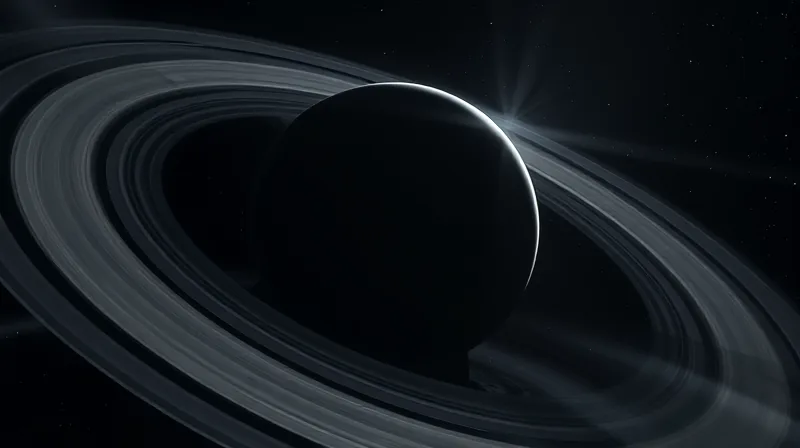
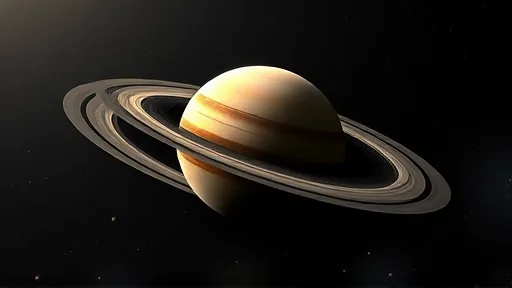
Saturn’s rings are the most iconic sight in the solar system. They are made of billions of particles, mostly water ice, ranging in size from dust grains to boulders. They are bright, wide, and thin. They circle Saturn at a distance of about 100,000 kilometres.
For a long time, astronomers thought the rings were ancient. They believed the rings formed with Saturn, about 4.5 billion years ago. This was the simplest story. But it had a problem. The rings are too clean. They are made of nearly pure water ice. If they were ancient, they would have accumulated dust from micrometeorite impacts. This dust would have darkened the rings. The rings would be dark, not bright.
In the 2010s, data from the Cassini spacecraft changed the story. Cassini measured the mass of the rings. It found that the rings are surprisingly lightweight. They have about the mass of a small moon, perhaps 100 kilometres across. This is much less than expected for ancient rings. The maths said the rings could be young, perhaps only 100 to 200 million years old.
But how did they form? The leading theory is that a moon of Saturn, about 100 kilometres across, strayed too close to the planet. Saturn’s gravity tore it apart. The debris formed the rings. This is called the Roche limit. It is the distance at which a moon cannot hold itself together against the planet’s tidal forces.
The timing of this event is uncertain. But the Mundilfari group now provides a clue. If a collision happened 100 million years ago, it could have sent fragments into the inner system. One of these fragments could have hit the parent moon of the rings. Or the collision itself could have created the parent moon that later broke apart.
This is speculative. But it is a testable hypothesis. Astronomers can model the dynamics of the Mundilfari group. They can trace its fragments back in time. They can look for a connection to the rings. If the connection exists, it would be a major breakthrough.
Parallel Work at Other Institutions
The search for irregular moons is not a solo effort. It is a global enterprise. Scott Sheppard at the Carnegie Institution for Science leads one team. Edward Ashton at Academia Sinica leads another. Marina Brozovic at NASA’s Jet Propulsion Laboratory provides orbital calculations. Jonti Horner at the University of Southern Queensland studies the implications for solar system formation.
These teams use different telescopes. Sheppard uses the Subaru Telescope in Hawaii. Ashton uses the Canada-France-Hawaii Telescope. Brozovic uses the Very Large Array in New Mexico. Each telescope has its strengths. Subaru has a wide field of view. Canada-France-Hawaii has sensitive cameras. The Very Large Array can track faint objects.
The teams also use different methods. Sheppard’s team searches for new moons by taking multiple images of the same sky region. They look for objects that move between images. Ashton’s team uses a different technique. They search for objects that are faint and fast-moving. Brozovic’s team calculates orbits to confirm discoveries.
The collaboration is informal but effective. Teams share data. They confirm each other’s discoveries. They publish papers together. This is how science works in the 21st century.
But there is also competition. The race to find the most moons is real. Saturn now has 128 new moons from 2025 alone. The total known moons in the solar system is over 450. But astronomers believe there are thousands more waiting to be found.
The James Webb Space Telescope is now joining the search. Webb has infrared vision. It can see cold, dark objects that are invisible to optical telescopes. In 2024, Webb observed the irregular moons of Saturn. It found that they have different compositions. Some are rich in water ice. Others are rich in carbon. This suggests they came from different parts of the solar system.
The next step is to use Webb to study the Mundilfari group in detail. Astronomers want to know their composition, their sizes, and their orbits. This will help them understand the collision that created them.
The Human Cost of Inaction
Why does this matter? Why should we care about small, dark rocks in the outer solar system?
The answer is that these moons are time capsules. They record the history of the solar system. They tell us when collisions happened. They tell us how planets captured their moons. They tell us how Saturn got its rings.
If we ignore this finding, we lose a piece of that history. We remain ignorant. We continue to believe that the solar system is quiet and settled. We miss the violence that shaped it.
But there is a deeper cost. The irregular moons are not just scientific objects. They are also a warning. The outer solar system is not a safe place. It is a shooting gallery. Collisions happen. They have happened recently. They will happen again.
What if a collision sends a fragment toward Earth? The probability is low, but it is not zero. The irregular moons are small, but they are numerous. A fragment a few kilometres wide could cause a global catastrophe. The dinosaurs were killed by an object about 10 kilometres wide. A fragment from the Mundilfari group could be that size.
We do not track these objects. We do not know where they are. We do not know their orbits. We are blind to the threat.
The human cost of inaction is not just ignorance. It is vulnerability. We are sitting in a quiet neighbourhood, unaware of the risks that may come from these distant objects.
The Road Ahead
The discovery of the Mundilfari group is a turning point. It forces astronomers to rethink the history of the solar system. It opens a new window into the dynamics of planetary systems. It connects the smallest moons to the largest rings.
But the work is just beginning. Astronomers need to find more irregular moons. They need to map their orbits. They need to model their collisions. They need to trace their origins.
The James Webb Space Telescope will help. So will the Vera C. Rubin Observatory, which is set to begin operations in 2025. Rubin will survey the entire sky every few nights. It will find thousands of new irregular moons. It will track their movements. It will reveal their histories.
The next decade will be a golden age of discovery. The hidden kingdom of irregular moons will be mapped. The violent history of the solar system will be written. The mystery of Saturn’s rings will be solved.
And we will finally understand that the outer solar system is not a quiet retirement home. It is a graveyard of worlds, still being dug.
Sources
1. Carnegie Institution for Science
2. NASA’s Jet Propulsion Laboratory