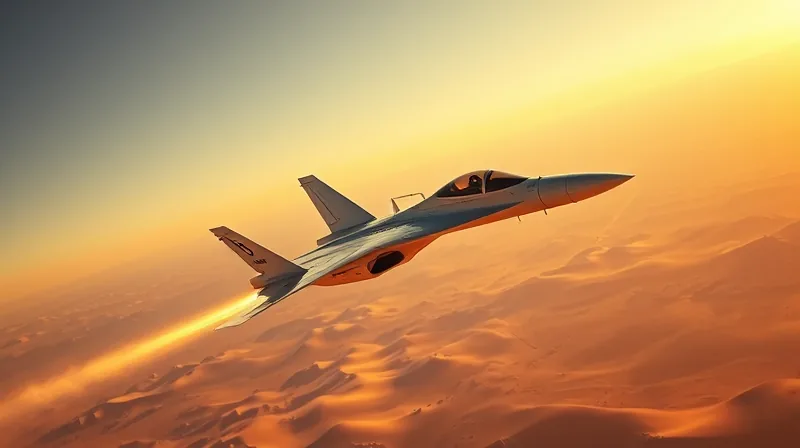
NASA X-59 Supersonic Jet Designed to Quiet Sonic Booms
Meta commentary - no external expert source; basis: Feeds.bbci.co.uk (2026-09-25). #MetaEconPol
4,520 miles per hour. That was the X-15, a rocket plane — a cylinder with tiny wings, dropped from a B-52 bomber — that flew at 6.7 times the speed of sound, all the way to the edge of space. The heat-resistant materials it demanded later proved vital to the Space Shuttle. Now the part that is easy to miss: speed was never the real obstacle to a fast airliner. Noise was. Each X-plane is built to answer a single question, and the next machine begins with whatever the last one proved. The current machine in that line is the X-59, and it is one of the strangest aircraft ever to leave a runway.
Bending the Boom Into a Bump
A sonic boom is not engine noise. It is the shockwave created by a jet breaking the sound barrier, and it arrives on the ground as a bang. That single physical fact shaped civil aviation for a generation. It restricted Concorde, the supersonic airliner, to flights over the sea and kept it off the lucrative routes across the United States. The boom, not the fuel bill, drew that line on the map.
NASA now works around the problem instead of accepting it. The X-59 uses an elongated snout — the anteater nose — to flatten a supersonic boom into something closer to a tolerable bump in the background. Whether it actually is tolerable is not a question for engineers alone. The agency flies the aircraft alongside community surveys that record what residents notice when the stretched nose bends the boom. Peter Coen, a 43-year NASA veteran who manages the programme, states the goal plainly: “We want to figure out what level of boom is acceptable to people on a regular basis
Coen’s own estimate of the sound is specific. He reckons his machine will come across “like a car door being closed across the street” when it passes Mach 1 — around 660 miles per hour at the altitude airliners cruise at. Mach 1 is the speed of sound; above it, an aircraft is supersonic.
Bullets and a Jigsaw Airframe
The X-59 is not a prototype airliner. It is the latest in a series of experimental NASA aircraft that reaches back to 1947 and the Bell X-1, the first plane to break the sound barrier. Coen explains the thinking behind 80 years of X-planes: “Our approach is to pick small goals we aim to prove with flight data and we construct an airframe for that one task.” The philosophy is subtraction: fewer goals, lower cost. Minimise goals, he says, because “the more goals you have the more expensive it gets.” For the X-59 the goal is suppressed sonic booms on a budget, and nothing else. Every aircraft in that series was built to answer exactly one question.
The X-1 was the purest expression of that logic. NASA knew a.50 calibre bullet travels faster than the speed of sound, so the stumpy little aircraft was shaped like a bullet with wings added. Chuck Yeager, the legendary test pilot, flew it through the barrier in 1947.
The X-59 is the opposite of a bullet. It is a jigsaw, assembled by Lockheed Martin for NASA: the cockpit and ejector seat came from a T-38 training jet, the landing gear from an F-16 fighter, the engine from an F-18. Because the cockpit sits so far back, the pilot has no forward vision and depends on a camera feeding a screen in front of him. That workaround relies on instantaneous computer processing. The aircraft first flew in 2025 and is now breaking the sound barrier over selected American towns. A shape built to be quiet on the ground is, from the cockpit, flown on a screen.
Who Flies When Drones Are Cheap
Cheap drones are being developed fast, not least in Ukraine’s war against Russia, and the obvious question follows: why put a human in an experimental jet at all? NASA asked it too and considered an uncrewed X-59. The answer was not sentiment. Removing the pilot would have added the cost and the complication of certifying a robot jet to fly fast over urban areas. There was a second constraint. The X-59 had to be big enough to resemble an airliner punching through the sound barrier, and that size left room for a cockpit in any case.
NASA is no stranger to pilotless X-planes. The X-48, a scaled-down model of an airliner whose wing and fuselage blend into a single lifting body, flew in 2007, and its 20-foot wingspan kept the programme within budget. Keeping it small kept the programme within budget. Coen’s forecast is conditional rather than romantic: “It’s likely that future X-planes will be uncrewed,” he says — “unless the technology we’re researching relates to piloting or if crewing it is more cost-effective
Guy Gratton, professor of Aircraft Test and Evaluation at Cranfield University, rejects the suggestion that crewed test planes have had their day. “There’s a belief in certain quarters that drones can do everything,” he says. “In Ukraine they’ve done amazing things with drones, but if you want to carry people you can’t take short-cuts.” His objection is about what is learned, not about what is flown. Without a pilot in the loop, the lessons a pilot would identify are lost. Testing a drone can also require four times as many people on the ground, and the staff monitoring signals are an indirect cost. Avoiding that cost is what keeps some piloted X-planes comparatively affordable.
Britain has run a parallel experiment. Chris Yeo sat in the pilot’s seat of the Experimental Aircraft Programme, which flew from Lancashire in 1986 and tested core systems for the Typhoon fighter. He sees the shared heritage with the American X-planes: they all research some facet of flight and demonstrate that a design works. “A lot of people say they can do something,” he says, “but you only know it works when the design has been tested and certified.”
Forty years on, a new British technology demonstrator is taking shape. Tony Godbold, who runs the project for BAE Systems, calls it “the X-plane of our generation It pulls together 100 UK suppliers, Rolls-Royce among them, to test ideas that might make it into the Global Combat Air Programme — the fighter Britain, Italy and Japan intend to fly in the 2030s. The demonstrator will borrow engines from the existing Typhoon and is scheduled to fly in 2028. The prospect has stirred Britain’s small community of qualified fast-jet test pilots: almost all of them, around 14, says Godbold, have already tried the aircraft on a flight simulator.
Godbold is direct about why the human still matters. “You can model a lot on computers and simulators,” he says, “but the experience of test pilots is when stuff gets real, we only really learn things when we get their feedback.” There is a political dimension as well. The aircraft demonstrates, in his words, that “we are serious in this space” — a message aimed at the partners in GCAP.
The first paradox resolves. The pilot looks like the most expensive component of an experimental aircraft and turns out to be a saving, because a machine tested from the ground can demand four times as many people to watch it. The second paradox is the one the programme has to keep flying. Coen expects future X-planes to be uncrewed — unless the research itself is about piloting, or unless a crew is the cheaper way to learn. The X-59 keeps a pilot in the seat for a reason that has nothing to do with his hands: the aircraft had to be the size of an airliner, so there was room for a cockpit. Whether that is an argument for keeping pilots, or only the reason this one had a place to sit, is left open. The arithmetic, not the romance, will settle it.
Sources
Mentioned organisations (context, not sources)
- NASA — Organisation (homepage)
- Lockheed Martin — Organisation (homepage)
- Cranfield University — Organisation (homepage)