Mega-Earth Discovery Challenges Planet Formation Theories
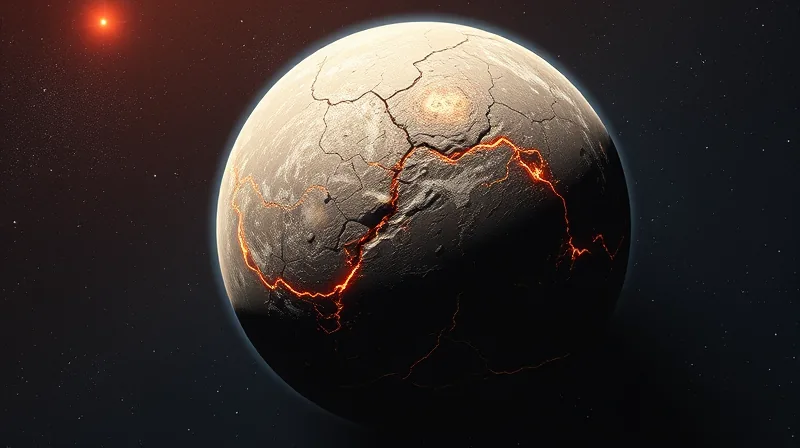
Astronomers have found a world that should not exist. The object, designated GJ 523b, sits far beyond our solar system. It is a rocky planet with a mass about 23 times that of Earth. Yet its width measures only about 2.5 times Earth’s diameter. That combination of size and weight defies everything scientists thought they knew about how planets form.
The discovery forces a fundamental rethink. Before this find, planetary science operated on a simple ladder of expectations. Small rocky worlds like Earth or Mars stay relatively light. Giant worlds like Jupiter or Saturn become gas giants because their gravity pulls in vast amounts of hydrogen and helium. A rocky planet this massive was considered impossible. The math did not allow it. The physics did not permit it. And yet GJ 523b exists, dense and solid, challenging the foundational assumption that massive planets must necessarily be gaseous.
Researchers have submitted their findings to The Astronomical Journal. The paper has not yet passed peer review, meaning other experts have not independently verified the results. Still, the data comes from a reliable source. NASA’s Transiting Exoplanet Survey Satellite first identified the planet. That space telescope has proven its worth many times over, spotting thousands of candidate worlds since its launch.
When Old Models Fall Short
The discovery of GJ 523b casts earlier planetary classifications in a new light. Astronomers have long used simple categories to describe exoplanets. There are rocky planets like Earth. There are gas giants like Jupiter. There are ice giants like Neptune. And there are super-Earths, which are larger than our planet but still primarily rocky. This new find fits none of those boxes comfortably.
The term ‘mega-Earth’ has emerged to describe this unusual object. It signals a category that was previously only theoretical. Scientists had speculated that such worlds might exist somewhere in the cosmos, but no one had confirmed one until now. The planet’s density is the key detail. It packs about 23 Earth masses into a volume just over six times Earth’s. That makes it far denser than any gas giant and comparable to solid rock.
The planetary system hosting GJ 523b is relatively young. Researchers estimate its age at nearly 170 million years, though this figure has not been independently verified. For context, our solar system has existed for about 4.6 billion years. This young system offers a snapshot of planetary evolution in its early stages. The fact that such a massive rocky world formed so quickly adds another layer of mystery to the discovery.
The Next Measurement That Matters
The research team has not yet revealed all the details of their work. The paper submitted to The Astronomical Journal contains their full analysis, but the scientific community awaits the peer review process. That review will determine whether the findings hold up under scrutiny.
What remains unknown is the planet’s exact composition. The current data tells astronomers that GJ 523b is dense and rocky. It does not tell them precisely what minerals or elements make up its interior. Future observations could measure the planet’s spectrum, revealing chemical signatures that hint at its makeup.
The broader implications stretch beyond one strange planet. If mega-Earths can form naturally, then planetary systems may be far more diverse than previously imagined. The billions of exoplanets that likely populate our galaxy might include many more of these dense, rocky giants. Each one would challenge existing theories of planetary formation. Each one would demand new explanations for how such worlds come to be.
Sources
1. NASA