Black Hole Duos Create a Lighthouse in the Sky: How Repeating Starlight Flashes Could Reveal the Universe’s Hidden Giants
Think of a single magnifying glass. To burn a hole in a leaf, you must hold it at the exact angle and distance. A single supermassive black hole works the same way. It can bend light from a star behind it, making it look brighter, but only if the star, the black hole, and Earth are in a nearly perfect line. This rare event is called gravitational lensing.
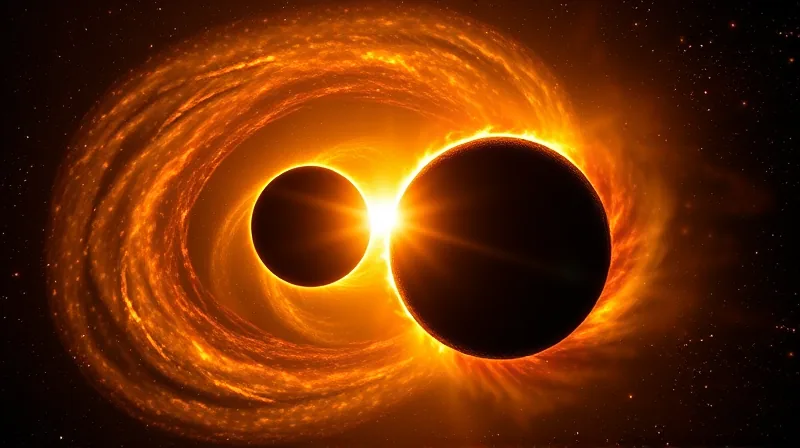
Now, imagine two magnifying glasses, spinning around each other. They create a much larger area where light gets bent and focused. This is the new idea from scientists at the University of Oxford and the Max Planck Institute for Gravitational Physics. [1] They say that when two supermassive black holes orbit each other very closely, they act like a pair of moving lenses. Instead of one perfect alignment, they create a moving, diamond-shaped zone of extreme focus. Any star that wanders into this zone gets magnified enormously.
This is not a one-time flash. Because the two black holes are spiraling inward, losing energy by sending out gravitational waves—a ripple in space-time predicted by Einstein—the diamond-shaped focus zone rotates and sweeps through space like a lighthouse beam. A star that sits inside this sweep will flash brightly each time the beam passes over it. These are not random flashes. They repeat in a predictable rhythm, tied to the black holes’ orbit.
Before this study, astronomers could only find supermassive black hole pairs that were far apart. The close-knit, tightly orbiting pairs were invisible. They are too small and too distant for our telescopes to see directly. The old way was to look for the gravitational waves they emit, but the best detectors for that are still years away from launch.
This new method changes the game. It uses existing and upcoming telescopes that scan the sky for changes in brightness, like the Vera C. Rubin Observatory and the Nancy Grace Roman Space Telescope. [3] Instead of waiting for space-based detectors, astronomers can now search for the repeating starlight flashes in data we already have or will collect soon.
The timing and brightness of these flashes are not random. They carry a fingerprint. By analyzing how fast the flashes repeat and how bright they get, scientists can estimate the masses of the two black holes and how fast they are spiraling together. This is like reading the label on a hidden package without opening it.
This work connects two big areas of astronomy. One is the study of galaxy mergers. When galaxies collide, their central black holes should eventually pair up. The Antennae galaxies, a famous pair of colliding galaxies 45 million light-years away, are a perfect example. Recent observations using the ALMA telescope in Chile have looked for flickering light in the center of these galaxies, searching for signs of a hidden, feeding black hole. That search is about finding one black hole that is active. The Oxford study goes a step further, predicting what happens when two black holes are locked in a death spiral.
The other area is gravitational wave science. The Laser Interferometer Space Antenna (LISA), a future space mission, will detect the gravitational waves from these supermassive black hole pairs. But LISA is not scheduled to launch until the 2030s. The new method offers a way to find the same systems years earlier using light alone. This is called multi-messenger astronomy: seeing the light flash from the black hole pair, and later, hearing the gravitational wave hum from the same source. It is like seeing the lightning before you hear the thunder.
Graduate student Hanxi Wang, who led the study, explained that the caustic curve—the diamond-shaped focus zone—rotates and precesses, sweeping across a large volume of stars. Each time it passes a bright star, a flash occurs. This pattern is a clear and distinctive signature, opening the door to testing gravity and black hole physics in entirely new ways.
The research, published in Physical Review Letters, builds on a study on gravitational lensing by black holes in the journal Nature (DOI: 10.1038/s41586-024-08121-1). That earlier work showed how single black holes can act as natural telescopes. The new study extends that idea to pairs. The core idea is simple: two moving lenses create a moving spotlight. The result is a new way to see the invisible giants at the heart of merging galaxies.
Sources
2. Max Planck Institute for Gravitational Physics