
Raindrops Can Generate 9000 Volts and Damage Car Paint
For decades, the car owner’s enemy list has been painfully predictable. Bird droppings, tree sap, road salt, and the relentless ultraviolet rays of the sun. People respond with wax layers, ceramic coatings, garage parking, and elaborate cover systems. The assumption has always been simple: if you block the physical contact between the environment and the paint, you win the battle. Rain, after all, seemed like the benign part of the equation. It washes things. It does not attack them.
That assumption now has a problem. Researchers have found that raindrops can generate a voltage of roughly 9,000 volts under certain conditions, a discovery published in the journal Nature To put that figure into perspective, a standard household electrical outlet in most homes delivers about 120 volts. An electric fence designed to contain livestock typically operates between 5,000 and 10,000 volts. A single raindrop, sliding across the right surface, can accumulate energy comparable to a fence meant to stop a charging bull.
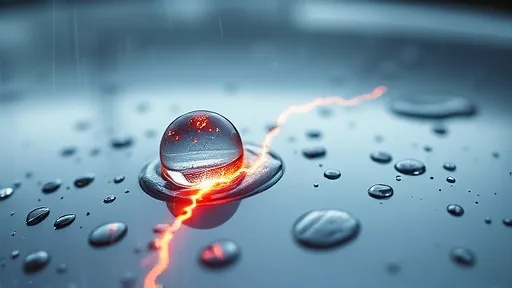
The mechanism at work is called sliding electrification. When a water droplet moves across an insulated surface, it exchanges electrical charges with that surface. The droplet leaves one type of charge behind while picking up the opposite charge for itself. The droplet becomes a tiny, traveling battery. When that charged droplet then encounters a metal surface, the electrical field between the droplet and the metal grows rapidly. Upon impact, the stored energy discharges. That discharge is what punches holes through protective coatings and attacks the metal underneath.
The researchers set up a careful experiment to observe this effect in action. They took a sample of copper and coated it with Teflon film, which is widely considered one of the most chemically resistant coatings commercially available today. They placed this sample at a slight angle of 10 degrees. Then they exposed it to 3,000 water droplets, each containing a small amount of salt to replicate the composition of real raindrops. That number of droplets was chosen deliberately, as it roughly matches what a surface would encounter during a moderate afternoon rain shower.
The results of that first test were surprisingly clean. The Teflon-coated copper surface showed no visible changes and no damage whatsoever. Direct rainfall alone, it seemed, was not the problem. The researchers had to look elsewhere to understand when raindrops become dangerous.
The Hidden Danger of the Second Landing
The key variable, it turned out, was not the droplet itself but the journey it took before arriving. The researchers prepared four different kinds of insulated surfaces, each chosen to represent a common real-world scenario. They used a plant leaf, representing natural vegetation. They used a polyvinyl chloride foam board, commonly known as PVC, representing construction materials. They used polystyrene glass, representing a window. And they used a quartz plate coated with a chemical water repellent called perfluorooctadecyltrichlorosilane, or PFOTS for short.
Each of these surfaces was tilted at roughly 50 degrees. The researchers then released the same 3,000 saltwater droplets onto each surface. This time, however, the droplets did not fall directly onto the protected metal. Instead, they were allowed to slide down the tilted insulated surface and then drop onto a fresh copper sample coated in Teflon, positioned just 5 millimeters below. The droplets were not hitting the metal directly from the sky. They were arriving after a journey across another material.
The difference was dramatic. Using atomic force microscopy, the researchers found defects on the metal samples that had eaten completely through both the Teflon film and the copper beneath it. [1] These were not superficial scratches or minor blemishes. The damage was structural, cutting through the protective layer and into the metal itself. The researchers also used a high-speed camera to film the droplets as they landed. The footage showed the water droplets visibly changing behavior as they struck the Teflon-coated copper surface.
The researchers then expanded their investigation to test whether the thickness of the coating or the type of metal made a difference. They tested various coating thicknesses on copper. They also tested the same approach on gold, a metal known for its resistance to corrosion. In every configuration, the results were the same. Regardless of the metal type or how thick the protective coating was, all samples experienced corrosion similar to what was observed in the initial Teflon-coated copper test.
This finding carries a specific implication. The damage is not a matter of weak materials or inadequate protection. The mechanism itself bypasses the protective qualities of the coating. The discharge event creates a physical breach, and once that breach exists, the saltwater left behind by the droplet continues to erode the exposed metal. The droplet also creates a small divot or pocket in the damaged surface, which means the saltwater has a place to pool and linger rather than washing away.
The Uneven Geography of Corrosion Risk
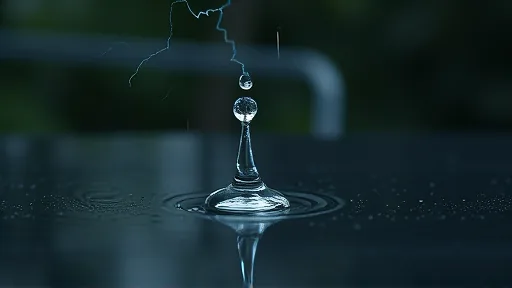
The practical implications of this research are specific rather than universal. The charging effect requires a particular sequence of events. A water droplet must first slide across an insulated surface, such as a house roof, a tree canopy, or a window. During that sliding motion, the droplet picks up its electrical charge. Only then, when it falls from that surface onto a metal object below, does the discharge occur. The droplet essentially becomes a small lightning bolt, carrying the accumulated charge from one surface and delivering it to another.
The researchers also tested what happens when droplets fall onto non-conductive materials. Those surfaces experienced no corrosion at all. The discharge event requires a conductive target. Plastics and other insulating materials do not provide the conditions necessary for the electrical breakdown to occur. This means the risk is not evenly distributed across all situations. A car parked in an open field, receiving direct rainfall, faces a different risk profile than a car parked under a tree or beside a building where water runs off one surface before landing on another.
The study focused on copper and gold as test metals, which are common in electrical components and certain automotive applications. The study focused on copper and gold, metals common in electrical components and certain automotive applications. The researchers did not test automotive clear coats or paint systems directly, so the connection to car paint remains an inference from the mechanism rather than a laboratory demonstration. What the study establishes is that sliding electrification can generate sufficient voltage to breach robust protective coatings on metals. Whether automotive paint systems respond identically to Teflon film remains an open question for future research.
What is clear from the research is that the physical pathway for this type of corrosion exists. Raindrops can carry a charge acquired from one surface and deliver it destructively to another. The 9,000-volt figure represents the upper range observed in the experiments, not a universal constant for every raindrop in every situation. The charge accumulates based on the distance the droplet travels across the insulated surface and the properties of that surface.A droplet that falls directly from the sky onto a metal surface carries no charge and causes no damage, as the first phase of the experiment demonstrated.
The research opens a new line of inquiry into how everyday environmental phenomena interact with the materials we rely on. The protective coatings industry has focused on chemical resistance and physical durability. This study suggests that electrical effects from mundane sources like sliding water may need to be part of that calculation. For the car owner, the practical takeaway is straightforward: parking under a tree or beside a structure where rainwater runs off and then drips onto the vehicle may carry risks that direct exposure to rain does not.
Sources
1. Nature