
Raindrops generate high voltage and corrode metal coatings
A single raindrop carries no visible power. It lands softly on a windshield, a roof, a hood. But scientists have discovered something unsettling about these gentle visitors: when they slide across certain surfaces, they can build up an electrical charge of up to 9,000 volts. [1] That is enough to punch microscopic holes through protective coatings and into the metal beneath. A study published in Nature reveals a form of corrosion driven not by chemical exposure alone, but by the electrical physics of moving water
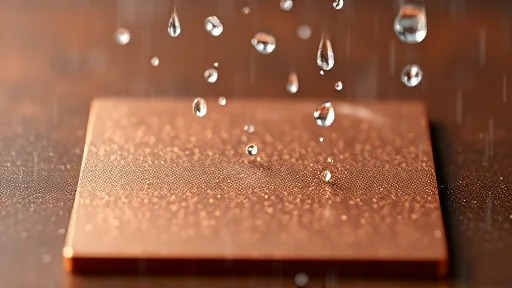
To understand how this works, researchers began with a simple experiment. They took a piece of copper and coated it in Teflon film, one of the most chemically resistant materials available today. They tilted the sample at a 10-degree angle and released 3,000 saltwater droplets onto it, mimicking what a surface might experience during a moderate afternoon rain. The droplets fell straight down. They did not slide. And after all 3,000 impacts, the surface showed no damage whatsoever. The Teflon remained intact, the copper beneath it untouched.
The second phase of the experiment changed everything. Researchers prepared four different insulated surfaces: a plant leaf, a PVC foam board commonly used in construction, a polystyrene glass window, and a quartz plate coated with a chemical water repellent called PFOTS. These represented everyday objects that rain naturally encounters. Each was tilted at about 50 degrees. This time, droplets were meant to slide down these surfaces before falling onto a fresh Teflon-coated copper sample placed just 5 millimeters below. The difference was dramatic. When droplets slid across an insulated surface and then dropped onto the metal, they carried a charge with them.
Using atomic force microscopy, researchers found defects that had eaten all the way through both the Teflon film and the copper itself. High-speed cameras captured the moment of impact, showing the droplets changing as they made contact with the coated surface. The charge accumulated during the slide was released upon impact, creating a tiny electrical discharge strong enough to break down the protective layer and corrode the metal underneath.
The phenomenon has a name: sliding electrification. When a water droplet moves across an insulated surface, it exchanges electrical charges with that surface. The droplet leaves one charge behind while picking up another. Over the course of its journey, it can accumulate thousands of volts. This is the same effect that occurs naturally in thunderstorms, crashing ocean waves, and waterfalls. Any process that creates water droplets and releases them into the air can produce charged water. But the charge does not appear until the droplet begins to move across a non-conductive material.
The researchers tested whether different coating thicknesses or different metals would change the outcome. They tried copper and gold, varying the thickness of the protective layers. The results were consistent: no matter the metal or the coating thickness, corrosion occurred in the same way. The charge exchange between the sliding droplet and the insulated surface was sufficient to damage every sample they tested. A water droplet collects a positive charge while the metal holds a negative charge. As the droplet approaches, the electric field between them intensifies. Upon impact, that field discharges, and the voltage creates a hole through the coating and into the metal.
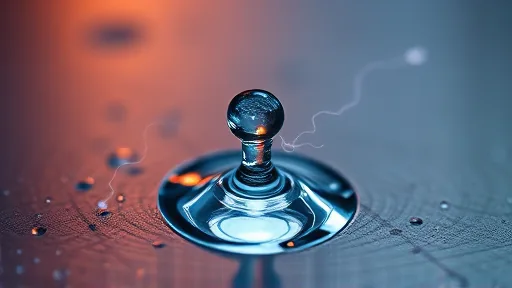
The salty water left behind makes matters worse. Once the discharge creates a small divot in the surface, the saltwater pools in that pocket and continues to erode the exposed metal. What began as a single electrical event becomes an ongoing chemical process. The damage does not stop at the moment of impact. It continues as long as the water remains in contact with the vulnerable metal beneath the compromised coating.
This finding raises uncomfortable questions about the limits of protective technology. Teflon is considered one of the most chemically resistant coatings available. It is used in industrial applications, cookware, and laboratory equipment because of its remarkable ability to withstand harsh conditions. Yet a single sliding raindrop can generate enough electrical energy to breach it. The researchers found that droplets falling onto non-conductive materials did not cause corrosion. Plastics and other insulators appear to be safe from this particular form of damage. But for metals, the threat is real and largely unaddressed by current protective measures.
The researchers did not test automotive paint systems, and their findings do not establish that charged raindrops can breach multi-layer car paint. The study’s relevance to vehicles remains speculative until further testing is done on real-world coating systems.
The study’s test materials — Teflon-coated copper and gold — differ substantially from commercial automotive paints, which contain multiple polymer layers and pigments. Whether the same discharge mechanism penetrates those systems is unknown.
The study opens a new chapter in understanding how corrosion begins. For decades, scientists have known that water causes rust. The chemical reaction between iron, oxygen, and water is one of the most studied processes in materials science. But the electrical dimension of raindrop impact adds a layer of complexity that previous models did not account for. Corrosion is not just a chemical process. It can also be an electrical one, triggered by the static charges that accumulate through everyday interactions between water and surfaces.
High-speed cameras captured the moment of discharge, when accumulated voltage releases and the coating begins to fail. Atomic force microscopy showed defects penetrating both the Teflon and the underlying metal — a process too quick to see with the naked eye.
No practical advice for car owners can be drawn from this laboratory study, which did not examine vehicles or automotive coatings.
The researchers noted that this effect occurs with droplets containing a small amount of salt, mimicking real-world rain. Pure water might behave differently, but natural rainfall rarely contains no dissolved minerals or pollutants. The salt content of the droplet enhances its ability to conduct electricity and increases the damage it can cause. This is particularly relevant for cars in coastal areas, where salt-laden rain is common, or for vehicles driven on roads treated with deicing salt in winter.
The researchers chose test materials — plant leaves, PVC foam, polystyrene glass, and a quartz plate with a water-repellent coating — to represent surfaces rain naturally encounters before reaching metal structures.
The laboratory experiment used controlled conditions — specific angles, droplet sizes, and materials. Real-world rain varies in angle, droplet size, and surface condition. Whether the effect plays a significant role in corrosion of real structures over years of exposure requires further study.
The study represents a step forward in understanding the complex interactions between water, electricity, and materials. It shows that even the most mundane natural phenomena can have surprising electrical dimensions. A raindrop sliding down a window or a leaf is not just water in motion. It is a tiny generator, building up electrical potential with every millimeter it travels. And when that potential discharges, it can do more damage than the drop itself might suggest.
Sources
1. Nature