Quarry Reveals Denisovan Life Over 100000 Years
The Accidental Find That Opened a Stone Age Window
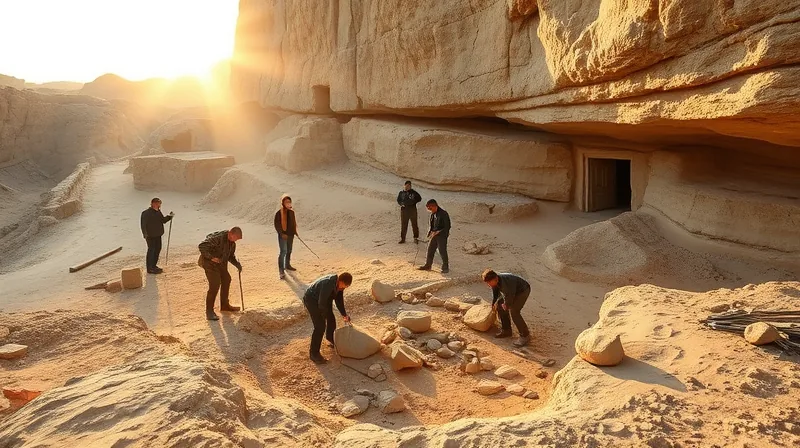
The story begins with a search for something else entirely. An abandoned quarry in southwestern China was not excavated with Denisovans in mind. The site yielded a trove of fossils and artefacts that no one had anticipated in this particular place. What researchers found there turned an ordinary quarry into what Ben Marwick, an archaeologist at the University of Washington in Seattle, calls “the full package.” [2] Marwick was not involved in the study. He states plainly: “It’s the first site that we have with a long, rich sequence that’s uniquely associated with Denisovans.” [2] That word — uniquely — is the hinge on which everything turns.
Before this quarry, the Denisovans were known mostly through genetic material and isolated fragments. In 2010, a team led by Svante Pääbo at the Max Planck Institute for Evolutionary Anthropology sequenced genetic material from a finger bone found in Denisova Cave in Siberia. [1] The DNA did not match that of any other known human species. That single finger bone created an entire category of ancient human. For sixteen years afterward, the Denisovans remained a people defined by absence — a genome without a face, a lineage without a settlement.
The quarry changes that equation. Evidence from the site indicates that Denisovans crafted bone tools similar to those made by their relatives. The items also suggest that Denisovans were skilled hunters of animals such as deer. These are not vague inferences. They are behaviours reconstructed from objects that survived in the ground. And the duration is staggering: Denisovans lived at the site for at least 30,000 years, and possibly as long as 120,000 years. No other site provides such a long, clear record closely connected to Denisovans. A people who once existed only as a sequence of nucleotides now have an address in the archaeological record.
Why Proteins Outlast DNA and What the Sequence Reveals
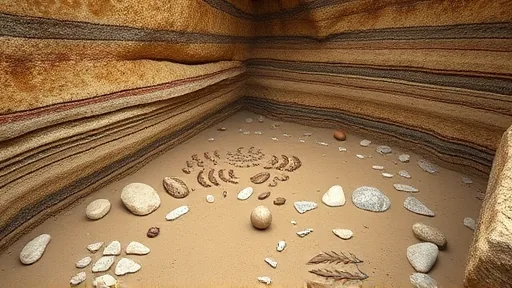
The reason this site can tell us so much comes down to preservation. Ancient proteins are hardier than ancient DNA. That single material fact determines which questions are answerable and which are not. This is why ancient proteins have proved most reliable for identifying Denisovan remains. The method is not a preference; it is a constraint imposed by chemistry itself.
That constraint has already stretched the map. Jawbones found on the Tibetan Plateau and in sediments dredged from the Taiwan Strait pushed the Denisovans’ known territory south and east of Siberia. Each find was a single point on a map, however. A jawbone here. A sediment sample there. What the quarry provides is not another point but a continuous sequence — a stratigraphic column of behaviour. The difference is the difference between a photograph and a film.
In 2025, a separate research group used protein analysis to show that a jawbone recovered from ocean sediments off the coast of Taiwan belonged to a Denisovan. [1] That same year, a team working on the Harbin skull finally put a face to the extinct people, confirming the fossil from northeastern China as Denisovan. [1] The confirmation was based on the skull’s proteins. Layer by layer, the Denisovans were acquiring bodies — a jaw, a skull, and now an entire way of life.
The quarry adds something none of those finds could. A jawbone tells you who someone was. A skull tells you what they looked like. A bone tool tells you what they did with their hands. And 30,000 to 120,000 years of occupation tells you that whatever they were doing, they kept doing it across a span longer than the entire history of written human civilization. The details of the finds were published in a peer-reviewed journal, with the full stratigraphic sequence and tool assemblage documented for independent scrutiny. The record now holds what no single fossil could contain.
What a Long Sequence Means for the Field
The broad significance lies in the word “uniquely.” Other sites have yielded Denisovan DNA. Other sites have yielded artefacts. But no other site has yielded a long, rich sequence uniquely associated with Denisovans. That distinction matters because it separates presence from behaviour. Knowing that Denisovans were somewhere is not the same as knowing how they lived there. The quarry collapses that gap.

The comparison to Neanderthals is instructive. Denisovans crafted bone tools similar to those made by their relatives. The similarity is not trivial. It places Denisovan technology within a known behavioural repertoire — one that archaeologists have studied for over a century in Neanderthal contexts. The quarry extends that repertoire eastward and deepens it in time. Denisovans were not merely surviving in some marginal corner. They were hunting deer, shaping bone, and persisting across tens of millennia.
The site also rewrites the geography of the Denisovan story. Siberia was the beginning. The Tibetan Plateau and the Taiwan Strait were expansions. Southwestern China, with its long sequence, is now the anchor. A people first identified from a single finger bone in a Siberian cave have emerged as long-term inhabitants of a Chinese quarry, with a material culture that connects them to their Neanderthal cousins. The mystery has not dissolved. It has acquired a floor plan.
What remains is the work of reading the sequence more closely. The quarry has given scientists a portal into the Stone Age, and the fossils and artefacts within it provide an unprecedented glimpse into the lives and abilities of Denisovans. That glimpse is not a final answer. It is a baseline — the first site where the questions “who were they?” and “how did they live?” can be asked of the same ground, across the same span of time. The Denisovans are no longer just a genome. They are a place.