
Our ancestors slow messy exodus from Africa
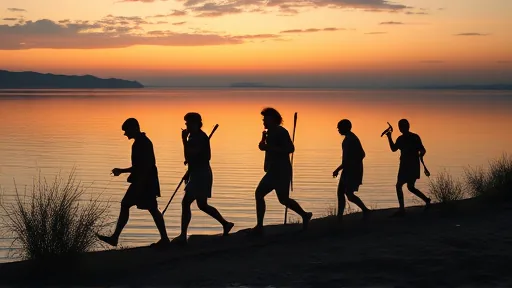
The air was cool and dry. A small group of people walked along the edge of a lake. They carried simple tools. They had children with them. They did not know they were making history. They were just looking for food. They were just trying to survive. This was not a planned migration. It was not a single event. It was a slow, messy, human process that happened over thousands of years.
For decades, scientists told a simple story about how modern humans left Africa. The story went like this. Around 60,000 years ago, our species, Homo sapiens, made a bold move. They walked out of Africa. They spread across Asia. They reached Europe. They reached Australia. They reached the Americas. They replaced all other human species. They conquered the world.
This story is called the out-of-Africa migration. It is one of the most famous stories in human evolution. It appears in textbooks. It appears in documentaries. It appears in museum exhibits. It is a clean, heroic narrative. It has a beginning, a middle, and an end.
But the real story is much more complicated. A growing number of scientists now say the simple story is wrong. The out-of-Africa migration happened. That much is certain. But it did not happen the way we imagine. It was not a single journey. It was not a sudden explosion. It was a long, drawn-out process. It involved many small groups. It happened over tens of thousands of years. Some groups went out. Some groups came back. Some groups stayed. Some groups mixed.
The evidence for this new view comes from many places. It comes from ancient bones. It comes from stone tools. It comes from the DNA of living people. It comes from the DNA of ancient skeletons. It comes from new ways of thinking about the past. The story is still being written. But the old certainties are crumbling.
The Genetic Evidence That Started It All
The old story was built on a strong foundation. That foundation was genetics. Scientists looked at the DNA of people alive today. They found a clear pattern. African populations have the most genetic diversity. They are the most varied. Non-African populations have less diversity. They are more similar to each other.
Think of it this way. Imagine a big jar of marbles. The jar has many colors. Red, blue, green, yellow, purple, orange. Now imagine someone takes a small handful from the jar. That handful has only a few colors. Maybe red, blue, and green. Those few colors are what spread to the rest of the world.
This is exactly what happened with humans. The first people who left Africa took only a small sample of the genetic diversity that existed on the continent. All non-African people today are descended from that small sample. That is why an Indigenous Australian and a Japanese person are genetically more similar to each other than two people from neighboring villages in Africa are.
This genetic evidence is powerful. It is clear. It is undeniable. It proves that modern humans spread from Africa. It proves that the spread happened relatively recently in evolutionary time. It proves that the spread was a major event in our species’ history.
But the genetic evidence has a problem. It cannot tell us exactly when the spread happened. It cannot tell us exactly how it happened. It cannot tell us exactly how many times it happened. The genetic data gives us a range. That range is wide. Very wide.
The Dating Problem
Different genetic studies give different dates for the out-of-Africa migration. Some say it happened about 56,000 years ago. Some say it happened less than 55,000 years ago. Some say it was most likely between 50,300 and 59,400 years ago. Some say it happened earlier than 75,000 years ago.
That is a huge range. For a recent event in geological terms, this uncertainty is surprising. It is like not knowing whether your grandmother was born in 1900 or 1950. The uncertainty matters. It changes the story.
Archaeologist Huw Groucutt at the University of Malta has been thinking He published a study in Quaternary Science Reviews on 15 April 2025. [1]e Reviews on 15 April**. [1] In that study, he outlines his concerns. He says the specific dates are over-interpretations. They are the result of leaning too heavily on models.
Models are simplified versions of reality. They are useful. They help us understand complex systems. But they are not perfect. They have assumptions. Those assumptions can influence the results.
Groucutt puts it bluntly. “The fact is, we don’t really understand how ancient populations were spread and interacting,” he says. [1] “There is a heavy dose of the model influencing the outcome.”
One of the key assumptions in genetic models is that people interbreed randomly. We know that is not true. Human populations are structured. They are divided into groups and subgroups. People are more likely to have children with people who live near them. They are more likely to have children with people who share their beliefs. They are more likely to have children with people who are like them.
Stone Age populations in Africa were also subdivided. They lived in different regions. They spoke different languages. They had different cultures. They did not mix randomly. Genetic models struggle to account for this complexity. “It’s just very hard to model that,” Groucutt says.
The Missing Archaeological Evidence
If genetics cannot give us a precise date, perhaps archaeology can. Archaeologists look for physical evidence of human presence. They find stone tools. They find bones. They find fire pits. They find art.
If large numbers of Homo sapiens were traveling from Africa to Eurasia around 60,000 years ago, we should find traces of that migration. We should find stone tools that look like African tools. We should find campsites. We should find evidence of human activity.
We do not.
Groucutt writes: “There is no convincing archaeological signal linking Africa and Eurasia at the time that genomic data is typically interpreted as suggesting successful dispersal into Asia.”
This is a major problem. The genetics says the migration happened around 60,000 years ago. The archaeology says there is no evidence for it at that time. Something does not add up.
There are older archaeological sites. Modern humans seem to have been living at the sites of Skhul and Qafzeh in Israel as early as 130,000 years ago. There are also earlier claims from Misliya in Israel and Apidima in Greece. These sites are older than 60,000 years. They suggest that humans left Africa much earlier than the genetic evidence indicates.
But these early sites are not connected to the main out-of-Africa migration. They seem to be separate events. Small groups of humans left Africa. They settled in the Middle East. They did not spread further. They may have died out. They may have returned to Africa.
The main migration, the one that led to all non-African people today, is supposed to have happened later. But the archaeological evidence for that migration is missing. It is like a crime scene with no fingerprints.
The Problem with “Revolutions”
Groucutt flags another issue. It is more conceptual. It is about how we think about the past.
Scientists have a tendency to look for “revolutions” in prehistory. They look for dramatic turning points. They look for times of rapid and significant change. They look for events that happen in a specific location and then spread.
For example, it was once claimed that around 50,000 years ago, our species became “behaviourally modern.” This means we started making specialized tools. We started creating art. We started performing rituals. We started speaking in true language. This was presented as a “great leap forward.” It was called “the Upper Palaeolithic Revolution.”
Virtually no active researchers believe this anymore, says Groucutt. Archaeology tells us that these behaviors emerged gradually. They may have been developed independently in different parts of the world. Other hominins, notably Neanderthals, also made art. There is no sign of an abrupt emergence of this behavior. Language seems to have deep roots.
But the idea of revolutions persists. It is a hangover from 20th-century thinking. The archaeologist V. Gordon Childe (1892-1957) characterized the advent of farming as the “Neolithic Revolution.” This was followed by the “Urban Revolution.” These ideas turned out to be oversimplifications. People often engage in “proto-farming” while also hunting and gathering. They sometimes live in dense settlements without also farming.
The same thinking has crept into how we read genetic data. “People talk about the out-of-Africa ‘event,’” says Groucutt. But the migration probably consisted of “tiny groups of people over tens of thousands of years, scattered over huge areas,” he says. “It’s not much of an ‘event’ to me.”
A New Framework for Understanding
Instead of a single event, Groucutt argues for a different framework. He says we should think of the out-of-Africa migration as a process. It was a long window of time. In that window, some groups of people were moving out of Africa. Some groups were moving back in. Some groups were staying put.
The timeframe for this process is wide. Groucutt says all we can say with confidence is that it was happening between 100,000 and 50,000 years ago. That is a span of 50,000 years. That is a long time. It is longer than the entire history of civilization.
Within that window, there were probably many small dispersals. A group of people would move out of Africa. They would settle in a new area. They would have children. They would adapt to the new environment. Some groups would die out. Some groups would thrive. Some groups would move further.
This is not a clean story. It is messy. It is human. It is real.
The genetic diversity we see today is the result of this messy process. The small handful of marbles that left Africa was not taken in one grab. It was taken in many small grabs. Some grabs were lost. Some grabs were combined. Some grabs were successful.
The Role of Neanderthals
The story of the out-of-Africa migration is not just about Homo sapiens. It is also about the people they met along the way. When modern humans left Africa, they encountered other human species. The most famous of these is the Neanderthal.
For a long time, scientists thought that modern humans and Neanderthals did not mix. They thought that modern humans replaced Neanderthals completely. They thought that there was no interbreeding.
We now know that is wrong. Genetic studies have shown that most non-African people today have a small amount of Neanderthal DNA. This DNA is a remnant of ancient interbreeding. When modern humans left Africa, they met Neanderthals. They had children with them. Those children became part ofA recent study published in Science on 12 December 2024 and reported by NBC News used ancient DNA from Neanderthal remains found in a cave in Germany. [2] December 2024 used ancient DNA from Neanderthal remains found in a cave in Germany. [2] The study suggests that the interbreeding happened around 45,000 to 50,000 years ago**. [2]
This timing is consistent with the new view of the out-of-Africa migration. It suggests that the main migration, the one that led to all non-African people today, happened later than 60,000 years ago. It happened closer to 50,000 years ago. It was not a sudden event. It was a gradual process. And it involved mixing with the people who were already there.
The Neanderthals were not replaced. They were absorbed. Their DNA lives on in us. This is a profound shift in our understanding of human evolution.
The Door That Just Opened
The new view of the out-of-Africa migration raises many questions. If the migration was a process, not an event, how do we study it? If the dates are uncertain, how do we refine them? If the archaeology does not match the genetics, how do we reconcile them?
These are the questions that scientists are now asking. They are using new tools. They are using new methods. They are using new ways of thinking.
One promising approach is to combine genetics and archaeology more carefully. Instead of relying on one type of evidence, scientists are trying to integrate both. They are looking for sites that have both ancient DNA and stone tools. They are trying to date those sites more precisely. They are trying to build a more complete picture.
Another approach is to study the ancient DNA of people who lived in the crucial time period. The study of Neanderthal DNA from Germany is an example. By analyzing the DNA of ancient individuals, scientists can trace the movements of populations. They can see when and where interbreeding happened. They can build a timeline.
But the most important question is this: What drove the out-of-Africa migration? Why did people leave? Was it climate change? Was it population pressure? Was it curiosity? Was it a combination of factors?
The answer is not clear. The climate was changing during the time of the migration. The Earth was going through ice ages. Sea levels were lower. Land bridges were exposed. This made it easier for people to move.
But climate alone does not explain everything. People are not passive victims of their environment. They make choices. They take risks. They explore. The out-of-Africa migration was as much a human story as it was a scientific one.
The Next Scientific Question
The new view of the out-of-Africa migration opens a door. It invites us to ask new questions. It invites us to think differently about our past.
The next scientific question is this: How many times did humans leave Africa? The old story said once. The new story says many times. But how many? And when? And where did they go?
To answer this question, scientists need more data. They need more ancient DNA. They need more archaeological sites. They need more precise dating methods. They need more sophisticated models.
They also need to think differently. They need to let go of the idea of revolutions. They need to embrace the idea of processes. They need to accept uncertainty.
The out-of-Africa migration is not a solved problem. It is a living, breathing area of research. The story is still being written, and every new discovery refines our understanding of this complex human journey.
The small group of people walking along the edge of the lake did not know they were making history. But they were. And we are still trying to understand what they did. We are still trying to understand who they were. We are still trying to understand why they left.
The journey is not over. It never was.
Sources
2. Science
3. NBC News