The Drawer That Held a New Predator
A skull fragment sat in a museum drawer for 102 years before anyone recognized what it was. [1] The Natural History Museum acquired it in 1924, and for decades its significance went unnoticed. That is not a story about neglect. It is a story about how much resolution a single piece of bone can hold — and how long it sometimes takes for the tools to catch up with the material.
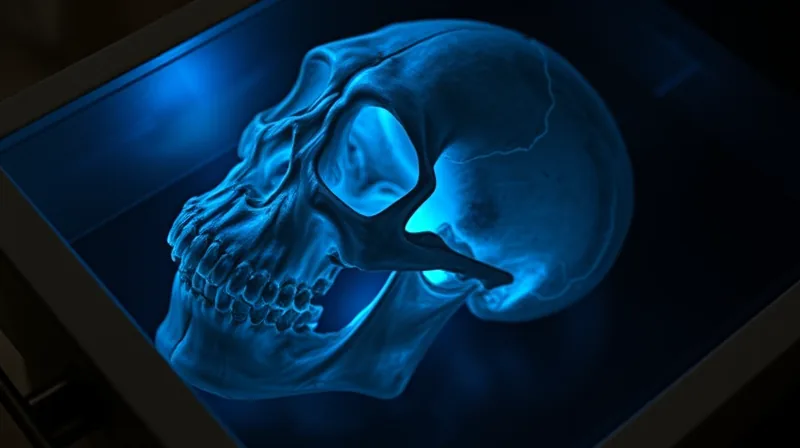
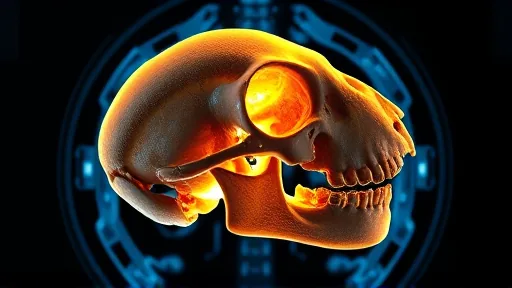
The identification became possible only through CT X-ray scans, which allowed researchers to peer inside the fossil and build 3D models of the skull without destroying it. Those digital reconstructions were then compared against other meat-eating dinosaurs — tyrannosaurs, spinosaurs and raptors among them. Two features stood out: an oval opening where the spinal cord entered the brain, and an hourglass-shaped crest.
Neither trait alone would have settled the question. Together, they identified the remains as Invictibellatrix amberina, a species previously unknown to science. The name translates as \"unconquered female warrior\”, with amberina referring to the amber found in the rocks where the fossil was uncovered.
A Hyena in Europe, Not an Apex Tyrant
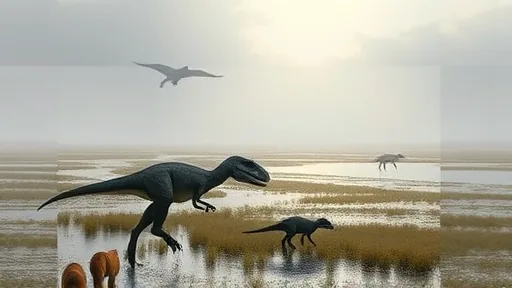
Invictibellatrix belonged to the megaraptorans, a group of agile, two-legged meat-eaters closely related to tyrannosaurs — including Tyrannosaurus rex — but built on a different plan. Rather than relying on huge jaws, it is thought to have used powerful arms armed with curved claws measuring up to 20 centimetres.
Its ecological role was not that of a top predator. “It was not the apex predator of its time,” said Dr Cassius Morrison, who led the research at University College London, “but for humans this dinosaur would have been more dangerous than a T. rex. We would have been perfectly sized prey, about a third of their body weight.” [1] A T. rex would not have bothered chasing a human — too small a meal for the effort. Invictibellatrix would have. Morrison added: “They definitely would have chased us.” The discovery is also the first evidence that megaraptorans, a group thought to have originated in Asia, once lived in Europe. From there, the group is thought to have moved through Europe and eventually reached Gondwana, the ancient southern supercontinent.
The Map Still Has Blank Spaces
The Isle of
Wight has yielded bones for generations, and this skull was hiding in plain sight among them. It was originally found at the foot of a cliff on the island’s south-west coast by amateur palaeontologist Reginald Walter Tooley. Morrison put the puzzle plainly: \"It is a real mystery that this fossil was overlooked for so long, sitting in a drawer for nearly 100 years. Lots of bones are found on the Isle of Wight — who knows what else is waiting to be discovered.\” [1].
Meanwhile, the broader picture of dinosaur behaviour remains contested at its foundations. Palaeontologist Dave Hone at Queen Mary University of London, who wrote a book on dinosaur behaviour and has described several new pterosaur species, describes himself as a zoologist of dead animals. He points out that cooperative hunting among carnivorous theropods rests on almost no evidence. The famous case — multiple Deinonychus fossils found alongside a large herbivore called Tenontosaurus — was interpreted as a pack kill. But as Hone notes, lions do not normally keel over when five of them bring down a buffalo, and reanalyses have questioned that reading, though he still considers it plausible. Dinosaurs lived on every continent, in almost every ecosystem, for 160 to 170 million years — so the absence of evidence for one behaviour says little about the group as a whole.
The open questions span from whether Velociraptor hunted in packs to what the elaborate frills of Triceratops were actually for, to why pterosaurs grew so much larger than birds. Each of those questions sits in the same place this Isle of Wight skull sat for a century: waiting for a method precise enough to read what the bone already recorded.