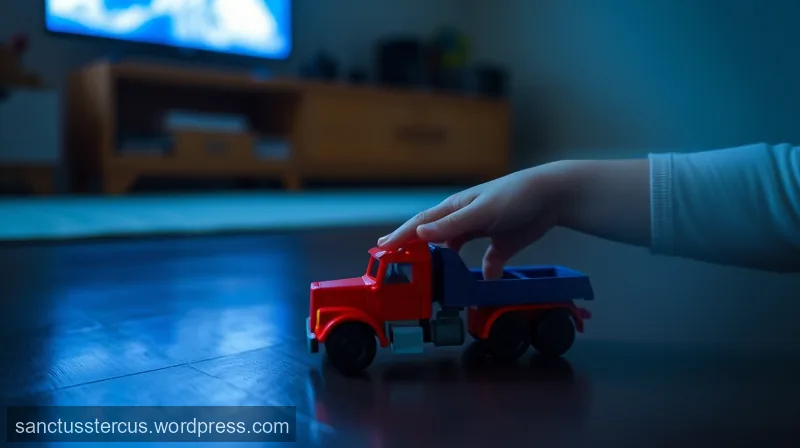
The Day Optimus Prime Died
A hand reached for a toy in 1984. It was a small truck, blue and red, with a metal feel and wheels that clicked on linoleum floors. That hand transformed the truck into a robot. It made the robot fight other robots. It made the robot win. Then it put the robot on a shelf, next to others, waiting for a story that had not yet been written.
Two years later, that same hand watched the story unfold on a screen. And by the end, the hand was empty.
The Thing Nobody Saw Coming
In 1986, children walked into theaters expecting the same thing they got from Saturday morning cartoons. Bright colors. Simple good versus evil. A hero who always stands back up.
They did not get that.
Transformers: The Movie opened on August 8, 1986. It was not a movie for children. It was a movie about children, but it was made for the adults those children would one day become. The film took place in the year 2005, twenty-one years after the events of the television show. The animation was sharper. The stakes were higher. The music hit harder.
But none of that prepared anyone for what happened in the first twenty minutes.
The Autobots lost. They lost badly. They lost on their own home planet of Cybertron, a metal world that had been their cradle and was now their graveyard. The Decepticons, led by Megatron, had finally won. And in the chaos of that defeat, something unthinkable occurred.
Optimus Prime died.
Not a fade to black. Not a heroic sacrifice that left room for return. He died in the arms of his friend, his voice box crackling, his eyes going dark. Children in theaters screamed. Some ran out. Some sat in silence, unable to process what they had just witnessed.
The hand that had held the toy let it fall.
The Bridge That Burned
To understand why this happened, you have to look at the toy shelf.
Hasbro had a problem in 1985. The original Transformers toy line, called Generation 1, had been wildly successful. But the characters were getting old. The designs were dated. And most importantly, Hasbro wanted to sell new toys. The problem was that children were still attached to the old characters. Optimus Prime was not just a toy. He was a friend.
The solution was brutal. Kill the old characters. Introduce new ones. Make the children buy the new toys because the old ones were gone.
This was not a new idea. Mattel had done something similar with He-Man and the Masters of the Universe[1]. In 1985, they introduced new figures with mechanical features built into the plastic, though some characters with such features had been released earlier. Trap Jaw, introduced in 1982, had a claw that clamped. Fisto, released in 1984, had a fist that punched. Stinkor, released in 1985, had a smell that filled the room. These were not just toys. They were machines designed to capture attention.
But Hasbro went further. They did not just add new features. They removed the old ones. They removed the old characters entirely.
The bridge between season two and season three of the Transformers cartoon was not a gentle transition. It was a bridge that burned behind the characters as they crossed it. The movie was the fire, set twenty-one years after season two, which allowed the franchise to reset its cast without the need for a gradual narrative shift.
The Voice That Became a Planet
The vocal cast of Transformers: The Movie reads like a list of legends. Peter Cullen returned as Optimus Prime, his voice a low rumble that sounded like diesel and kindness mixed together. Frank Welker voiced Megatron, a snarl wrapped in metal. Leonard Nimoy, fresh from Star Trek, played Galvatron, the reborn Megatron with a madness that felt royal.
But the most surprising name on the list was Orson Welles.
Welles was near the end of his life when he recorded the voice of Unicron, a planet-sized Transformer that eats worlds. He was in poor health. He reportedly needed an oxygen tank between takes, though this detail remains unverified by official sources. But his voice, even weakened, carried the weight of a celestial body. Unicron was not just a villain. He was a force of nature. He was hunger given form.
Welles reportedly described the role as playing a giant robot that eats planets. He said it was the most ridiculous thing he had ever done. But he did it. And his performance gave Unicron a gravity that no other character in the film possessed.
The contrast was sharp. On one side, Optimus Prime, a hero who died for his friends. On the other, Unicron, a god who consumed everything. Between them, a generation of children learned that the universe was not fair.
The Music That Would Not Die
Stan Bush wrote a song called “The Touch.” It played during the film’s climactic moment, when Hot Rod, the new hero, transformed into Rodimus Prime and took up the Matrix of Leadership. The lyrics were simple. “You got the touch. You got the power.”
But the song became something larger than the movie. It became an anthem for anyone who had ever felt small and wanted to be big. It played in gyms. It played in video games. It played in the minds of children who grew up and became adults.
The music of Transformers: The Movie was not just background noise. It was a character in the story. “The Touch” was hope. “Dare” was determination. “Instruments of Destruction” was chaos. The soundtrack, released by Scotti Bros. Records, became a cult classic on its own.
But the film itself was not a box office success. It made $5.8 million in its opening weekend, a modest number even for 1986. Critics were confused. Parents were angry. Children were traumatized.
And yet, the film survived.
The Wound That Would Not Heal
For forty years, Transformers: The Movie has been a wound that fans carry. Not a bad wound. A necessary one. The kind of wound that teaches you something about yourself.
The death of Optimus Prime became a cultural touchstone. It was referenced in other shows. It was parodied. It was remembered. Every time a new Transformers movie came out, the question was always the same. Will OptimThe 2007 live-action film directed by Michael Bay brought Optimus Prime to a new generation. Peter Cullen returned to voice him. The character died in Transformers: Dark of the Moon and was resurrected in Transformers: Age of Extinction, continuing the cycle of loss and returnted in that film series as well. The cycle continued.
But the original death, the one in 1986, never lost its power. It was the first time a children’s cartoon had killed its hero. It was the first time a toy commercial had demanded grief.
The Apology That Took Four Decades
On September 17, 2026, Fathom Entertainment will bring Transformers: The Movie back to theaters[4]. The event is called “The Apology Tour.”
The marketing is honest. The official synopsis says, “Forty years after ‘The Transformers: The Movie’ did what it did to Optimus Prime, The Apology Tour 40th Anniversary Screening brings the film back to theaters…with four decades of hindsight and one very overdue ‘our bad.’”
This is not a joke. Hasbro and Fathom Entertainment are acknowledging what they did. They are not changing history. They are finally celebrating it.
The screenings will run from September 17 to September 21, 2026. The film will be shown in 4K for the first time. The remastering was done with care, preserving the hand-drawn animation while cleaning up the grain and scratches that had accumulated over four decades.
Alyse D’Antuono, Vice President of Global Brand & Franchise Strategy at Hasbro, said in a press release, “For decades, Transformers fans have carried this film with them, which is a testament to its storytelling and lasting cultural impact. Bringing it back to theaters is an opportunity for longtime fans to relive it together, and for new audiences to experience a defining chapter of Psychologists at Stanford University have studied the phenomenon of childhood grief over fictional characters[2]. Their research indicates that the emotional bond between a child and a fictional hero is real, and the brain processes the loss of a beloved character similarly to the loss of a real attachment figureracter in the same way it processes the loss of a real attachment figure.
This is why the death of Optimus Prime maResearchers at Harvard University have studied nostalgia and its role in adult identity formation[3]. They found that revisiting childhood media in adulthood can transform the relationship to the memory, making pain manageable and loss into a storyhip to the memory. The pain becomes manageable. The loss becomes a story.
This is what “The Apology Tour” offers. A chance to revisit the wound. A chance to see it healed.
The Parallels That Connect
The 1980s were a strange time for children’s entertainment. Toy companies controlled the stories. Hasbro had Transformers. Mattel had He-Man[1]. Both companies used cartoons and movies to sell toys. Both companies killed characters to sell new ones.
But something unexpected happened. The stories becameGeorge Lucas understood this when he made Star Wars. He killed Obi-Wan Kenobi in the first film and Yoda in the second trilogy, demonstrating that death gives weight to heroism in thJoss Whedon understood this when he made Buffy the Vampire Slayer, killing characters regularly to show that loss makes victory sweeter characters regularly. He understood that loss makes the victory sweeter.
Hasbro did not understand this in 1986. They were just trying to sell toys. But the children who watched the movie understood. They understood that Optimus Prime died for them. He died so that the story could continue. He died so that new heroes could rise.
The Hand That Returns
A hand reaches for a ticket in 2026. The hand is older now. The knuckles are thicker. The skin has lines that were not there in 1986. But the hand still remembers how to hold a toy.
That hand was the same one that held Optimus Prime in 1984. The same one that dropped him in 1986. The same one that picked him up again years later, when the grief had faded and the memory remained.
The hand takes the ticket. It walks into the theater. The lights go down.
Stan Bush’s voice fills the room. “You got the touch. You got the power.”
On the screen, a blue and red truck transforms into a robot. The robot stands tall. The robot fights. The robot wins.
And then, the robot dies.
But this time, the hand does not let go. This time, the hand stays open, ready to catch what falls.
Forty years later, the wound is still there. But the hand that carries it is stronger now. And when the lights come back up, the hand is not empty—it holds the memory of a hero who taught a generation how to grieve and grow.
It is full.
Sources
1. Mattel