AI hunts for precision antibiotics to spare gut bacteria
For decades, doctors believed a powerful antibiotic was a perfect weapon. You fight a bad infection with a drug that kills many bacteria. This was the standard. Then we learned the cost. Broad-spectrum antibiotics act like a bomb in the gut. They kill the harmful pathogen. They also destroy the beneficial microbes that keep us healthy. This collateral damage is especially dangerous for people with chronic gut diseases like Crohn’s disease. It also creates a breeding ground for superbugs. Now, a new approach is emerging. Scientists are using artificial intelligence to find antibiotics that hit only the bad guys. They want a scalpel, not a bomb. The goal is precision medicine for the gut microbiome.
The Old Way: A Bomb in the Belly
Before this shift, the logic was simple. You have a bacterial infection. You take a broad-spectrum antibiotic. It kills a wide range of bacteria. This includes the good ones. The immediate problem is clear. You might get diarrhea. You might feel worse before you feel better. The long-term problem is far worse. When you kill many bacteria, you create empty space. Resistant bacteria can move in. They have no competition. They multiply. This is how antibiotic resistance spreads. The old method was effective for acute illness. It was terrible for long-term health. The gut microbiome is a complex ecosystem. A bomb destroys the ecosystem. We are now learning that a healthy microbiome is critical for immunity, digestion, and even mental health. The old way treated the infection. It ignored the patient’s entire internal world.
The New Target: A Single Molecule
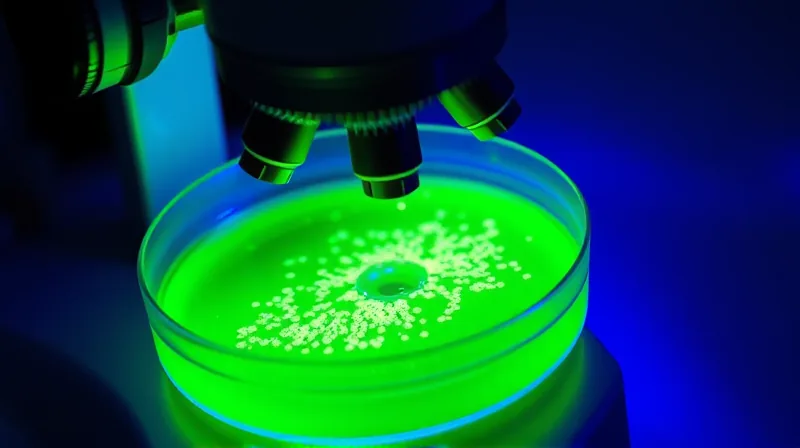
In 2023, a team at McMaster University in Canada, led by microbiologist Jonathan Stokes and doctoral student Denise Catacutan, screened over ten thousand bioactive compounds against a pathogenic strain of E. coli. They applied strict filters for toxicity and structural novelty, finding only one molecule that met all criteria, which they named enterololin. [3]. The challenge was not over. They had to prove it was specific. They had to show it would not harm the good bacteria. Traditional methods would take months or years. They turned to artificial intelligence instead.
AI as the Microscope for the Invisible
The team used AI to understand how enterololin works. Normally, researchers use biochemical screens. They use RNA sequencing. They use proteomics. These methods are slow and expensive. AI can analyze massive datasets quickly. It can predict how a molecule interacts with bacterial cells. It can find the exact pathway the molecule disrupts. This is a huge advantage. It speeds up the discovery process. It also reduces the cost. The AI model looked for patterns. It found that enterololin targets a specific protein in the harmful E. coli. The good bacteria in the gut do not have that protein. So the drug leaves them alone. This is the precision we need. It is a major step forward. The AI did not replace the scientists. It gave them a tool to see what was invisible before. It turned a long shot into a clear target.
The Bigger Picture: Resistance is a Global Crisis
The need for precision antibiotics is urgent. Antibiotic resistance is a global health crisis. It is often compared to climate change. Former chief medical officer of England, Sally Davies, has described antibiotic resistance as a threat more acute than climate change. [4] The threat is real. Common infections could become deadly. Surgeries like C-sections and organ transplants could become too risky. A major driver of this crisis is animal agriculture. Over two-thirds of all antimicrobials sold globally go to farm animals. They are used to make animals grow faster. They are used to prevent disease in crowded conditions. This overuse creates resistant bacteria. These bacteria can spread to humans through meat, waste, and the environment. The United States is third in the world for farm antibiotic use. The problem is not just in hospitals. It is on farms. It is in our waterways. Antibiotics break down, but they still drive resistance in the environment. The solution must be multi-pronged. We need new drugs. We need better farming practices. We need smarter use of existing drugs.
Parallels in Cancer Treatment
The fight for a healthy gut is not just about infections. It is also about cancer. The gut microbiome plays a critical role in the immune system. This connection is now a major focus in cancer research. Doctors like Marcel van den Brink have seen this firsthand. In the 1990s, transplant patients were kept in sterile bubbles. They were given high doses of broad-spectrum antibiotics. Many died from infections or graft-versus-host disease. Doctors realized they were causing collateral damage. The aggressive treatment was destroying the microbiome. This insight launched a new field. Researchers now study how gut bacteria affect cancer immunotherapy. There are nearly one hundred ongoing studies on this topic. One late-phase trial is testing a probiotic called CBM588. It is a strain of Clostridium butyricum. It is already used in Japan for gut issues. The trial will test if it can boost cancer treatment in kidney cancer patients. The goal is to change the standard of care. The same principle applies. Protect the good bacteria. Help the immune system fight.
How It Works: The Mechanism of Precision
Let us break down how a precision antibiotic works. A broad-spectrum antibiotic attacks a common structure in bacteria. It might target the cell wall. It might target the ribosome. Many bacteria share these structures. So the drug kills many types. A precision antibiotic does something different. It targets a unique feature of a specific pathogen. This could be a protein. It could be an enzyme. It could be a metabolic pathway. The bad bacteria depend on this feature. The good bacteria do not have it. So the drug only affects the target. This is like a key that fits only one lock. The AI helps find that lock. It scans the genetic and protein data of the pathogen. It predicts which molecules will fit. It filters out molecules that might harm other bacteria. The result is a drug that is effective and safe for the microbiome. This is a paradigm shift. We move from killing everything to killing only the threat.
The Bridge: From Lab to Patient
The path from discovery to patient is long. Enterololin is a promising start. It must pass many tests. It needs to be safe in animals. It needs to be effective in humans. It needs to be scalable for manufacturing. The AI can help at every step. It can predict toxicity. It can suggest modifications. It can design better versions. This is not just one molecule. It is a new method. The method can be applied to other pathogens. We can search for precision drugs for tuberculosis. We can search for drugs for hospital-acquired infections. The AI platform is a tool. It can be trained on different targets. It can be shared across labs. This accelerates the entire field. The bridge is built on data. Every successful test teaches the AI. Every failure refines the model. We are building a library of precision tools.
The Threat: What Happens If We Fail
If we do not find new antibiotics, the consequences are dire. We will enter a post-antibiotic era. Minor infections could kill. C-sections could become deadly. Cancer treatments could be too risky. Organ transplants could be impossible. The threat is not hypothetical. It is already happening. Drug-resistant tuberculosis is spreading. Resistant E. coli is common. The World Health Organization lists antibiotic resistance as one of the top global public health threats. [4] The economic cost is huge. The human cost is larger. The failure is not just about new drugs. It is about how we use existing ones. We overprescribe in humans. We overuse in animals. We dump them into the environment. The antibiotics break down. The resistance genes remain. They spread through water. They spread through soil. They spread through food. The problem is everywhere. The solution must be everywhere too. Precision antibiotics are one part. Better stewardship is another. We need a global effort.
The Adaptation: How We Must Change
We must adapt our approach to bacteria. They evolve quickly. We must evolve faster. AI gives us speed. It gives us precision. But we must also change our habits. Doctors must prescribe fewer antibiotics. Patients must finish their courses. Farmers must reduce antibiotic use. The European Union has stricter rules on farm antibiotics. The United States has made some progress. The FDA implemented a rule in 2017 that phased out the use of medically important antibiotics for growth promotion in livestock. [5] But use is creeping up again. We need better animal husbandry. We need cleaner living conditions for animals. We need alternatives like probiotics and vaccines. The adaptation is cultural. It is economic. It is political. It is not just a scientific problem. It is a human problem. The AI is a tool. We must use it wisely. We must also change our behavior.
The Hope: A New Generation of Drugs
The hope lies in the new generation of drugs. AI is helping to discover them faster. It is also helping to repurpose old drugs. It can find new uses for existing molecules. This reduces cost and time. The first precision antibiotics are in the pipeline. They target specific pathogens. They spare the microbiome. This is a revolution. It is like moving from chemotherapy to targeted cancer therapy. The side effects are fewer. The outcomes are better. The hope is that we can stay ahead of the bacteria. We can create a sustainable cycle. We discover a drug. We use it precisely. The bacteria develop resistance slowly. We have time to find the next drug. This is the dream. The AI makes it possible. The researchers make it real. The funding makes it happen.
The Children of Tomorrow
The long-term vision is a future where precision antibiotics, guided by AI, allow us to treat infections without disrupting the gut microbiome, potentially improving immune health and reducing the risk of resistance. This goal, while ambitious, represents a paradigm shift in medicine that researchers are actively working toward.
Sources
2. DOI: 10.1038/d41586-026-01818-9A
5. FDA