
New monkey species discovered in Congo rainforest
A Fresh
Look at an Old Photograph
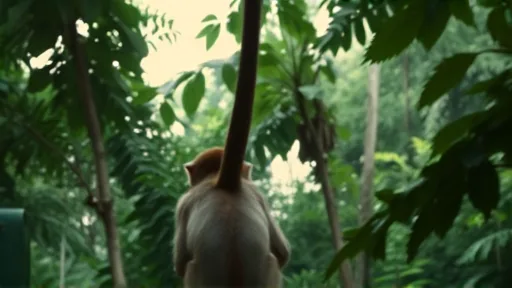
For decades, the scientific understanding of African monkeys rested on a relatively stable set of categories. Biologists assumed that the colobus monkeys of the Congo Basin were largely accounted for. Then, in 2008, a survey team working along the Lomami River in what is now Lomami National Park captured a single photograph. The image showed only a partial view of a monkey high in the canopy. It was a glimpse of something that did not match any known species. This single photograph became the first piece of new evidence that would eventually force a reconsideration of the entire group’s classification.
The researchers did not immediately declare a discovery. They waited. In November 2018, another team spotted the same kind of monkey again. Between 2018 and 2022, observers recorded 114 separate sightings. Of those, 25 were based solely on vocalizations. The monkey was about 1.3 meters long and weighed roughly 7 kilograms. These observations built a case that could not be ignored. The animal was not a rare variant of a known species. It was something else entirely.
Then came the key evidence. In 2021, hunters killed several of these monkeys for bushmeat. The carcasses were confiscated and handed over to researchers. This allowed for detailed morphological and genetic analysis. The results confirmed what the field sightings had suggested. The monkey was a wholly separate species. The genetic tests and recordings of its calls added further proof of its uniqueness. This was not a case of gradual revision. It was a direct contradiction of the existing model.
A Face That Holds an Ancient Secret
The new species, given the scientific name Colobus congoensis, is known locally as likweli. Its most striking feature is its face. The skin around the mouth and beneath the nose is light-colored. This pattern is unlike any other African colobus monkey. However, it strongly resembles the facial pattern seen in some Asian colobine monkeys. This resemblance is not a coincidence. It may be a direct inheritance from a common ancestor that lived more than 8 million years ago.
Kate Detwiler, a primatologist at Florida Atlantic University, explains the implications “The genetic analyses revealed that likweli is a deeply divergent lineage that split from its closest known relative, Colobus satanas, approximately 4 to 5 million years ago,” she says. [1] This timeline was much older than the team expected. It means that likweli may have retained characteristics that were subsequently modified or lost in other African colobus species. The face is not an anomaly. It is a living fossil of an ancient trait.
The isolation of likweli is extreme. It is separated from Colobus satanas by more than 1,200 kilometers and several major river barriers. Most members of the genus have habitats exceeding 60,000 square kilometers. Likweli is only known to exist in 1,700 square kilometers of rainforest. This tiny range is one of the most inaccessible places in Africa. There are no paved roads or infrastructure. “A typical expedition involves multiple modes of transportation: a flight, followed by a motorcycle ride, two days of hiking on foot and finally travel by dugout canoe to reach the monkey’s range,” says Detwiler. [1] The data do not fit the standard model of widespread, connected populations.
What This
Means for the Field

The discovery of likweli is only the fifth new monkey species documented from Africa in the past 75 years. This rarity underscores how much remains unknown about the continent’s biodiversity. The finding forces a reexamination of the evolutionary relationships among African and Asian colobine monkeys. The mask-like face may represent ancestral traits that were present before the two lineages diverged. If so, the entire family tree may need adjustment.
The immediate practical concern is survival. Hunting is one of the primary threats facing likweli. The species has a small known range and appears to occur at low densities. Because of the risk of poaching and the monkey’s small population and home range, the team is proposing that the species should be listed as endangered. “Now that likweli has been recognised as a distinct species, another important step would be to grant it protected status under national law,” says Detwiler. This would make it illegal to hunt the species, including in the buffer zone surrounding the park.
The discovery of likweli does not close a chapter. It opens one. The field now has a new data point that demands a broader view of how these primates evolved, dispersed, and survived in one of the most remote places on Earth. .