Moon Formation Mystery Solved by Collision Temperature
Imagine two balls of dough, one warm and soft, one cold and firm. Throw them both at a wall with the same force. The warm one splatters. The cold one might bounce off in one piece. For decades, scientists modeling the Moon’s formation treated the colliding worlds like the warm dough. New research suggests the cold dough behaves very differently - and might explain a mystery that has puzzled planetary scientists for years.
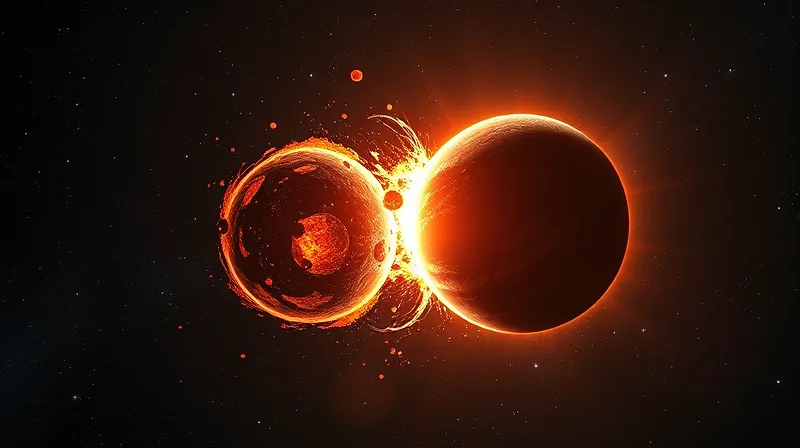
The Giant Impact Hypothesis has been the leading explanation for the Moon’s origin since the 1970s. It holds that roughly 4.5 billion years ago, a Mars-sized body named Theia struck the young Earth. The collision was so violent that debris from both worlds was thrown into orbit, eventually clumping together to form the Moon. The scenario explains many observed facts about the Earth-Moon system, including why the Moon has such a tiny iron core compared to our planet.
But the hypothesis has always had a nagging problem. The isotopic composition of Earth and the Moon - the precise ratios of different chemical elements - is nearly identical. If the Moon formed mostly from Theia’s mantle, as the classic model predicts, its composition should differ noticeably from Earth’s. It does not. This discrepancy has driven decades of refinement and debate.
Previous computer simulations of the giant impact made a simplifying assumption. They treated the colliding bodies as fluids, ignoring the material strength of rock under extreme conditions. The reasoning seemed sound: in a collision energetic enough to vaporize rock and melt entire planetary mantles, the strength of the material should be negligible. For smaller collisions, like those between asteroids, strength matters. For a Moon-forming event, most researchers assumed it did not.
Dr. Adeene Denton, a postdoctoral researcher in the Southwest Research Institute’s Solar System Science and Exploration Division, decided to test that assumption. [1] Her team’s new study, published in The Astrophysical Journal Letters, incorporated temperature-dependent material strength into their simulations for the first time. The results surprised them. “We weren’t sure if it would matter for the Moon or not,” Denton said in a press release. “When we did the simulations, we found it actually matters quite a bit.” [1]
How Heat Changes the Collision’s Outcome
The physics behind the finding is straightforward. Hotter materials are weaker than colder ones. A warm piece of metal bends more easily than a frozen one. The same principle applies to planetary bodies. When Theia and the proto-Earth collide, their internal temperatures dictate how they respond to the immense forces of the impact.
The team’s simulations showed that the outer few hundred kilometers of Theia play a critical role. Although the strength of this outer layer is negligible compared to the stresses deep in the interior, it still resists deformation. This resistance alters how momentum transfers between the two bodies during the collision. The effect is not subtle - it fundamentally changes the outcome of the Moon-forming event.
Rocky protoplanets cool over time. They form hot and gradually lose heat to space over hundreds of millions of years. This means the temperature of Theia and the proto-Earth at the moment of collision depends on when that collision happened. A young, hot Theia behaves one way. An older, cooler Theia behaves very differently. “For one set of otherwise identical canonical impact parameters, a hot but solid Theia produces an intact Moon, whereas a colder, stronger Theia - i.e., a later Moon-formation scenario - produces a classic protolunar disk,” the authors write. In other words, the same collision parameters produce two completely different outcomes depending solely on the thermal state of the bodies involved.

The classic protolunar disk is what earlier models produced. In that scenario, the impact destroys Theia almost entirely. A disk forms from material mostly originating from Theia’s mantle, with relatively little contribution from Earth. The disk is not fully vaporized. Its cooler outer regions become the birthplace of the Moon. This model has been the standard picture for decades.
The alternative outcome is startling. When the colliding bodies are cooler and therefore stronger, Theia survives the impact. Instead of being destroyed and forming a debris disk, a substantial portion of Theia remains intact and becomes captured in orbit around Earth. The Moon forms quickly - within about five hours of the collision - as a nearly complete world rather than accreting slowly from a disk over thousands of years.
A New Connection Between Impact Dynamics and Lunar Chemistry
The researchers found that when the collision involves hotter, weaker material, Earth accretes about 91 percent of Theia. The remaining material forms a melt-dominated debris disk. This result aligns with previous models. But the colder scenario tells a different story. With material strength included, Earth directly accretes less of Theia - about 84 percent - and an intact Moon-mass remnant is captured into orbit.
These two scenarios have profound implications for understanding the Moon’s geochemistry. “These completely different scenarios arise from different mechanical responses due to temperature and establish an important new connection between giant impact dynamics and the timing and geochemistry of lunar formation,” the researchers write. The inclusion of strength - the resistance to shear in solid materials - determines whether the Moon forms intact or accretes from a debris disk.
The timing difference is dramatic. In the intact-capture scenario, the Moon forms within hours. In the classic disk scenario, the process takes much longer. This temporal distinction could help explain chemical differences between the two worlds that have been difficult to reconcile with a single formation model.
The Moon is depleted of volatile elements - substances that evaporate easily. It has only a tiny iron core, possibly none at all. Its mantle is enriched in refractory elements, which withstand high temperatures without vaporizing. Earth, by contrast, has a large iron core and a different volatile inventory. The nearly identical isotopic compositions of Earth and the Moon have been a major strength of the Giant Impact Hypothesis, since both bodies likely formed in the same region of the young solar system’s protoplanetary disk. But the bulk compositional differences have remained harder to explain.
Dr. Robin Canup, vice president of SwRI’s Solar System Science and Exploration Division, was not involved in the study but has published earlier research about the Giant Impact Hypothesis. [1] She highlighted the broader significance of the findings. “These surprising and exciting new results imply a potential connection between the physical properties of the Moon today, including perhaps its volatile content, and the thermal state of the Earth and Theia at the time of the giant impact,” Canup said. “This in turn might help scientists better constrain when the Moon-forming event occurred.” The connection between temperature and outcome opens a new avenue for linking lunar observations to the timing of the giant impact. If the Moon’s current physical properties - its volatile content, its internal structure - can be traced back to the thermal state of the colliding bodies, then measuring those properties today could reveal when the collision happened. This would be a significant step forward, because the timing of the Moon-forming event has been uncertain.
The Road From Models to Understanding
The research builds on a growing body of work using smoothed-particle hydrodynamics simulations to study giant impacts. This computational technique models the behavior of materials under extreme conditions by dividing them into many small particles and calculating how each interacts with its neighbors. The approach has been refined over decades to include ever more realistic physics.
Denton’s previous work applied similar methods to the formation of the Pluto-Charon system. That research demonstrated that material strength matters for collisions between smaller bodies. The question was whether the same physics would prove important for a collision as energetic as the Moon-forming impact. The answer, it turns out, is yes.
The team’s simulations are not the first to produce an intact Moon from a giant impact. Other researchers have run simulations with different parameters that resulted in intact Moons rather than disk accretion. But this work is the first to show that temperature and material strength alone - without changing the collision parameters - can produce both outcomes. This is a crucial distinction.
The results suggest that the canonical picture of the Moon forming from a debris disk may only apply to a specific set of conditions. If the collision happened when both bodies were relatively cool, the intact-capture scenario becomes viable. This could help explain the Moon’s isotopic similarity to Earth, since a captured Theia remnant would share the same isotopic signature as the proto-Earth if both formed in the same region of the solar nebula.
The simulations still leave important questions unanswered. The isotopic compositions of Earth and the Moon being nearly identical remains a key constraint. The bulk compositional differences - the Moon’s volatile depletion, its small core, its refractory-enriched mantle - still need explanation. No single model has yet accounted for all these observations simultaneously. “The broader implication of this work is to establish a novel connection between the giant impact dynamics of Moon formation and Theia’s strength as a function of temperature, potentially connecting the initial state of the Moon - formed intact or from a debris disk - to the timing of the collision between Theia and the proto-Earth,” the authors conclude.
The research represents a step forward in understanding one of the most fundamental events in Earth’s history. The Moon has accompanied our planet for over four billion years, stabilizing its axial tilt and driving ocean tides. How exactly it formed has implications not just for lunar science but for understanding the formation of rocky planets throughout the galaxy. Each new simulation brings scientists closer to reconciling the Moon’s chemistry with the violence of its birth.
Other research groups are pursuing complementary approaches to the same questions. Some focus on refining the isotopic measurements that constrain the Moon’s origin. Others are developing more sophisticated simulation techniques that can capture finer details of the collision dynamics. The convergence of these different lines of investigation may eventually produce a complete picture of how the Earth-Moon system came to be.
The question of whether the Moon formed intact in hours or accreted from a disk over longer timescales is not merely academic. It affects predictions about the Moon’s internal structure, its thermal history, and its volatile content. Future lunar missions could test these predictions by measuring the Moon’s interior more precisely or by analyzing samples from previously unexplored regions.
As simulation techniques continue to improve, incorporating ever more realistic physics, the Giant Impact Hypothesis will be refined further. The new results demonstrate that assumptions once considered safe - like ignoring material strength in high-energy collisions - can prove significant when examined more carefully. What other assumptions might need revisiting remains an open question that only further research can answer. For now, the temperature of two worlds colliding billions of years ago has emerged as a decisive factor in how our Moon came to be.