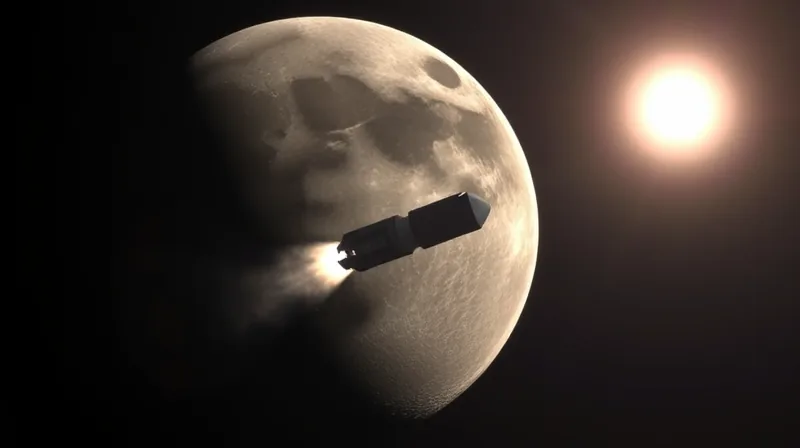
Falcon 9 Rocket Stage Headed for Moon Impact
Direct Eyes on a Predicted Impact
Ground-based telescopes and space-based instruments are tracking a used Falcon 9 upper stage from a commercial mission, and the object is now on course for the Moon. NASA and SpaceX are following the rocket body together and remain in communication about its flight path. An upper stage is the part of a rocket that finishes the push after launch and then separates. The impact is expected on Wednesday, Aug. 5. [1] The strike zone lies near the Einstein and Bell craters. [1]
The collision poses no danger to Earth. It matters for a different reason. NASA scientists plan to collect lunar data from the event. They also want to refine the techniques used to track objects in space. The crash was first predicted through calculation. SENTENCE: It is the fact that it was expected, tracked, and will be watched in real time.
CORRECTION: It is the fact that it was expected and tracked, and that NASA will attempt to watch it in real time.
The ground-based part of the observation will be handled by NASA’s Meteoroid Environments Office at the Marshall Space Flight Center in Huntsville. [3] Its telescopes will try to image the impact in real time. Success is not guaranteed. Weather and lighting conditions may make viewing difficult.
Orbiting spacecraft will join the effort. NASA’s Lunar Reconnaissance Orbiter will look for chances to image the site before and after the impact. So will ShadowCam, an instrument aboard South Korea’s Korea Pathfinder Lunar Orbiter. Two orbiters, from two space programs, will study the same patch of ground. The availability of those images depends on lighting, the timing of when a spacecraft is positioned to observe, and the position of the spacecraft. It may take several days for the imagery to reach Earth.
From Launch Site to Crash Site
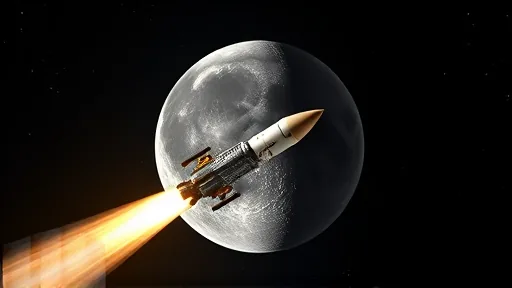
The stage’s story began in January 2025. On Jan. 15, a SpaceX Falcon 9 rocket lifted off and deployed Firefly Aerospace’s Blue Ghost 1, a lunar lander bound for the Moon. [2] The mission flew under NASA’s Commercial Lunar Payload Services initiative, known by the acronym CLPS. That initiative is NASA’s way of sending cargo to the Moon aboard commercial landers.
The upper stage, however, did not simply drift away. Solar activity — the Sun’s restless output of energy and particles — and gravitational forces caused the stage’s unplanned return to the Moon. [2] No one on the ground commanded this ending. It came from the invisible pushes and pulls that act on every object in orbit.
The new path was first spotted outside the space agencies. Independent astronomers identified the trajectory using publicly available data. NASA later confirmed what they had found.
The confirmation came from a center with a different day job. The Center for Near Earth Object Studies, based at NASA’s Jet Propulsion Laboratory in Southern California, normally tracks natural objects that could pose hazards to Earth. [6] This time it checked a human-made object. Its verdict was exact: the stage has a 100 percent chance of impacting the Moon. [5] NASA will keep tracking the stage as part of training operations.
The reason such an event can be studied at all lies in the Moon itself. The Moon has no atmosphere to slow incoming objects. Meteoroids — natural rock fragments from space — strike it daily. Human-made impacts are far less common, but they do occur. Each one is a rare appointment inside a process that never stops.
A Crater 60 Feet Wide
Unplanned as this event is, the destination is not unusual. Disposing of upper stages on the lunar surface is a technically accepted and safe method. For missions in a low orbit around the Moon, it can be the only practical option. Many operators choose controlled impacts because they provide predictable, trackable final disposal states for spacecraft after their missions end. NASA, for its part, is committed to reducing space junk and to demonstrating responsible disposal practices that safeguard Earth, its orbital environment, and other planetary bodies.
When the upper stage strikes, the surface will answer. The impact is expected to create a crater about 60 feet wide and 12 feet deep. [1] Dust and rock will be thrown outward from the impact. Observing that spray gives scientists valuable insight into how clouds of dust and rock thrown out by an impact behave. That helps them understand the Moon’s geology. It also refines the models that guide future exploration and science missions. Any data collected will sharpen the understanding of artificial impacts and their exploration implications.
To grasp the scale, a comparison helps. A meteoroid with the same energy as the upper stage hits the Moon about every six days. What makes this crash different is not its energy. It is the fact that it was expected, tracked, and will be watched in real time. The lunar surface is constantly absorbing impacts with the same force.
Sources
1. NASA
2. SpaceX
3. Marshall Space Flight Center