
Microscope Chills Atoms to Near Absolute Zero
Cold Silence, Quantum Voices
Picture a stadium packed with fans. At room temperature, every person is shuffling, shouting, waving — a blur of motion that makes it impossible to pick out a single face. Cool that crowd to near absolute zero, and everyone freezes mid-gesture. Suddenly each individual becomes clear. That is precisely what happens to atoms inside a material. At room temperature, they vibrate with thermal energy and smear across any image. Near zero kelvin, they slow almost to a halt. Some even begin to display quantum behaviours that warmth had been hiding all along.
For decades, scientists have chased a single goal: make the world’s most powerful imaging tools — transmission electron microscopes, or TEMs — operate at the coldest temperatures achievable. A TEM fires a beam of electrons through a sample to reveal its atomic structure. The colder the sample, the sharper the picture. The sharper the picture, the more likely a researcher is to catch an atom doing something no one has seen before.
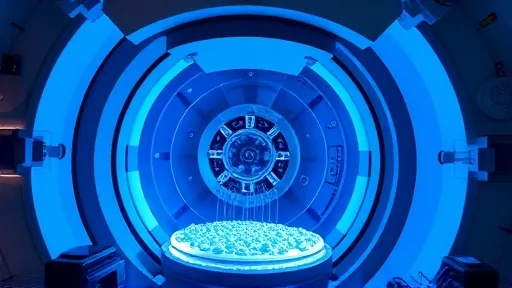
The instrument at the centre of this story is called GAIA. It is a scanning transmission electron microscope with a built-in system that cools samples to ultra-low temperatures using liquid helium. GAIA operates near absolute zero for hours at a time — a duration that sets it apart from earlier attempts that could only hold such cold for brief windows. [1]

A Machine Built to Stay Cold
The challenge was never simply reaching low temperatures. It was staying there. Earlier cold-stage designs in electron microscopy could touch a few kelvin, but only transiently. The sample would warm, the image would degrade, and the experiment would end. GAIA’s liquid-helium cooling system changes that equation by sustaining the cold for hours. That endurance is what transforms a physics demonstration into a usable research tool.
The instrument will soon ship to a few labs. Researchers are thrilled — a word that undersells a decades-long bottleneck finally breaking.
What makes GAIA a scanning transmission electron microscope rather than a standard TEM matters here. A STEM focuses the electron beam into a fine probe that scans across the sample point by point. That scanning motion, combined with extreme cold, allows researchers to build up images with atomic resolution while the sample remains in a fragile quantum state. Warm the sample even slightly, and that state collapses.
What Comes After the First Cold Look
The precedent lies in magnetic resonance imaging. When MRI machines first pushed to stronger magnetic fields, they did not simply improve existing pictures — they revealed tissue properties that weaker fields could not detect at all. Each leap in field strength opened a new diagnostic category. The same pattern is now set to unfold in electron microscopy. GAIA’s sustained near-absolute-zero operation is not an incremental improvement; it is a new category of measurement.
The instrument will soon ship to a few labs, and researchers are thrilled. [1] What those labs will find is not yet stated. But the trajectory is clear from the MRI parallel: when an imaging technology is pushed past a threshold it has never crossed, it does not just show the same things more clearly. It shows things that were never visible before. GAIA has crossed that threshold. The quantum revolution it could spur begins the moment the first sample cools to silence.