A Distant Rocky World Offers New Hope for Life Beyond Earth
Two Paths Converge on a Life-Friendly Planet
Astronomers used two different methods to study the same exoplanet, and both reached the same conclusion. One technique measures the tiny dip in starlight when a planet passes in front of its host star, revealing the planet’s diameter and hints of what its atmosphere contains. The other tracks how the star wobbles, showing the planet’s mass and pulling force. For the exoplanet LHS 1140 b, the combined data show that it is a rocky world—one that has a genuine atmosphere. This dual evidence makes it the strongest case yet for a planet outside our solar system that could support life.
The planet lies 48 light-years from Earth, a relatively close neighbor in cosmic terms. It is roughly the size of Earth but more massive, placing it in the category known as a super-Earth, a common type of exoplanet. The temperature on its surface and the pull of gravity are comparable to Earth’s, creating conditions that could allow liquid water to exist. Observations indicate the presence of rocks on its surface and key gases in its atmosphere, including carbon compounds essential for life as we know it Together, these features make LHS 1140 b the most promising target in the search for habitable worlds.
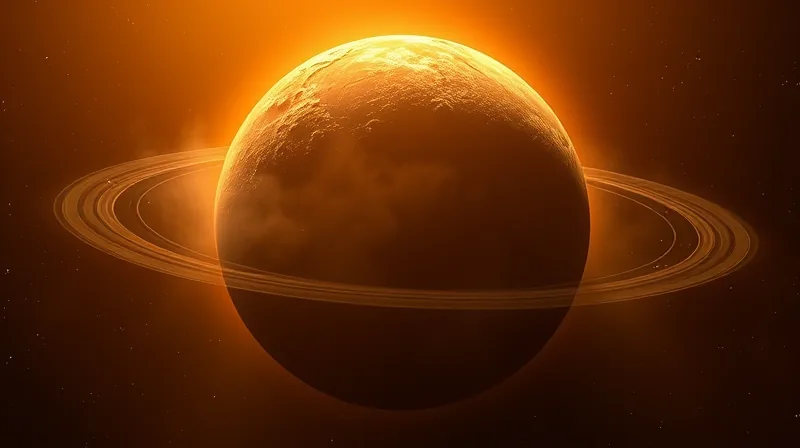
An artist’s impression of LHS 1140 b shows a rocky world with a thin atmosphere A few promising candidates turned out to be gas dwarfs, with thick atmospheres of hydrogen that likely block any chance for life. A parallel research effort at the University of Montreal has been using the same detection techniques to study super-Earth atmospheres, but no definitive results have been published yet. LHS 1140 b, however, is in a wider orbit around a quieter star. Its atmosphere is thinner and easier to analyze, and the planet has retained its rocky crust. This specific combination of size, distance, and composition had not been seen before with such confidence.
The new observations therefore shift the narrative. Where earlier claims rested on circumstantial information—a planet in the habitable zone, but unknown surface—now there are direct measurements of the air and ground. The essential ingredients for life, such as carbon, oxygen, and nitrogen, have been detected. No other exoplanet has shown this cocktail of conditions so clearly. The discovery reframes earlier candidates as stepping stones rather than final answers. They remain interesting, but they lack the same level of evidence.
An Unresolved Gap
A diagram illustrates the two detection methods used to study LHS 1140 b The same observations that reveal an atmosphere also show that its exact composition is unknown. The air could be rich in water vapor, which would be ideal, but it could also be thick with carbon dioxide or even hydrogen, which would drastically change the surface environment. Without a full spectrum from a next-generation telescope, astronomers cannot tell which scenario is correct. The planet could be a watered world or a choking greenhouse.
The second unresolved point is whether the atmosphere can last. LHS 1140’s host star, while quieter than many red dwarfs, still sends out flares that could strip surrounding gases over time. The planet’s gravity is strong enough to hold an atmosphere for billions of years only if the air is dense enough. If it is too thin, it will leak away. The evidence strongly suggests LHS 1140 b could support life, but confirmation of biological activity has not yet been achieved No trace of biological activity has been found. The search for biosignatures continues, and the answer lies in the next round of observations.