Mars Loses Atmosphere to Giant Solar Wind Waves
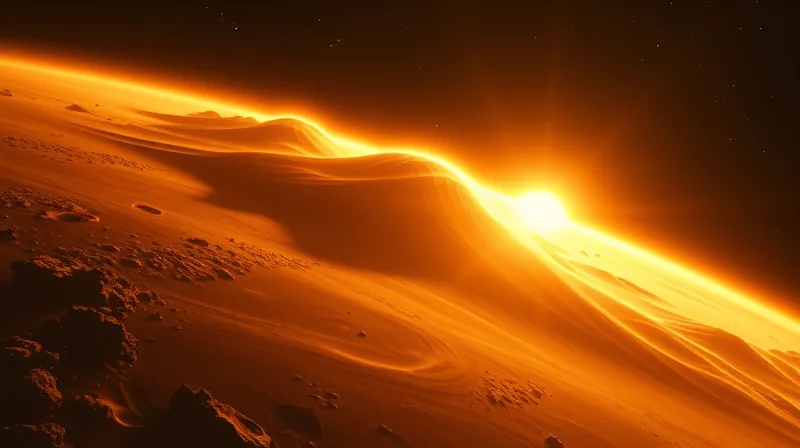
For decades, scientists have understood that Mars has a thin atmosphere, a weakness that makes it vulnerable to the solar wind. The prevailing theory painted a picture of gradual, steady erosion over billions of years. But new research from Boston University, analyzing data from NASA’s MAVEN and China’s Tianwen-1 missions, has fundamentally changed that view. The atmosphere is not leaking away passively; it is being actively ripped off by what researchers describe as giant rolling waves of solar wind. This is a dynamic, violent process, more like a cosmic tsunami than a gentle breeze. The finding is counterintuitive because it suggests atmospheric loss on Mars was not a slow bleed, but rather an aggressive, episodic stripping driven by powerful interactions between the solar wind and the Martian ionosphere.
This discovery does more than just refine our models; it throws conventional wisdom into question. For years, the scientific community has operated on the assumption that Mars dried out gradually, losing its water and atmosphere over eons. The new Boston University research suggests a far more dramatic narrative, one where the planet’s habitability window may have been violently slammed shut. The implications extend beyond Mars itself. If a planet can lose its atmosphere through these giant rolling waves, then the conditions for sustaining liquid water, and therefore life as we know it, might be far more fragile than previously assumed. This reshapes how we assess the long-term habitability of exoplanets orbiting stars with similar stellar winds, making the search for extraterrestrial life more complex and more urgent at the same time.
The story takes an even more intriguing turn when we consider the timing. This breathtaking scientific revelation arrives in the wake of a major programmatic failure on Earth. In January 2026, NASA made the controversial decision to effectively cancel the Mars Sample Return (MSR) program. [5] The rover Perseverance has been painstakingly collecting rock samples on the red planet, samples that scientists believe could hold the definitive proof of ancient Martian life. [6] Now, those samples are sitting on Mars, effectively orphaned, with no confirmed plan to retrieve them. The confluence of a stunning discovery about Mars’ atmosphere and a high-profile cancellation of a flagship mission creates a fascinating, and sometimes frustrating, landscape for anyone interested in the future of space exploration.
The New Lens That Changes Everything We Knew
The key to this discovery lies in a new method of analysis that makes old data appear in a completely different light. The research team at Boston University did not necessarily collect new data; they re-examined existing information from the MAVEN and Tianwen-1 missions with fresh eyes. [1] By focusing on the interaction between the solar wind and the Martian ionosphere, they uncovered a process that had been hiding in plain sight. [3] The solar wind, a constant stream of charged particles from the Sun, does not just buffet Mars’ atmosphere; it creates massive, turbulent waves that literally sweep atmospheric gases away. This is a radical departure from the idea of a steady, gentle erosion that has dominated planetary science for years.
This new understanding is significant because it provides a much more robust explanation for Mars’ desiccation. The planet is now a cold, dry desert, but evidence suggests it once had liquid water on its surface. For that water to exist, Mars needed a thicker atmosphere to create pressure and warmth. The question has always been: where did that atmosphere go? The old model suggested a slow leak over time. The new model, however, points to a more violent process. The giant rolling waves of solar wind would have been far more effective at stripping the atmosphere away, potentially accelerating the planet’s transformation from a potentially habitable world to the desolate one we see today. This changes the entire timeline and mechanism of planetary evolution, not just for Mars, but for any planet without a strong magnetic field.
The research draws on the combined power of two separate missions, which is a testament to the value of international collaboration in space science. NASA’s MAVEN mission, the Mars Atmosphere and Volatile Evolution, has been studying the Martian upper atmosphere for years. China’s Tianwen-1 mission, which includes an orbiter, has been providing complementary data. By pooling their resources, the Boston University researchers were able to see a pattern that neither mission could reveal on its own. This is a crucial point, as it shows how scientific progress often comes not from a single breakthrough, but from the synthesis of multiple lines of evidence. The discovery of these giant rolling waves is a direct result of this collaborative approach, and it underscores the importance of maintaining diverse assets in orbit around other planets.
The implications of this finding for the study of exoplanets are profound. We are now discovering thousands of planets orbiting other stars, and we are constantly trying to assess which ones might be habitable. A key factor in that assessment is whether a planet can retain its atmosphere. If the process of atmospheric stripping is as violent as the Boston University research suggests, then many planets we have considered potentially habitable might actually be far more vulnerable. The window for a planet to sustain liquid water could be much narrower than we thought, perhaps even a brief period in its early history before the solar wind strips away its protective blanket. This forces a re-evaluation of what we look for when searching for life beyond our solar system, and it makes the study of Mars all the more critical as a nearby laboratory for understanding these cosmic processes.
The Scaling Problem From a Dying Planet to a Cancelled Program
The principle of violent, large-scale disruption does not just apply to the physics of planetary atmospheres; it also applies to the human systems we build to explore them. The discovery of the giant rolling waves of solar wind is a story of a small team of researchers using data from two spacecraft to overturn decades of assumptions. In a parallel fashion, the cancellation of the Mars Sample Return program is a story of a massive, multi-billion-dollar enterprise being brought down by a combination of ballooning costs, escalating delays, and shifting political priorities. The scaling is evident: from the microscopic interactions of charged particles to the macroscopic decisions of government agencies, the same theme of dynamic and often destructive change is at play.
The Mars Sample Return program was designed to be the ultimate prize of robotic Mars exploration. The plan called for collecting samples on the Martian surface, launching them into orbit, docking with a second spacecraft, and returning them to Earth for study in advanced laboratories. Scientists have dreamed of these samples for decades, believing they hold the key to understanding Mars’ past and potentially confirming the existence of ancient microbial life. Yet the program’s complexity proved to be its undoing. The projected cost ballooned to potentially exceed $10 billion, and the timelines stretched far into the future. [5] In January 2026, NASA made the agonizing decision to effectively cancel the program, leaving Perseverance’s precious cargo on the red planet as a poignant symbol of what could have been.
The cancellation of MSR is not just a setback for a single mission; it creates a vacuum in the entire trajectory of Mars exploration. Flagship missions like MSR often serve as anchors, driving technological development and setting the pace for subsequent missions. They foster international collaboration and provide a clear goal for the scientific community to rally around. Without that anchor, there is a scramble to re-evaluate priorities and find new, more cost-effective approaches. This disruption, while frustrating for scientists, creates a fascinating dynamic for the commercial space sector. When the established order is disrupted, new players and innovative solutions often emerge to fill the void. The need for more agile, affordable technologies becomes paramount, potentially opening the door for a new wave of private enterprise to step in.
This scaling from the planetary to the programmatic level reveals a common thread: the old models no longer hold. Just as the steady-erosion model of Mars’ atmosphere has been replaced by a more dynamic and violent picture, the traditional model of NASA-led, multi-billion-dollar flagship missions is being questioned. The future may belong to smaller, more focused missions and a greater reliance on commercial partners. The uncertainty created by the MSR cancellation, combined with the new scientific understanding of Mars, is forcing a fundamental rethink of how we approach the red planet. It is a moment of both crisis and opportunity, where the old rules are being rewritten in real-time.
The Unanswered Question of What Survives the Storm
The new discovery about Mars’ atmosphere and the cancellation of the MSR program together raise a critical, unanswered question: what comes next? The scientific community is left with a profound understanding that Mars’ habitability was likely cut short by violent cosmic forces, and our best-laid plans to study that history have been upended by budget realities. The question of scalability remains open. Can we scale down our ambitions and still achieve meaningful science? Can we find new, more efficient ways to retrieve those orphaned samples? Or will we be forced to accept that the rocks collected by Perseverance will remain on Mars for the foreseeable future, their secrets locked away from the scientists who desperately want to study them?
The Boston University research suggests that Mars’ atmospheric loss was not a slow, steady process, but a series of violent episodes driven by giant rolling waves of solar wind. This has profound implications for our understanding of planetary habitability. If a planet can lose its atmosphere this quickly, then the window for life to emerge and thrive might be incredibly narrow. This makes the study of Mars all the more urgent, even as the means to study it directly have been curtailed. The samples sitting on the Martian surface represent our best chance to understand this history, yet we currently have no way to bring them home. The disconnect between scientific need and programmatic reality is stark.
Meanwhile, the commercial sector is watching closely. The cancellation of MSR has created a market for more cost-effective solutions, and companies specializing in everything from advanced propulsion to miniaturized scientific instruments stand to gain. The demand for capabilities that can achieve scientific goals at a fraction of the traditional cost is only going to grow. This could mean a surge in demand for more agile, affordable technologies, or entirely new mission architectures that did not fit into the previous, rigid framework. The vacuum left by NASA’s decision is not empty; it is a space waiting to be filled by innovation and private enterprise, driven by the same public interest in Mars that has captivated humanity for generations.
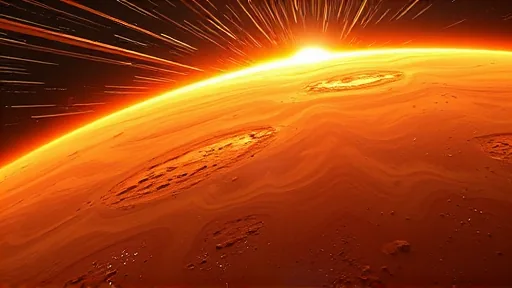
Ultimately, the question of scalability remains open and unanswered. Can we scale up our efforts to understand Mars, or will we be forced to scale them down? The new discovery about the solar wind’s fury suggests that the forces shaping Mars are immense and unforgiving. The cancellation of MSR suggests that our own human systems are equally susceptible to disruption and failure. In this new era, the path forward is unclear. Will NASA pivot to smaller, more focused missions? Will they seek to re-engage with international partners? Or will the private sector take the lead? The only certainty is that the landscape of Mars exploration has been fundamentally altered, and the consequences of both the scientific discovery and the programmatic failure will be felt for years to come.
Sources
2. NASA
3. MAVEN
4. Tianwen-1
6. Perseverance