
Neijuan and the China Shock Reshaping Global Trade
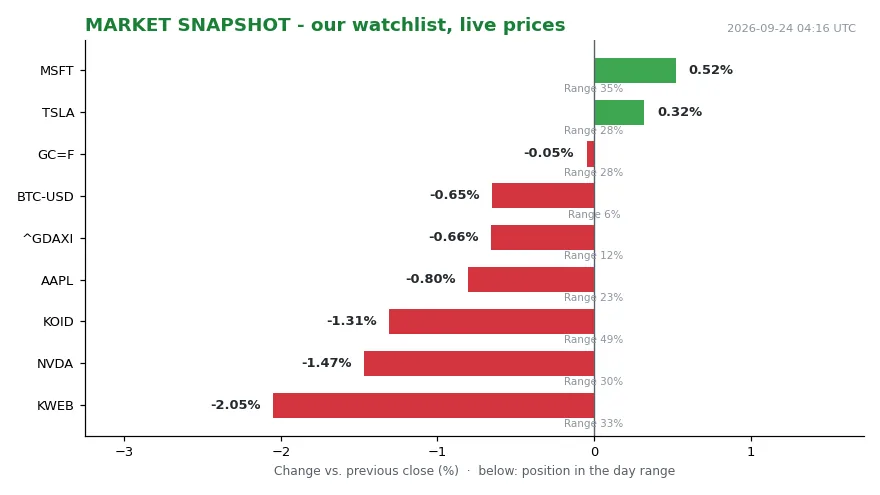
KWEB, the standard proxy for Chinese internet and consumer names, trades at 24.85, down 2.05% against the previous close and sitting mid-range. NVDA prints 225.51, off 1.47%. The DAX is at 25,410.63, down 0.66%, pinned near its day’s low with only 12% of the daily range left beneath it. Gold is flat at 4,319.10. Bitcoin sits at 83,875.09, also near its lows. MSFT is green at 500.59. TSLA is barely green at 380.12.
That is not a broad risk-off. It is a narrow one. The selling is aimed at China exposure and at the export cycle that feeds it. Europe is leaking. American mega-cap tech is split down the middle.
Chinese has a word for the pressure underneath all of this: neijuan. Roughly, involution. Competition so fierce that everyone runs harder and nobody advances.
The tape itself reflects the confusion. Chinese internet and consumer names are down, the export-linked semiconductor complex is down, and European industrials are down, while American mega-cap software holds its ground. That split, not a single index level, is the signal.
So what is the news? U.S. President Donald Trump and Chinese President Xi Jinping are expected to meet this week. It would be their second in-person summit of the year. U.S. concerns about artificial intelligence have gained prominence in the days before the meeting. Businesses are not hoping for a breakthrough. The best they hope for is an extension of the trade truce reached last fall.
Here is the part that matters. Tariffs have done little to dent America’s appetite for Chinese goods. The escalation last April briefly pushed the U.S. trade deficit with China to its lowest level since 2017. Surging demand for AI-related parts then pushed it higher again this year. Those are China Customs figures, accessed through Wind Information.
Jens Eskelund, president of the European Chamber of Commerce in China, points out that Asia still accounts for more than 60 % of U.S. imports. That is the same share as before “Liberation Day.” He estimates that between half and three-quarters of container traffic from China to Southeast Asia subsequently moves on to other destinations. Rerouting has not reduced dependence. It has accelerated the world’s reliance on China-made goods.
Eskelund once expected China to reach 40 % of global container exports in 2030. That milestone arrived this summer. Four years early.
How did the world get here? Eskelund dates the real “China shock” to 2022. The pandemic had distorted everything. China was first in and first out, so it could let its exchange rate rise and its export prices rise. It could do that because, in his words, China was “the only game in town.”
Then domestic demand broke. China’s real estate market began its downturn in 2022. That dragged down internal consumption. Companies answered by expanding abroad and exporting. The result, Eskelund says, is a direct and perfect correlation between falling export prices and accelerating export volumes.
The second channel is technology. U.S. data-center buildouts to power AI supported demand for Chinese goods. That support may be softening. Think tank CF40 estimated that AI-related exports fell significantly in August from a year earlier, the first such drop this year. Macquarie’s chief China economist, Larry Hu, noted last week that the PHLX Semiconductor Index tends to predict how China’s high-tech exports will grow six months out. Its recent performance, he said, “does not bode well for China’s export outlook over the next year.” [1]
The tape is consistent with that reading, though it proves nothing. NVDA is down 1.47%. AAPL is down 0.80% and near its day’s lows. That is a read on sentiment, not on Chinese customs forms.
Winners include Chinese exporters of critical minerals and industrial robots. Losers include European manufacturers carrying the bloc’s deficit with China, American importers who never found a substitute at scale, and Chinese property developers. The deciders are few: two presidents in one room, EU trade officials working against an October deadline, and China’s own policymakers, who on Hui Shan’s reading feel little urgency.
Within tech manufacturing, industrial robot output rose 34.6% year-on-year in August. Smartphone output fell 22.3%. Goldman Sachs chief China economist Hui Shan wrote on September 20 that “because there are always high-flying subsectors for the government to point to, policymakers do not appear to feel much urgency to introduce additional easing measures, absent a sharp deterioration in the labor market.” [1] House prices have fallen 30% over six years, in line with large-scale property downturns elsewhere. Weak labor markets and still-falling rents, she adds, are likely to prolong the downturn in many parts of China. Loss-making companies now account for 24% of industrial firms.
Slower growth has made competition harsher, not softer. The American Chamber of Commerce in Shanghai reported this month that three-quarters of surveyed members see Chinese rivals as more advanced. The perceived gap in product quality narrowed by 6 percentage points from last year. For the first time since 2022, domestic competition replaced geopolitical tension as members’ top challenge.
That spills across borders. European Union officials are starting to follow Washington in scrutinizing China-origin exports. EU Trade Commissioner Maroš Šefčovič has urged “tangible results” from China on trade by October and is expected in Beijing next month. Eskelund notes the EU runs the largest trade deficit with China of any economy.
Chinese firms also dominate global supply chains for critical minerals, which reinforces Beijing’s self-sufficiency goals. Chad Bown of the Peterson Institute for International Economics puts it bluntly. “There’s no sense in which China’s strategy seems to be at all dependent on actions that the rest of the world might take.” [1] He describes a strategy of “one-way dependence of the rest of the world on China that it’s going to weaponize.”
What to watch next is unglamorous. Whether the summit produces anything beyond a truce extension. The PHLX Semiconductor Index, as a rough six-month leading indicator. The monthly AI-related export prints. The EU’s October deadline. And Chinese house prices, rents and the labor market, which Hui Shan flags as the trigger that would actually move policy. None of this is a recommendation; it is a watchlist.
Each item carries uncertainty. CF40’s August estimate is one think tank’s reading. A single month is a single month. The semiconductor index is a tendency, not a law. The mechanism is real; its timing is not knowable in advance.
Sources
1. Usnews (Original laut Text: CNBC) — Quote source (original article)
Mentioned organisations (context, not sources)
- Wind Information — Organisation (homepage)
- European Chamber of Commerce in China — Organisation (homepage)
- CF40 — Organisation (homepage)
- Macquarie — Organisation (homepage)
- European Union — Organisation (homepage)
- Goldman Sachs — Organisation (homepage)
- American Chamber of Commerce in Shanghai — Organisation (homepage)
- Peterson Institute for International Economics — Organisation (homepage)